


- Fixed Income Portfolio Manager
United States, Institutional
Change
The views expressed are those of the author at the time of writing. Other teams may hold different views and make different investment decisions. The value of your investment may become worth more or less than at the time of original investment. While any third-party data used is considered reliable, its accuracy is not guaranteed. For professional, institutional, or accredited investors only.
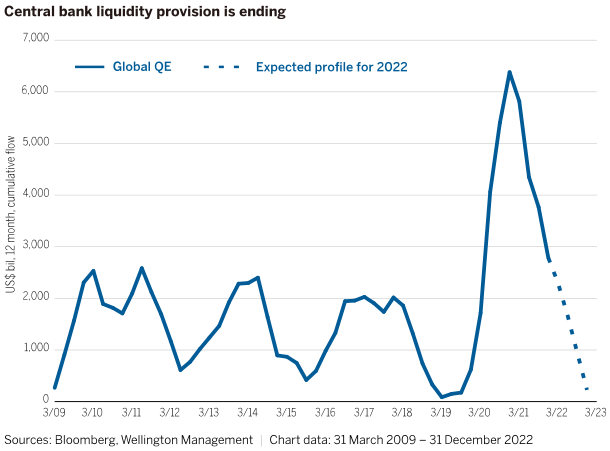
2022 promises to be another challenging year for central banks as they attempt to normalise policies in the face of surging inflation, while navigating the growing fallout from Russia’s invasion of Ukraine. Since 2009, there has essentially been one trade in capital markets: riding a huge wave of central bank liquidity in support of the financial system and the economy, with the G4 central banks alone pumping approximately US$20 trillion into the system via quantitative easing (QE).
The COVID pandemic took this stimulus to a new level with unprecedented fiscal and monetary policy support globally. Most of this liquidity and support has been recycled in asset markets, resulting in lower and lower yields and compressed spreads and volatility. However, as the world recovers from the pandemic, we believe that the supply capacity of economies will become much less flexible and slower to adjust to demand. Essentially, the output gap concept will become relevant again, producing higher and more volatile inflation. The unfolding Ukraine tragedy is accelerating and amplifying this shift, with inflation rates moving even higher and potentially becoming stickier on the back of an increased risk of energy and supply-chain disruptions. This leaves central banks in a perilous situation as they seek to unwind accommodative policies in tandem with hiking rates, while dealing with increased recession or even stagflation risk.
The regime change we are now witnessing — as illustrated by Figure 1, which highlights the sharp drop in central bank liquidity — also means that monetary policymakers will move away from the implicit contract with investors to preemptively support risk markets. They will be no longer be suppressors of volatility and will be less of a backstop for markets. This changing stance will, in our view, structurally alter market dynamics and asset pricing.
We expect investment-grade (IG) credit spreads to adjust with wider distributions and higher volatility before reaching new equilibrium levels. Over the near term, we anticipate markets remaining weak, with spreads widening further, until the geopolitical tensions ease and we receive greater clarity about the future path of monetary policy in key markets. We think this transition period is going to present abundant investment opportunities. We are already seeing some very interesting regional disparities opening up.
The euro IG credit market spreads have widened significantly since the beginning of the year — underperforming their equivalent bonds in the US IG market and trading weaker relative to other regions. This repricing reflects not only a surprisingly quick adjustment by investors to a post-QE environment, but also uncertainty about the pace and magnitude of the policy normalisation process, widening swap spreads and the escalating Russia-Ukraine conflict. Given the wider distribution of economic risks in Europe, we expect that the European Central Bank (ECB) will be slower in normalising its monetary policy than the US Federal Reserve (Fed) or the Bank of England (BOE), which should be supportive for European credit over time. For example, while the Fed and the BOE have signalled their intention to reduce their bond balance sheet holdings, the ECB has committed not to sell until 2025, by which time over 30% of its holdings will have matured.
The evolution of hedging costs is also an important consideration, as the rate of tightening is likely to diverge across regions, with the Fed moving significantly faster than the ECB. This different pace will cause hedging cost volatility and provide foreign investors in euro-based assets with an increasing hedged yield. The above factors, coupled with strong fundamentals, weak technicals and rapidly adjusting valuations, mean it may be opportune to consider selectively increasing exposure to euro IG.
In our view, this year is likely to offer attractive buying opportunities, especially for investors looking for long-term value in strategies such as buy and maintain. Dispersion within and between IG markets is likely to be a key feature in 2022. Deglobalisation of supply chains, increased geopolitical tensions and different health, monetary and fiscal policies between countries all contribute to this divergence, which is compounded by shrinking liquidity and weaker technicals.
To help us think through the implications, we have developed the below framework (Figure 2), which shows the ranges in which we believe the global IG market is likely to operate in 2022.
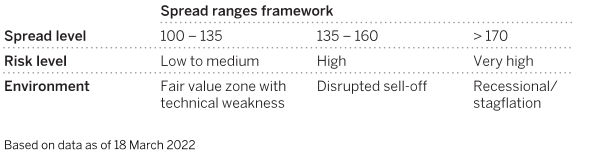
At the time of writing, euro and US IG credit sit in the disrupted sell-off zone, which, in our opinion, creates selective opportunities for investment. But we believe there is also scope for global IG credit to widen further and move into the disrupted sell-off zone — especially if the war in Ukraine continues to worsen.
On balance, therefore. we think a global approach to IG credit allocation will offer a potentially attractive solution for investing in these more uncertain times, as it could help to diversify risks and catch the multiple tightening waves we expect to see across the different regions and over different timescales.


JPY intervention: what makes it so important this time?
Continue readingMore from the core: How fundamental extension (140/40) strategies could help
Continue readingBroadening underway? 6 equity ideas for 2026
Continue readingFinding durable value amid shifting currents
Continue readingThe evolution of derisking: Assessing new and time-tested liability-hedging ideas
Continue readingURL References
Related Insights
Stay up to date with the latest market insights and our point of view.

JPY intervention: what makes it so important this time?
Fixed Income Portfolio Managers Sam Hogg and Ed Meyi and Investment Director Takashi Nakao explore what’s different about the unconfirmed but likely JPY intervention and why it matters for global investors.

2026 Insurance Outlook: Cautious optimism and a second bite at the apple
Members of our Insurance team share their economic expectations, investment ideas, and a regulatory roundup for the year ahead.

The soft underbelly of US foreign policy
Our experts discuss the US-EU financial dynamics amid Greenland tensions and analyze US foreign policy's vulnerabilities.
Monthly Market Review — December 2025
A monthly update on equity, fixed income, currency, and commodity markets.

Opportunity ahead: Optimism or illusion?
Explore our latest views on risks and opportunities across global capital markets.

The spending bubble driving corporate profits looks set to burst
US corporate profits have been fueled by government deficits, low rates, and consumption — drivers now at risk, raising questions about the sustainability of market valuations.
By

Oil: The real influencer in the Venezuela intervention
Multi-asset Strategist Nanette Abuhoff Jacobson details the role of oil in the recent events in Venezuela and shares the investment implications.

Geopolitics in 2026: Risks and opportunities we’re watching
Geopolitical Strategist Thomas Mucha shares his outlook, highlighting conflicts to watch, the importance of national security, and investment opportunities.
By

Top of Mind: The allocator’s checklist for 2026 and beyond
Multi-Asset Strategist Adam Berger offers near- and longer-term ideas for allocators, including thoughts on alternatives, potential market surprises, and risk management.

IPOs aren’t dead, they’re just napping
Experts from our venture capital and trading teams explore the current IPO landscape. They highlight three challenges and three opportunities for private companies aiming to go public today.
URL References
Related Insights














Quarterly Market Review — 4Q2025
A monthly update on equity, fixed income, currency, and commodity markets.
By