
- Head of Late-Stage Growth
Skip to main content
- Funds
- Insights
- Capabilities
- About Us
- My Account
United States, Institutional
Changechevron_rightThank you for your registration
You will shortly receive an email with your unique link to our preference center.
The views expressed are those of the authors at the time of writing. Other teams may hold different views and make different investment decisions. The value of your investment may become worth more or less than at the time of original investment. While any third-party data used is considered reliable, its accuracy is not guaranteed. For professional, institutional or accredited investors only.
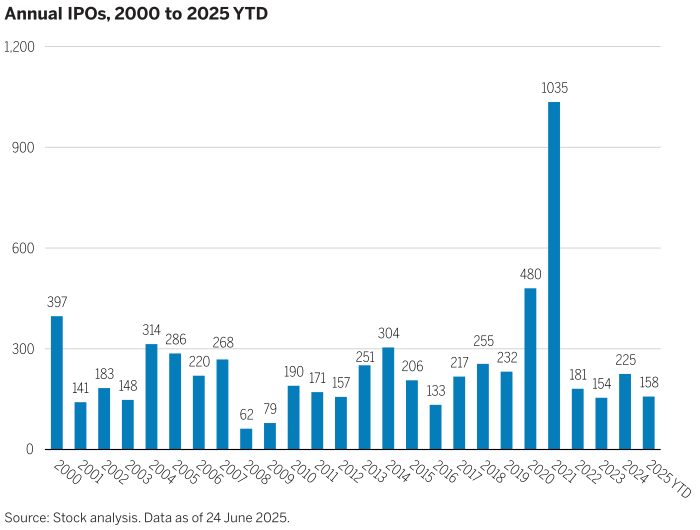
It would be a massive understatement to say that the IPO market has seen fluctuations over the past five years. Only four short years ago, US markets experienced a record-breaking 1,035 IPOs, driven largely by the near-zero interest-rate market environment. These giddy years stand in sharp contrast to the more than 80% drop that followed in 2022 and 2023 (Figure 1) — and to the 20-year historical average of 254 IPOs per year.1
Not surprisingly, the relatively muted IPO environment of the last three years has led many to question whether companies will stay “private forever,” and if the path to public listing is permanently challenged. In our view, the answer to both is a definitive “no.”
Below we explore the underlying issues in today’s IPO environment, key lessons learned for private companies, and reasons why we believe the death of the IPO market has been greatly exaggerated.
Figure 1
Though each IPO is a distinct pricing event — reflective of a company’s unique quality, desired pricing, and overall demand — we see three common mistakes that lead to issues at IPO (and stock performance thereafter).
Overall, companies get caught up on where their IPO is priced, whereas we believe they should be more concerned about where it goes. In our view, companies that price modestly and beat expectations will fare much better than those who go as high as possible and then face the risk of underperformance.
While IPOs are currently delayed without a stable public-market backdrop, we believe they are not canceled. In our view, it’s inevitable that many leading private companies will eventually go public for three key reasons:
Figure 2
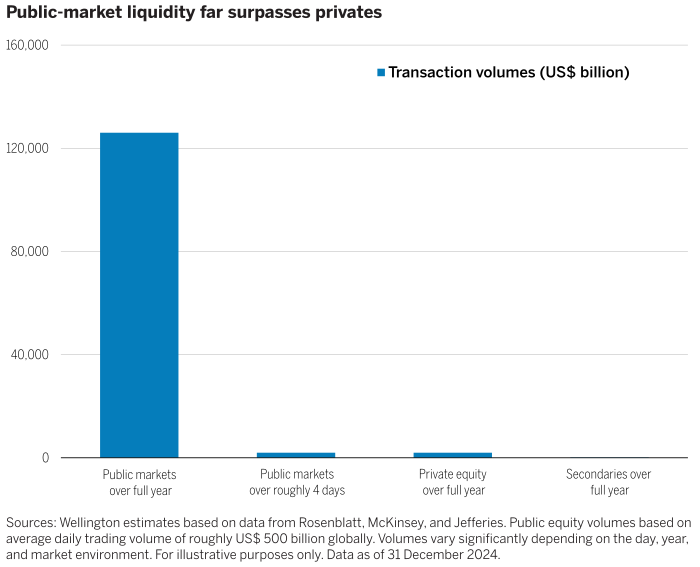
While companies may continue to stay private longer, we believe leading companies will not remain private forever. The trend of extended private ownership allows private-market investors to benefit from higher growth profiles, sector diversification, and value creation potentially unavailable in public markets. However, we believe the IPO’s significant value proposition remains strongly intact.
So, IPOs are not dead, in our view, but it’s critical for investors and companies to understand the dynamics driving their long and misleading nap. By addressing these issues, stakeholders can better navigate the complexities of IPOs, prepare for a smoother transition from public to private, and capitalize on opportunities in both private and public markets.
1 “IPO trends: First half of 2024 and beyond,” Stout, 26 August 2024.
Experts
Related insights
Private credit outlook for 2026: 5 key trends
Continue readingVenture capital outlook for 2026: 5 key trends
Continue readingMultiple authors
Private real estate debt: An evolving opportunity set
Continue readingInvesting in climate solutions across public and private markets
Continue readingHuman capital management for private companies
Continue readingMultiple authors
What’s the Fed got to do with it? The impact of rate cuts on CLO equity
Continue readingCommercial real estate debt: Transitional assets deep dive
Continue readingMultiple authors
URL References
Related Insights
Stay up to date with the latest market insights and our point of view.
Thank you for your registration
You will shortly receive an email with your unique link to our preference center
Private credit outlook for 2026: 5 key trends
Our private credit experts discuss five themes driving the asset class’s 2026 outlook, including public/private convergence, changing credit profiles, the growth of retail, and much more.
Venture capital outlook for 2026: 5 key trends
We explore 2026's venture capital trends, highlighting IPO momentum, M&A acceleration, secondary market growth, public-private convergence, and the focus on quality investments.
Multiple authors
Private real estate debt: An evolving opportunity set
In our latest Insurance Quick Takes video, Fixed Income and Global Insurance Strategist Amar Reganti talks to Ravi Anand, Portfolio Manager and Head of Private Real Estate Credit. They discuss trends driving interest in private real estate and the diversification opportunity the asset class may offer insurers.
Investing in climate solutions across public and private markets
Collaboration between public and private market investors can be powerful. Opportunities where expertise and resources can be shared to accelerate innovation and deployment are optimal. Our experts explore how AI, geopolitics, and global policy are reshaping climate solutions across sectors.
Human capital management for private companies
We discuss why effective people management is critical for private companies and outline four strategic focus areas that can help companies navigate evolving employee needs, regulatory changes, and investor expectations.
Multiple authors
What’s the Fed got to do with it? The impact of rate cuts on CLO equity
Our CLO experts discuss the implications of Fed rate cuts on CLO equity, emphasizing its potential to maintain income amidst rate sensitivity challenges in other credit assets.
Commercial real estate debt: Transitional assets deep dive
Our private commercial real estate debt experts explore transitional CRE assets, highlighting their key characteristics, how they differ from other parts of the CRE debt universe, their potential roles in a portfolio, and much more.
Multiple authors
Venture and growth equity: The future of private-market evergreen funds?
Investment Director Cara Hubbard highlights how the VC and growth equity landscapes are transforming, details the rising popularity of evergreen funds, and shares how these themes may converge to expand access to private markets.
Investment-grade private credit market deep dive
Emeka Onukwugha and Elisabeth Perenick explore the evolving investment-grade private credit market, highlighting its key characteristics, liquidity profile, roles in a portfolio, and much more.
Collaboration in practice: Late-stage growth
Matt Witheiler, Head of Late-stage Growth, explores the impact of Wellington’s collaborative culture. He highlights the potential benefits of working with his private-market colleagues across sectors and stages as well as leveraging Wellington’s hundreds of public-market experts.
Collaboration in practice: Late-stage biotech
Nilesh Kumar, Head of Biotech Private Investing, explores how working with Wellington’s public-market biotech experts helps his team better understand the feasibility of emerging biotech innovations.
URL References
Related Insights
© Copyright 2025 Wellington Management Company LLP. All rights reserved. WELLINGTON MANAGEMENT ® is a registered service mark of Wellington Group Holdings LLP. For institutional or professional investors only.
Enjoying this content?
Get similar insights delivered straight to your inbox. Simply choose what you’re interested in and we’ll bring you our best research and market perspectives.
Thank you for joining our email preference center.
You’ll soon receive an email with a link to access and update your preferences.