
- Global Industry Analyst
United States, Institutional
Change
The views expressed are those of the authors at the time of writing. Other teams may hold different views and make different investment decisions. The value of your investment may become worth more or less than at the time of original investment. While any third-party data used is considered reliable, its accuracy is not guaranteed. For professional, institutional or accredited investors only.
In March 2024, the Bank of Japan made a landmark decision to end the world’s last negative interest-rate policy and raise rates for the first time in 17 years. Markets reacted swiftly and Japanese bank stocks rallied, driven by stronger earnings, improved return on equity, and more disciplined capital management. Japan’s ongoing corporate governance reforms also supported this dynamic.
Now, the questions are: Is the rally over, or just beginning? Is there still alpha to be found?
We believe the rally is just beginning and alpha opportunities remain, especially among regional banks, which are still, in our view, underappreciated and undervalued. Despite continued strong earnings growth, improving capital allocation, and rising shareholder returns, many of these banks are still trading at significant discounts compared to the megabanks.
Beyond valuation gaps and earnings momentum, there's another powerful force that could reshape the landscape for Japan’s regional banks — consolidation.
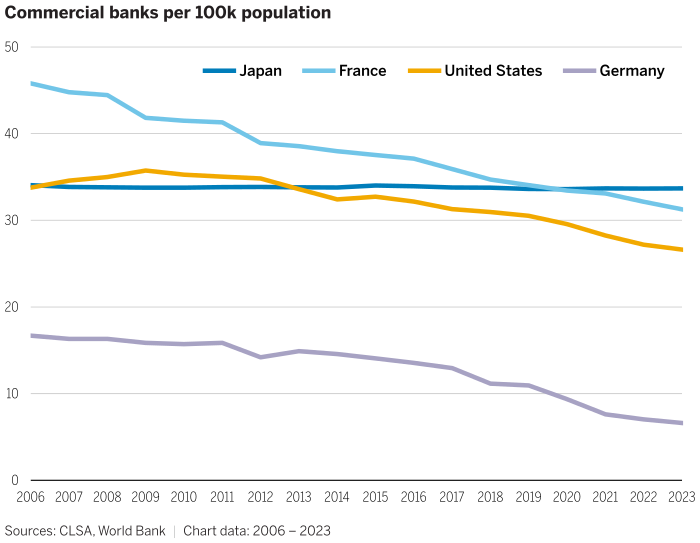
One of the most exciting developments is the growing momentum in regional bank M&A activity. Japan remains among the most overbanked countries in the world, with 62 tier-one regional banks, 37 tier-two regional banks, and five city banks. Historically, consolidation has only occurred during times of stress, with stronger banks absorbing weaker ones. Rarely have we seen mergers driven by strategic growth or shareholder value creation. This is starting to change. Regulatory barriers that once prevented mergers within the same prefecture were largely lifted in 2020 by the Japan Fair Trade Commission, opening a 10-year window for consolidation. Meanwhile, the Financial Services Agency is actively encouraging smaller regional banks to consider their future and how M&A might fit into it.
Figure 1
In recent months, conversations with regional banks have taken a noticeable turn. Institutions that were once resistant —hostile, even — to the idea of merging are now open to it. Even traditionally conservative banks are reconsidering their stance.
Why the change? Several factors are converging:
Because the regulatory barriers lifted in 2020 were given a 10-year window, the clock is ticking — antimonopoly exemptions expire in 2030. And now, with two major M&A deals recently announced — including one involving a bank that hasn’t participated in a merger since 1945 — and a three-way business alliance that’s expected to lead to a capital tie-up, momentum is clearly building. These developments are likely to encourage other regional banks to act quickly, as no one wants to be left behind while their peers move ahead with strategic partnerships.
There’s value to be found on both sides of the deal table. Acquirers may benefit from financial engineering — booking negative goodwill, restructuring low-yield bond portfolios, and boosting capital. Targets, meanwhile, often trade at deep discounts, with improving fundamentals and untapped upside from interest-rate hikes and better capital management.
For investors, owning the acquirers remains the most liquid and straightforward strategy. But there’s also a solid fundamental case for owning the targets. Many are still attractively valued, with improving returns and stronger business momentum. The potential for M&A may add further upside, making them even more appealing. In a market where passive strategies often dominate, we think Japan’s regional banks present a compelling case for active investment. Many of these institutions remain under-researched and lightly covered, creating inefficiencies and opportunities for discerning investors. As structural reforms, interest-rate normalization, and M&A momentum reshape the sector, the ability to identify undervalued names — particularly among the smaller, less visible players— will be key to unlocking potentially outsized returns. For those willing to do the work, the alpha may be there. And in Japan’s evolving banking landscape, the journey may be just beginning.