

- Global Industry Analyst
United States, Institutional
Change
The views expressed are those of the author at the time of writing. Other teams may hold different views and make different investment decisions. The value of your investment may become worth more or less than at the time of original investment. While any third-party data used is considered reliable, its accuracy is not guaranteed. For professional, institutional, or accredited investors only.
Against a backdrop of rising wages, labor shortages, and increased reshoring, the benefits of automation in the manufacturing sector have never been more apparent. Despite this growing necessity, many manufacturers have continued to postpone placing new orders for automation equipment in an environment of uncertainty fueled by geopolitics, the upcoming US election, ongoing concerns about a slowdown in China, and high interest rates.
But I believe we’re now on the verge of a multiyear cyclical upturn in the factory automation sector. In particular, with a strong global share in key segments of the market, including industrial robots and machine vision, I see a compelling outlook ahead for select Japanese players in this sector, as outlined below.
In my view, a number of factors are fueling the upturn I anticipate in Japan’s factory automation sector:
We think the wide dispersion between valuations and stock performance in the Japanese factory automation sector versus its European and American counterparts is about to change. Many market participants in Japan are focused on short-term earnings. A recovery in near-term orders would drive a re-rating and we expect select Japanese factory automation players to be key beneficiaries of increased global market demand via company-specific initiatives, such as launching innovative products and platforms and expanding end-market applications, customers, and regions.
Through our deep research and local presence in Japan, we have identified a number of Japanese factory automation companies that we believe offer significant investment opportunities amid the growing demand for their products and services. As well as local expertise, having a global reach enables us to undertake extensive research worldwide on the sector. I recently visited China, for example, where I met Chinese competitors in factory automation and employees of Japanese and European companies to gain their perspectives. This ability to engage with companies throughout the world because of Wellington’s global scale and experience in asset management is, in my view, a vital component of a research-led, bottom-up approach to stock selection.
The three companies highlighted below are prime examples of the opportunities our research is uncovering in Japan’s factory automation sector.
Example 1:
Our first example is a global leader in machine vision and sensors, which enhance the flexibility and responsiveness of industrial robots and other factory automation equipment. We think that this subsector — set to be among the fastest-growing within factory automation — has the potential to experience a compound annual growth rate (CAGR) of more than 10% over the next decade, and we view this company as a key beneficiary.
The company has gained market share through innovative solutions, for example, by merging a number of sensing technologies (including laser proximity sensors, ultrasonic proximity sensors, laser 2D/3D profilers, and pressure sensors) into one product, and through extensive use of software, data, and AI. In our view, it has one of the best sales teams globally, who, as engineers, have the technical expertise to develop solutions for customers’ pain points. It has one of the highest levels of profitability in the global industry, driven by its fabless business model — it has no internal manufacturing capability but holds the intellectual property for all its products.
Example 2:
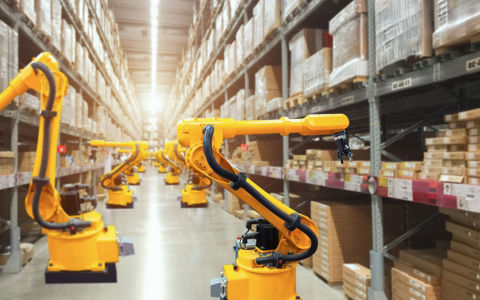
Our second example is a leading global player in industrial robots, a sector we expect to benefit from a high-single-digit CAGR over the next decade. The company has a strong presence in the automotive industry — the first major adopter of robots — and we expect it to benefit from a reacceleration in capacity expansion for electric vehicles and lithium-ion batteries, particularly if automotive original equipment manufacturers (OEMs) reshore production back to the US, where the company has a dominant market share.
In addition to rising demand from the auto industry, the end market for robots has been rapidly expanding and diversifying into electronics, pharmaceuticals, logistics, and general industrials, a trend that has accelerated since the COVID-19 pandemic. The company is also at the forefront of the development of a new addressable end market for collaborative robots (“cobots”) that can operate safely in close proximity to humans, for example, to assist with tasks that require heavy lifting or involve dangerous environments.
Example 3:
Our third example embodies the compelling opportunities we’re uncovering among smaller-market-cap and niche players that offer differentiated products and services. This small-cap company offers a “one-stop” service for a wide range of factory automation components, via catalogues and e-commerce, that can be delivered within one to three days. It recently launched a new global platform aimed at significantly reducing the time spent by customers on the ordering process and lowering customers’ costs.
These companies exemplify the stocks we seek to identify through our on-the-ground engagement. In our view, this focus on local as well as global research has enabled us to uncover the Japanese companies that we believe will be the key beneficiaries of the significant upturn we anticipate in demand for factory automation in the years ahead.