


- Director of Multi-Asset Research
United States, Institutional
Change
The views expressed are those of the authors at the time of writing. Other teams may hold different views and make different investment decisions. The value of your investment may become worth more or less than at the time of original investment. While any third-party data used is considered reliable, its accuracy is not guaranteed. For professional, institutional, or accredited investors only.
Every quarter, the Wellington Investor Survey team polls around 100 of our Wellington colleagues across different investment disciplines and locations to get their views on what they see as the key macro questions of the day. The results can pinpoint where the firm’s views differ from the consensus and can also reveal important shifts in our collective thinking.
Given the current uncertainty about the economic outlook, we wanted to see what our survey respondents thought about the global cycle outlook for the next 12 months. As Figure 1 shows, growth concerns are rising, with the views on the cycle mix in our August survey including a 45% recessionary phase over the next 12 months. This compares with fewer than one third giving the highest weighting to that option when we conducted the survey in May. While August’s survey shows that the second-most likely phase remains the late cycle, based on our respondents’ views, the likelihood of this outcome has shifted meaningfully since May.
Interestingly, we also saw a slight uptick in the likelihood of the early cycle phase, suggesting we may be approaching the beginning of a new cycle.
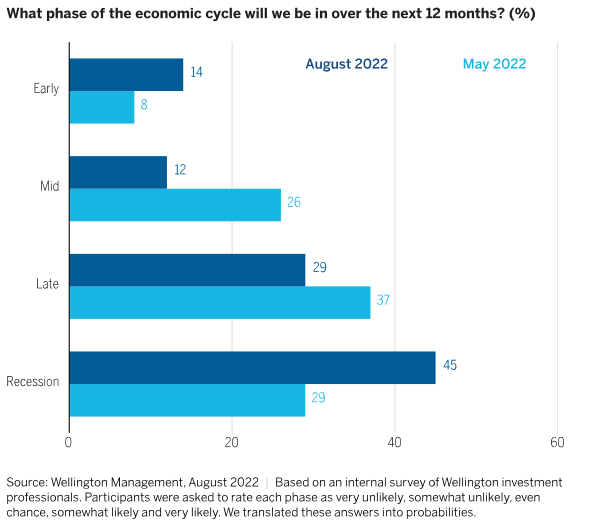
Increasing pessimism over the global economic outlook reflects the challenging environment of rising inflation amid an economic slowdown, and the resulting concerns over the growth implications of central banks’ inflation-induced policy tightening. The risk to interest rates for the foreseeable future appears to be to the upside, and whether policymakers can bring inflation down to a comfortable level without sparking recession remains a pressing concern for our respondents and for investors more broadly. Against this backdrop, our survey respondents remain mildly bearish towards risk assets.
Wellington’s recurring macro survey originated from a conversation three of our macro thinkers had over six years ago about Philip Tetlock and Dan Gardner’s book Superforecasting. Tetlock and Gardner argue that forecasting is a skill which can be improved, and we thought their theory could work well in practice at Wellington, given the firm’s collaborative culture. The hope was to sharpen our collective and individual forecasting skills, enhance our internal investment dialogue, reveal where our views differ from the market consensus and identify how they change over time.
In January 2016, we launched an internal survey of macro thinkers across all disciplines, asset classes and office locations. The responses are anonymous. The precise formulation of the questions is important. Wherever possible, they are precise, time-bound, measurable, probabilistic and rollable from one quarter to the next, giving us a richer data set over time.


The questions incoming Fed Chair Warsh will need to answer
Continue readingBy
The spending bubble driving corporate profits looks set to burst
Continue readingBy
The rising tide of AI: How it could lift US productivity, growth, and profits
Continue readingRotations and reallocations: Rethinking equities
Continue readingTwilight zone: how to interpret today’s uncertain macro picture
Continue readingURL References
Related Insights
Monthly Market Review — August 2026
A monthly update on equity, fixed income, currency, and commodity markets.

The questions incoming Fed Chair Warsh will need to answer
We examine the key questions that incoming Fed chairman Kevin Warsh may need to confront as monetary policy faces new limits and new risks.
By

Quarterly Market Review — 2Q26
A quarterly update on equity, fixed income, currency, and commodity markets.

The spending bubble driving corporate profits looks set to burst
US corporate profits have been fueled by government deficits, low rates, and consumption — drivers now at risk, raising questions about the sustainability of market valuations.
By

The rising tide of AI: How it could lift US productivity, growth, and profits
From an economic and market standpoint, a lot is riding on the future of artificial intelligence. Macro Strategist Juhi Dhawan sees plenty of reasons for excitement but also a need for patience along the way.

Rotations and reallocations: Rethinking equities
Since April's Liberation Day, equity markets have recovered losses and appear to be on an upwards trajectory. But under the surface of the highs, argues Equity Strategist Andrew Heiskell, is a market and an economy looking for direction. Why is the economy so stuck?

Twilight zone: how to interpret today’s uncertain macro picture
Macro Strategist John Butler and Investment Director Marco Giordano explore how to interpret today’s uncertain macroeconomic picture and its key implications.

Stagflation watch: Thoughts on tariffs, inflation, and Fed policy
US Macro Strategist Juhi Dhawan considers signs the US economy may be moving toward a toxic mix of slowing growth and rising inflation, creating challenges for the Fed and investors.

Weighing the economic winners and losers of the One Big Beautiful Bill Act
Macro Strategist Juhi Dhawan unpacks the impact of One Big Beautiful Bill Act, including its potential effect on economic growth, corporate earnings, and the US government deficit and debt.

International equities: Five reasons they may not be a one-hit wonder
Global Investment and Multi-Asset Strategist Nanette Abuhoff Jacobson explains why those who doubt the staying power of the recent outperformance of international equities may want to reconsider.
Monthly Market Review — January 2025
A monthly update on equity, fixed income, currency, and commodity markets.
URL References
Related Insights







Monthly Market Review — August 2026
Continue readingBy