



- Fixed Income Strategist
Explore our insights
Asset class
Formats
Education

Education
The views expressed are those of the authors at the time of writing. Other teams may hold different views and make different investment decisions. The value of your investment may become worth more or less than at the time of original investment. While any third-party data used is considered reliable, its accuracy is not guaranteed. For professional, institutional, or accredited investors only.
The sell-off in most fixed income assets over the course of 2022 has been brutal. Pernicious and stickier-than-expected inflation, a hawkish US Federal Reserve (Fed) laser-focused on the inflation portion of its dual mandate, and the ongoing Russia/Ukraine conflict have derailed the decades-long fixed income bull market. However, the two biggest drivers of this year’s downturn have begun to abate:
While macro uncertainties remain, and market volatility is likely to stay elevated, we believe large swaths of fixed income look more attractive than they have in some time.
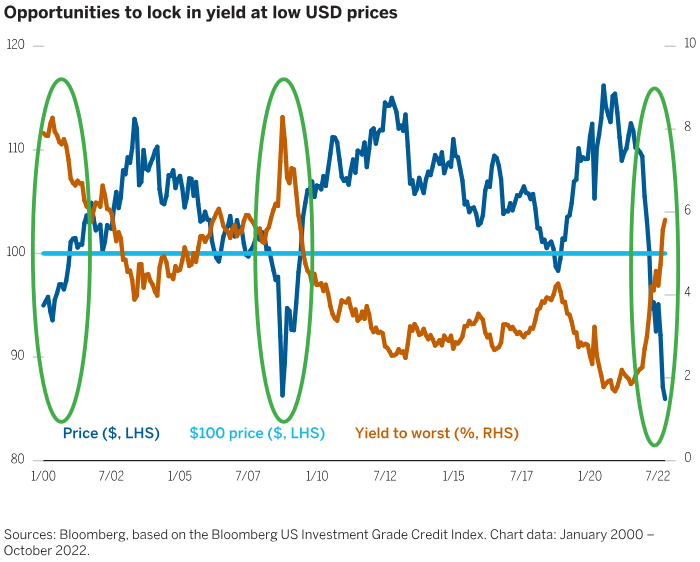
One area that we believe stands out these days is the investment-grade (IG) corporate credit market. As of this writing, current yields on IG credit are in the mid-single digits — a decade-long high. Most of these high-quality companies have very low default risk, and many have been trading at significantly discounted US dollar (USD) prices. For example, as of November 30, the Bloomberg US Investment Grade Credit Index traded at an average yield of 5.3% and an average USD price of $89.1. A low USD price can be an important credit metric: In the unlikely case of distress or default, the bondholder has legal recourse to seek the bond’s full par amount (face value), even if it was purchased at a below-par level.
Moreover, while a slowing global economy could lead to wider credit spreads going forward, we believe USD rates have now reached levels that can potentially serve as an adequate cushion against a broader sell-off in risk assets. The defense supplied by this cushion is twofold: 1) higher bond coupons (yields) that can help offset any short-term market price declines; and 2) the historically diversifying nature of having portfolio exposure to interest-rate risk and credit risk.
There are some relatively simple, straightforward ways to implement a positive view on IG credit. For instance:
Experts


Band-aids, bazookas, and boomerangs: Equity investing in a volatile US rate regime
Continue readingHow AI is impacting the high yield market
Continue readingBy
2026 midyear outlook: Time to rethink EM debt
Continue readingURL References
Related Insights

Weekly Market Update
What do you need to know about the markets this week? Tune in to Paul Skinner's weekly market update for the lowdown on where the markets are and what investors should keep their eye on this week.

AI capex and the new credit cycle
Fixed Income Portfolio Managers Alyssa Irving and Liz Kleinerman, and Head of Investment Grade Private Credit Emeka Onukwugha explore the emergence of an AI investment cycle in credit markets.

Band-aids, bazookas, and boomerangs: Equity investing in a volatile US rate regime
With fiscal pressures and Treasury-market fragilities keeping bond yields volatile, Macro Strategist Juhi Dhawan outlines implications for equity investors.
Monthly Market Review — July 2026
A monthly update on equity, fixed income, currency, and commodity markets.

How AI is impacting the high yield market
Fixed Income Portfolio Manager Blake Huynh examines how AI is reshaping the high-yield market using the latest issuance data. He explores what this transformation may mean for investors.
By

2026 midyear outlook: Time to rethink EM debt
Our expert argues that emerging market debt may merit a fresh look as stronger fundamentals, credible policymaking, and attractive yields challenge outdated assumptions about the asset class.

Growth outlook faces a new test: Inflation
Explore our latest views on risks and opportunities across global capital markets.

Tighter spreads, wider dispersion
Fixed Income Portfolio Managers Campe Goodman and Rob Burn share their midyear outlook for credit markets. They find that tight index spreads do not mean a lack of opportunity.
No rerun of the 2022 rates scenario but flexibility is key
Fixed Income Portfolio Manager Martin Harvey and Investment Director Marco Giordano share their outlook for rates (government bonds) for the second half of the year.
The questions incoming Fed Chair Warsh will need to answer
We examine the key questions that incoming Fed chairman Kevin Warsh may need to confront as monetary policy faces new limits and new risks.
By
A credit investor’s perspective on inflation, fiscal policy, and AI
Paul Skinner, Investment Director, and Connor Fitzgerald, Fixed Income Portfolio Manager. explore the forces shaping the economic landscape today, from the inflation outlook and the evolving role of fiscal policy, to the transformative impact of artificial intelligence on markets and corporate behaviour. Connor shares his perspective on where opportunities and risks are emerging across fixed income and what it all means for investors positioning their portfolios in an uncertain environment.
URL References
Related Insights












Monthly Market Review — July 2026
Continue readingBy