



- Fixed Income Portfolio Manager
Explore our insights
Asset class
Formats
Education

Education
The views expressed are those of the author at the time of writing. Other teams may hold different views and make different investment decisions. The value of your investment may become worth more or less than at the time of original investment. While any third-party data used is considered reliable, its accuracy is not guaranteed. For professional, institutional, or accredited investors only.
This is an excerpt from our 2023 Investment Outlook, in which specialists from across our investment platform share insights on the economic and market forces that we expect to influence portfolios in the year to come. This is a chapter in the Bond Market Outlook section.
First, the bad news: Global fixed income markets have undergone an extremely challenging 2022, with historically negative stock/bond correlations breaking down and leaving even diversified investors with seemingly no place to hide. Indeed, many credit market segments have posted dismal year-to-date performance, stemming from a combination of sharply higher government bond yields and wider credit spreads as the US Federal Reserve (Fed) and other global central banks have aggressively tightened monetary policies in an effort to rein in persistent inflation.
Now the good news: While this year’s economic and market turmoil has led to negative total returns in most fixed income sectors, the widespread sell-off and continued volatility have also created some attractive opportunities for discerning credit investors with longer-term time horizons.
I believe higher-yielding and income-seeking fixed income strategies – including well-run multisector credit portfolios – have the potential to act as powerful buffers against future interest-rate and credit-spread volatility. In particular, strategies designed to generate yield and total return in a risk-controlled manner by aiming to take advantage of the credit market dislocations that I anticipate going forward might be well worth considering. To further help exploit such market moves, many fixed income investors may wish to adopt a more defensive risk posture heading into 2023 and to preserve significant cash/liquidity stockpiles in their portfolios.
Despite looming (and growing) economic recession risks, I see several potential opportunities in higher-yielding credit sectors (Figure 1).
In aggregate, our predictive cycle indicators currently suggest that the global economy will likely enter a recession in 2023. However, it is not yet clear whether a mild recession would be sufficient to bring services inflation down to more manageable levels, or if we might be in for a much more severe economic downturn. In any case, I believe this year’s heightened uncertainty and volatility – which have contributed to different credit sectors selling off to varying degrees and at different times – have spawned opportunities to rotate across the global fixed income spectrum and to shift credit risk to areas that may offer compelling risk/reward trade-offs. Notably:
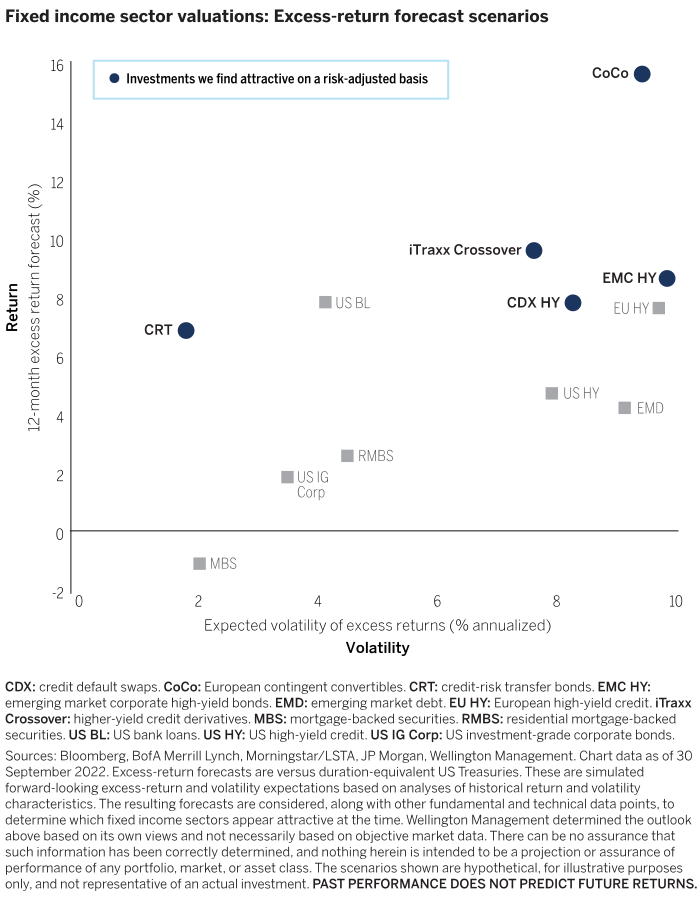
Bottom line: I expect there to be numerous relative-value opportunities for fixed income investors to judiciously add credit risk at potentially wider spreads in 2023.
While the deteriorating macroeconomic backdrop and challenging liquidity conditions appear to paint a dire picture for corporate bonds, I believe the bearishness is tempered somewhat by relatively attractive valuations, still-strong fundamentals, and a lack of imbalances compared to past credit cycles.
I acknowledge that monetary policy indicators, which have historically been a reliable predictor of credit market returns, look quite poor these days. Moreover, current credit spread levels, which are wide versus their historical medians across most fixed income sectors, already seem to reflect an impending slowdown in global economic activity. On a more upbeat note, corporate balance sheets appear very healthy to me overall, while many of the weaker individual credits in the market already defaulted during the early stages of the COVID pandemic.
Again, I believe many investors may be well served by building portfolio positions around various dislocations in higher-yielding credit markets, with a goal of pursuing yield and total return in as efficient and risk-aware a manner as possible. I also think it is important for investors to stay flexible and nimble with their portfolio allocations in an uncertain market landscape. Among other things, that might mean having sizable allocations to cash and liquid, developed market government bonds to be able to capitalize on market opportunities as they arise.
Expert

READ NEXT
Article 3

Weekly Market Update
What do you need to know about the markets this week? Tune in to Paul Skinner's weekly market update for the lowdown on where the markets are and what investors should keep their eye on this week.

AI capex and the new credit cycle
Fixed Income Portfolio Managers Alyssa Irving and Liz Kleinerman, and Head of Investment Grade Private Credit Emeka Onukwugha explore the emergence of an AI investment cycle in credit markets.

Band-aids, bazookas, and boomerangs: Equity investing in a volatile US rate regime
With fiscal pressures and Treasury-market fragilities keeping bond yields volatile, Macro Strategist Juhi Dhawan outlines implications for equity investors.

How AI is impacting the high yield market
Fixed Income Portfolio Manager Blake Huynh examines how AI is reshaping the high-yield market using the latest issuance data. He explores what this transformation may mean for investors.
By

2026 midyear outlook: Time to rethink EM debt
Our expert argues that emerging market debt may merit a fresh look as stronger fundamentals, credible policymaking, and attractive yields challenge outdated assumptions about the asset class.

Growth outlook faces a new test: Inflation
Explore our latest views on risks and opportunities across global capital markets.

Tighter spreads, wider dispersion
Fixed Income Portfolio Managers Campe Goodman and Rob Burn share their midyear outlook for credit markets. They find that tight index spreads do not mean a lack of opportunity.
No rerun of the 2022 rates scenario but flexibility is key
Fixed Income Portfolio Manager Martin Harvey and Investment Director Marco Giordano share their outlook for rates (government bonds) for the second half of the year.
The questions incoming Fed Chair Warsh will need to answer
We examine the key questions that incoming Fed chairman Kevin Warsh may need to confront as monetary policy faces new limits and new risks.
By
A credit investor’s perspective on inflation, fiscal policy, and AI
Paul Skinner, Investment Director, and Connor Fitzgerald, Fixed Income Portfolio Manager. explore the forces shaping the economic landscape today, from the inflation outlook and the evolving role of fiscal policy, to the transformative impact of artificial intelligence on markets and corporate behaviour. Connor shares his perspective on where opportunities and risks are emerging across fixed income and what it all means for investors positioning their portfolios in an uncertain environment.
URL References
Related Insights










Monthly Market Review — July 2026
A monthly update on equity, fixed income, currency, and commodity markets.
By