
- Head of Biotech Private Investments
United States, Intermediary
Change
The views expressed are those of the authors at the time of writing. Other teams may hold different views and make different investment decisions. The value of your investment may become worth more or less than at the time of original investment. While any third-party data used is considered reliable, its accuracy is not guaranteed. For professional, institutional, or accredited investors only.
The private biotech market continues to grow on the back of scientific breakthroughs fueled by steadfast innovation. This is in spite of sharp public market volatility as the sector’s COVID-driven exuberance fades. Critically, private market valuations are starting to reflect this public market volatility.
In this piece, we explore the state of the private biotech market and highlight three key themes we expect to continue.
Biotech M&A activity was unremarkable last year, but we believe it should accelerate in 2023 as pharma companies adapt to upcoming patent cliffs, leverage approximately US$500 billion of buying power,1 and lean into attractive valuations. While the US Inflation Reduction Act legislation was a headwind to the biotech industry in 2022, it has also provided greater clarity and limited the sector’s drug-pricing-related downside risks going forward.
Though existing macroeconomic uncertainties and ongoing regulatory considerations continue to challenge the overall sector in 2023, we believe winners should be disproportionately rewarded on substantial progress and strong data.
Amid today’s environment of innovation, legislation, volatility, and macro risks, there are three major themes we expect to persist throughout 2023 and beyond.
Investor sentiment and risk appetite are shifting
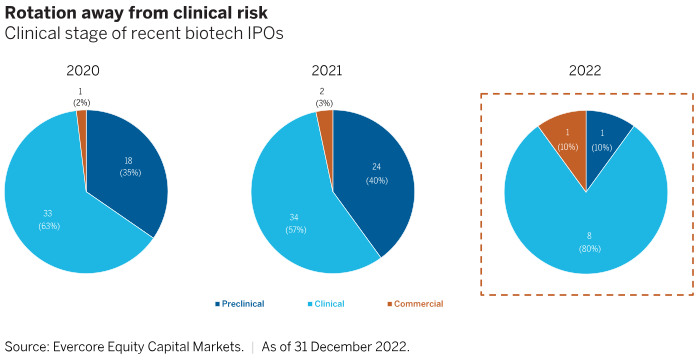
Market volatility and uncertain liquidity has shifted investor focus away from preclinical platform stories toward tangible, derisked assets at more forgiving valuations (Figure 1). Several companies are cued up to test the market in 2023 and given the underperformance of recent IPO classes, we believe investors are likely to remain hesitant and increasingly selective. In our view, they are likely to support a limited set of high-quality and preferably clinical-stage stories with strong insider support and constructive valuations.
New biotech venture creation should continue to fund innovation
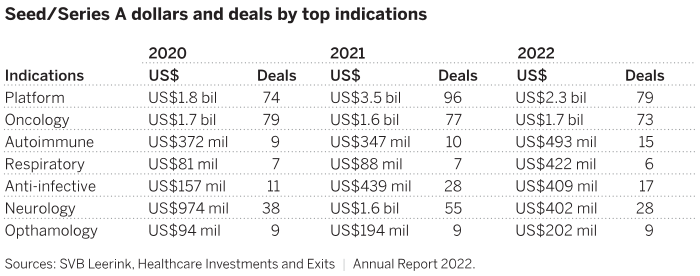
There has been an abundance of venture creation activity despite broader volatility in the sector (Figure 2). In our view, today’s persistent innovation in early biotech companies should continue. Notably, we believe there is an acute focus on capital efficiency. This emphasis is evidenced in venture firms focusing more on products than platforms to conserve cash runway. We believe oncology, immunology and inflammation, rare diseases, and novel modality platforms will likely continue to see investor interest going forward.
Biotech valuation reset
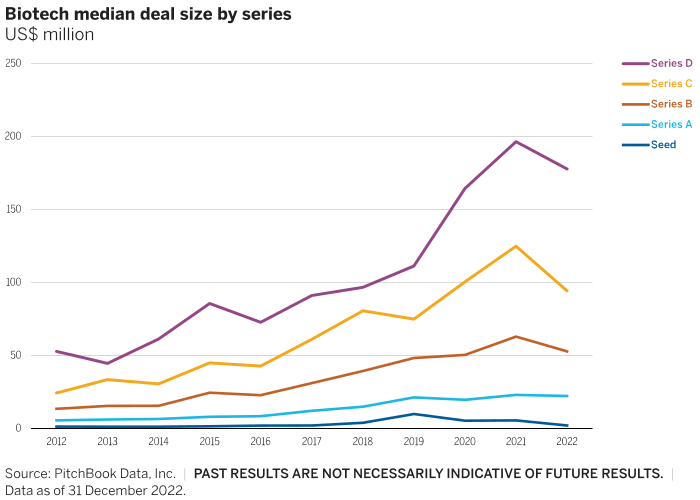
Historically, we expect a six-to-nine-month lag in the valuation reset from public to private biotech. However, given the amount of capital raised in the frothy markets of 2020 and 2021, this valuation reset has taken longer than anticipated (Figure 3). Crucially, we believe 2023 has been — and will continue to be — a year of delivering value inflection on the back of valuations more reflective of historical expectations.
In our view, the current biotech market landscape reflects lower valuations, a focused innovation pipeline, and a renewed emphasis on capital efficiency. We believe private biotech firms with differentiated assets with scientific merit and a focus on valuation discipline can thrive in this environment.
1Source: Centerview Partners estimates
Please refer to the investment risks page for information about each of the following risks:
Experts



The role of secondaries in venture and growth private equity
Continue readingSecondary investment: Flexibility in private equity
Continue readingVenture capital outlook for 2026: 5 key trends
Continue readingURL References
Related Insights
Related Insights

The role of secondaries in venture and growth private equity
Our experts discuss how secondaries are reshaping venture capital and growth markets, offering liquidity and strategic portfolio diversification opportunities.

Yes, climate change (still) matters in private markets
We explore why climate change matters in private markets, highlight the current regulatory landscape, and profile key questions to expect from public market investors.

2026 Venture Capital Roundtable
Our three-part video series brings together experts from across our venture capital platform to explore opportunities outside of AI, how to identify quality among today’s noise, and what investors may be underestimating for the year ahead.

Private equity deep dive
We explore four key private equity questions to help investors better understand how these strategies compare and complement each other in a portfolio. In particular, we highlight the distinct opportunity sets, risk-return characteristics, and portfolio roles of venture capital and buyout strategies.

Private Market Perspectives 2025: Full Picture
At our Annual Meeting, we explored private markets trends, from private credit growth to opportunities across the credit continuum, powered by our integrated public and private insight.

Secondary investment: Flexibility in private equity
Our private equity experts highlight how secondary transactions offer liquidity solutions for LPs, capital support for GPs, and a growing opportunity set.

Venture capital outlook for 2026: 5 key trends
We explore 2026's venture capital trends, highlighting IPO momentum, M&A acceleration, secondary market growth, public-private convergence, and the focus on quality investments.

Human capital management for private companies
We discuss why effective people management is critical for private companies and outline four strategic focus areas that can help companies navigate evolving employee needs, regulatory changes, and investor expectations.

Venture and growth equity: The future of private-market evergreen funds?
Investment Director Cara Hubbard highlights how the VC and growth equity landscapes are transforming, details the rising popularity of evergreen funds, and shares how these themes may converge to expand access to private markets.

Understanding private equity performance
We dive deep on best practices for measuring and benchmarking private equity performance. In addition, we outline the J-curve and the impact of fund lifecycle on returns.

Allocating to alternatives: A role-based guide for corporate DB plans
For corporate plan sponsors thinking about weaving hedge funds and private equity into their portfolios, we offer this brief guide to the potential benefits and key considerations when establishing an allocation, including liquidity stress testing.
URL References
Related Insights