



- Co-Head of Private Investments
Explore our insights
Asset class
Formats
Education

Education
The views expressed are those of the authors at the time of writing. Other teams may hold different views and make different investment decisions. The value of your investment may become worth more or less than at the time of original investment. While any third-party data used is considered reliable, its accuracy is not guaranteed. For professional, institutional, or accredited investors only.
This is an excerpt from our Investment Outlook, in which specialists from across our investment platform share insights on the economic and market forces that we expect to influence portfolios.
The landscape has changed significantly since our 2025 outlook when we predicted an imminent reopening of the IPO market. Luckily, despite the ongoing volatility, venture capital is both a long-term and creative business with expanding avenues for liquidity.
In this mid-year outlook, we explore the implications of the IPO market’s delayed reopening and dive into four additional related trends in venture capital.
1. When will the IPO market reopen?
The window that was opening in 1Q25 froze quickly amid market volatility. While we’ve seen early signs of it thawing (with a few IPOs in May showing initial success), it’s too early to tell how thick the ice may be. Continued strong performance in these names could lead to more robust issuance as early as the second half of this year, especially if paired with solid returns across public markets more broadly. In our view, however, it will more likely take until the back half of this year for meaningful momentum to rebuild, which means the real window is probably 2026. Importantly, continued improvement in the IPO outlook is sensitive to large macro developments — such as negative tariff updates or, worse yet, a recession — which can quickly reverse any progress.
In the meantime, the IPO backlog continues to grow as an increasing cohort of mature private companies are ready to go public but are waiting for a better entry point. So, while we believe market uncertainty will broadly slow deployments across early- and growth-stage venture, delayed IPOs could actually increase late-stage deployment. Notably, a volatile macro backdrop fueled by tariff uncertainty will likely result in longer times between financing rounds, a higher quality bar, and valuation pressures in venture (outside of AI).
2. What’s going on in M&A?
Global M&A deal values relative to GDP were at a near 30-year low at the end of 2024.1 The hope of tax cuts and reduced regulations had many expecting a large uplift in M&A activity for 2025, but this trend has yet to play out meaningfully. Halfway through the year, it is still unclear if these potential tailwinds will continue to be outweighed by market uncertainty, recession fears, and higher-for-longer interest rates.
The data thus far has been a mixed bag, with a 25% increase year over year in March 2025 followed by a nearly 20% month-over-month drop in April.2 We’re hesitant to predict long-term trends for the year based on this early pullback but will be watching subsequent M&A volume closely to better understand the full impact of the recent volatility on buying appetites. While uncertainty can be a cold bucket of water for prospective buyers, it’s also not uncommon to see some companies with cash lean into periods of dislocation.
The regulatory environment presents another big unknown. Following President Trump’s reelection, shares of companies with pending mergers surged, driven by expectations of reduced regulatory scrutiny. However, that contends with rhetoric around not giving large companies (and, in particular, big tech) a “free pass.” We saw a relatively normal first quarter compared to historical trends, with three significant merger investigations concluded.3
3. Is there still room for growth in private equity secondaries?
Private equity (PE) secondaries saw record transactions in 2024, with market volume rising 45% to US$162B.4 Moreover, the expectation of even higher deployment going forward is being fueled by an expansion in dry powder, which reached an all-time high for PE secondaries of US$288B last year.5 This accumulation of dry powder is itself being driven by a robust fundraising environment.
In fact, funds in 1Q25 raised a record US$50.7B, the strongest first-quarter start in recent history, nearly matching the US$53B raised in all of 2022.6 This momentum is expected to continue, with over 250+ secondaries funds estimated to be in market, targeting a total of US$93.8B.7 Importantly, this understates the amount of capital sought as many managers do not disclose targets.
Is this expected influx of capital a cause for concern? In our view, not necessarily, as the secondaries market has less than 2x dry powder to transaction volume compared to more than 3x in the primary space.8 On that basis alone, one could argue it’s significantly undercapitalized, regardless of the exponential growth the market has gone through to date.
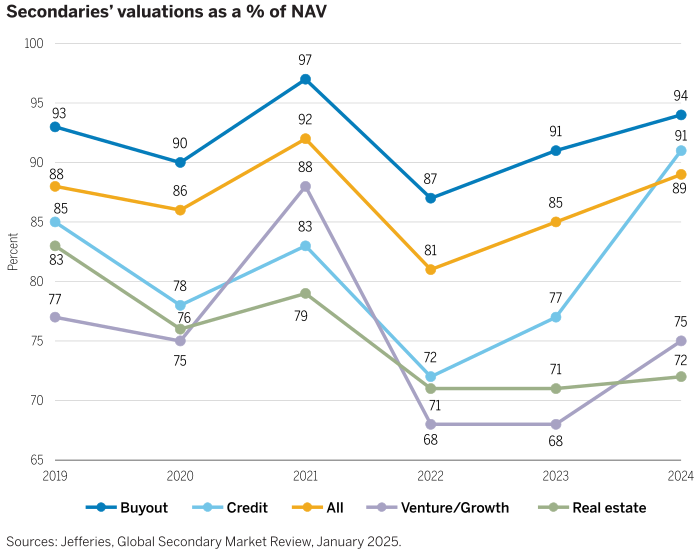
However, we think it is crucial to monitor secondaries’ discounts as a percentage of NAV. Many investors rely on a discount to NAV to mitigate j-curves, as realizing that discount upon purchase results in an immediate spike in performance. Notably, buyout valuations average 94% of NAV and the influx of new capital could drive this higher (Figure 1). Investors should consider at what point the fundamental thesis of secondaries could be broken if dry powder forces managers to pay above NAV. In contrast, growth/venture may be relatively attractive given valuations average just 75% of NAV.
Figure 1
4. What does today’s environment mean for GPs?
PE fundraising was previously expected to plateau in 2025 after dropping for the past couple of years. However, given today’s ongoing market volatility, we now expect another down year for broad PE fundraising, with recovery pushed out to 2026.
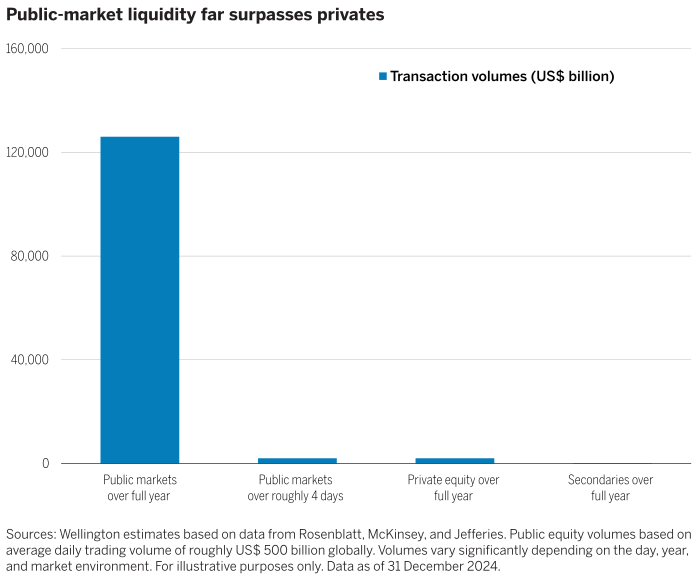
Critically, while the growth in PE secondaries is a positive tailwind for liquidity, it’s still many multiples too small to replace the liquidity generated by the public market. In fact, the public market handles roughly the same volume in four days as private equity (as an asset class) transacts on over a full year (Figure 2). This is especially relevant in growth and venture, where investors and employees are incentivized largely through company shares.
Figure 2
In our view, this means that institutional LPs are likely to remain stretched on their PE allocations and new liquidity will likely need to come from the wealth market. This could create added pressure for GPs to expand further into wealth and into the investment vehicles that resonate there (e.g., semi-liquids).
5. Can tokenization help ease the pain?
A lack of liquidity can be painful across LPs and GPs, but we believe this pain can lead to innovation. While illiquidity is currently in focus, high investment minimums, operational inefficiencies, and lack of transparency all remain hurdles to private market access.
Near-term, liquidity solutions such as continuation vehicles (part of the expansion of secondaries covered in point 3 above), NAV financing, and strip sales have provided incremental relief. But we believe tokenization (a digital representation of a real-world asset) may provide a more robust and durable solution to these challenges:
Additionally, the implementation of tokenization and blockchain technologies will be essential for the efficient operation of AI systems that function as economic agents.
Outlook for venture capital
Today’s venture capital environment is likely to further delineate between the industry’s haves and have-nots. Companies that are well capitalized, show significant growth, and have strong unit economics will likely see increased focus and have an easier road to financing. Those that lack these features are less likely to raise capital at attractive valuations. Cash-burning companies that can’t secure further financing will likely need to either increase capital burn in the hope that it reignites growth, cut spending (and therefore growth) in pursuit of profitability, or pursue an M&A.
We believe this era of differentiation is an opportunity for investors with dry capital and the expertise, resources, and networks to identify potential long-term winners.
1Sources: Dealogic, S&P, Bain & Co analysis. Data as of 31 December 2024. | 2“M&A activity insights: May 2025,” EP, as of 20 May 2025. | 3“DAMITT Q1 2025: Slow start to merger enforcement amid leadership transitions in US and EU,” Dechert LLP, 1 May 2025. | 4“Global Secondary Market Review, January 2025,” Jefferies. | 5Ibid. | 6“Behind 2025’s hot secondaries fundraising start,” Secondaries Investor, 10 April 2025. | 7“Secondaries in 2025: the outlook for fundraising, deals, and performance,” Preqin, data as of 27 January 2025. | 8Ibid.
Experts


The convergence of public and private markets — part 2
Continue readingEvergreen and drawdown funds: Structural considerations for private equity
Continue readingThe Next Great AI Companies May Look Like Services Companies
Continue readingURL References
Related Insights

The convergence of public and private markets — part 2
The convergence of public and private markets is opening new opportunities for wealth and institutional investors — but each will approach them differently. Part 2 of our series explores how evolving investor needs are shaping portfolio construction, product design, and implementation.

Evergreen and drawdown funds: Structural considerations for private equity
We explore the key differences between evergreen and drawdown funds, including how each structure affects capital deployment, liquidity, compounding, portfolio flexibility, and diversification within venture and growth equity portfolios.

The Next Great AI Companies May Look Like Services Companies
The question is no longer simply whether AI can make an existing workflow faster, but whether an AI-native operator can deliver the service faster, cheaper, and more reliably than incumbents.

Governance best practices in public markets
For private companies approaching the public markets, we highlight the corporate governance best practices that can help pave strong relationships with public market investors.

Climate investing in a constrained world
As systems across the physical economy hit capacity limits, technologies that unlock constrained capacity, improve reliability, and reduce risk are becoming increasingly important.

AI capex and the new credit cycle
Fixed Income Portfolio Managers Alyssa Irving and Liz Kleinerman, and Head of Investment Grade Private Credit Emeka Onukwugha explore the emergence of an AI investment cycle in credit markets.

Deep dive on CLO equity investing
Alyssa Irving, Fixed Income Portfolio Manager, discusses the CLO equity asset class, highlighting its diversification potential, risk-return dynamics, and the crucial role of managers.

What investors should watch as private credit market matures
Private credit is entering a more mature phase, marked by greater selectivity, broader opportunities, deeper market infrastructure, and growing emphasis on manager selection.

AI governance for private companies
Explore the critical need for AI governance for private companies, addressing evolving risks, regulations, and best practices for responsible gen AI usage.

The role of commercial real estate debt in an insurance portfolio
We examine how commercial real estate debt fits within an insurance portfolio, from its diversification and income characteristics to key considerations around regulatory classification, capital treatment, and portfolio construction.

Looking beyond mega-caps
We explore how the growing concentration of capital in mega-cap private companies is reshaping the venture and growth opportunity set, and the implications for portfolio construction, manager selection, diversification, and potential return opportunities across private markets.
URL References
Related Insights