



- Fixed Income Portfolio Manager
United States, Institutional
Change
The views expressed are those of the author at the time of writing. Other teams may hold different views and make different investment decisions. The value of your investment may become worth more or less than at the time of original investment. While any third-party data used is considered reliable, its accuracy is not guaranteed. For professional, institutional, or accredited investors only.
“It depends on what the meaning of the word ‘is’ is.” —Bill Clinton
The most common question I get is, “when will the business cycle turn and send the US into recession?” Implicit in this query is the idea that economic cycles should dictate asset-price returns. But this is rarely the case.
The slowdown caused by the COVID-19 pandemic, for example, was the worst economic recession since the Great Depression yet its impact on asset prices was short-lived, thanks to the unprecedented fiscal and monetary response in the US and around the world. More recently, US housing starts — a key leading economic indicator — have been anemic, yet most homebuilder stocks have outperformed owing to a structural lack of inventory. These dynamics suggest that the relationship between asset prices and the economic cycle is tangential at best, and that individual industries and market segments can experience ups and downs independent of broader macroeconomic trends. This lack of correlation does not mean investors should ignore macro, but rather take a nuanced view of which parts of the market are more or less likely to be affected by it.
Given this context, the US Federal Reserve’s (Fed’s) recent interest-rate cut (and Chair Powell’s subsequent commentary) could have a meaningful impact on the relative cycles of a number of industries, so it is first important to decipher what this last meeting could mean for future policy. In August, I thought the Fed would cut rates by 25 basis points rather than 50. While this turned out to be incorrect, in my September piece, I stated that the more salient point was that the Fed no longer believes the labor market to be a significant source of inflation, and is therefore shifting to its pre-pandemic policy of aligning the fed funds rate with its view of the neutral rate of the economy — currently around 3%. This theory was all but confirmed in the Fed’s September “dot plot,” with the median FOMC participant indicating that future cuts would achieve the central bank’s estimate of neutral by the end of 2025. Unless inflation surprises meaningfully to the upside, the state of the US labor market should continue to be the best clue of how close the Fed believes rates are to neutral.
As for the unemployment rate, my sense is that it could rise more substantially than the Fed thinks, albeit at a slower pace than in prior cycles. Typically, when growth slows, there is a sharp, quick rise in the unemployment rate. During the current cycle, however, this metric has been increasing much more slowly. I believe there are two reasons for this gradual ascent. First, recessions are usually caused by financial crises (as in 2008) or the lagged impact of high interest rates (as in 2001). Today, a financial crisis is less likely because of high capital requirements for banks, and an interest-rate-induced recession is improbable since the US economy is far more services oriented than manufacturing oriented, compared to the 2001 recession. Manufacturing is highly interest-rate sensitive, while services are not.
In addition, pent-up demand for services after COVID kept unemployment low and labor participation high. This is because, in aggregate, the service sector is less productive and efficient than the manufacturing sector. Consider the difference in productivity between a restaurant or retail store and a factory. When restaurants and stores experience rising demand, they hire additional staff to serve more customers. When a factory experiences higher demand, it can retool, run longer hours, and expend excess capacity, often without hiring more staff.
When government spending surged after COVID, the large US service sector had no choice but to hire workers to keep up with demand. As a result, the unemployment rate quickly normalized and remained under 4% from December 2021 until May 2024. Now that consumers have largely worked through their pandemic-induced excess savings, they are starting to pull back, which means the reverse may well happen. Companies in the services sector, seeing lower demand, have reduced hiring and may eventually lay off less productive workers. For this reason, I think the unemployment rate could rise well above the Fed’s projection of 4.4% by the end of 2025 and usher in an environment marked by a persistently dovish Fed.
One other point: While rate markets have largely priced in the Fed’s ability to cut aggressively, currency markets have not. The US dollar remains stubbornly strong despite the recent and expected near-term cuts. Given that the market anticipates policy rates to converge across the developed world within two years, it is strange for the dollar to be as strong as it is currently.
A dovish Fed focused on a weaker labor market is a significant shift from the past few years. To me, this means that relative cycles across industries and market segments are also set to diverge. Just as consumers have been largely interest-rate agnostic, given excess savings and persistent fiscal spending, falling interest rates are unlikely to spur further demand. Rather, unemployment levels and fiscal implications following the US election may dictate the trajectory of the consumer cycle from here.
On the other hand, interest-rate-sensitive sectors of the US economy, including small caps, industrials, and metals and mining, among others, have been in recession for the last two years. Because the change in the Fed’s stance is apt to bolster these cycles, investors should pay particular attention to companies and subsectors with limited inventory, as they may enjoy significant pricing power.
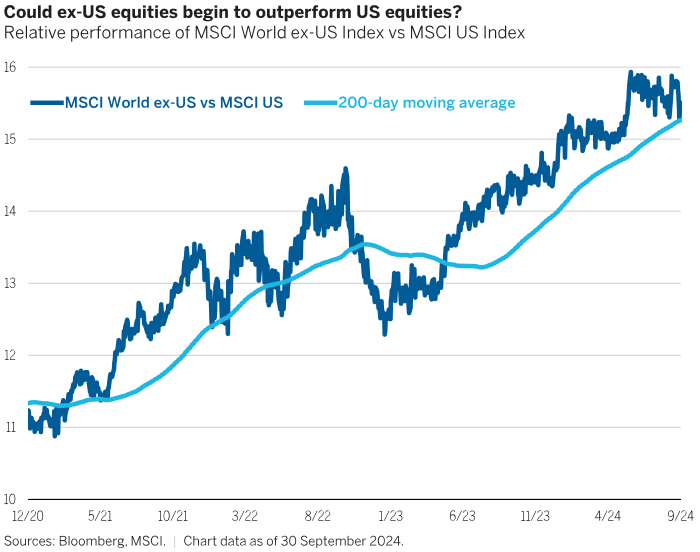
Finally, a dovish Fed and potentially weaker dollar are also a boon to countries outside the US, particularly those where manufacturing is more important to growth than the consumer sector. As Figure 1 shows, we are already seeing signs of this tailwind, with the MSCI World ex-US Index relative to the MSCI US Index approaching its 200-day moving-average trendline for the first time since May 2023. Could this be an early sign of a change in stock leadership?
Figure 1




















Monthly Market Review — September 2026
Continue readingBy