
- Co-Head of Multi-Asset Portfolio Management and Portfolio Manager
United States, Institutional
ChangeUnited States, Institutional
Changechevron_right
The views expressed are those of the authors at the time of writing. Other teams may hold different views and make different investment decisions. The value of your investment may become worth more or less than at the time of original investment. While any third-party data used is considered reliable, its accuracy is not guaranteed. For professional, institutional, or accredited investors only.
Inflation fears for 2025 are back, especially after Trump's election. Key policies and robust growth could lead to unexpected inflation, and in turn, different implications on investment returns. As such, understanding inflation and interest rates is crucial.
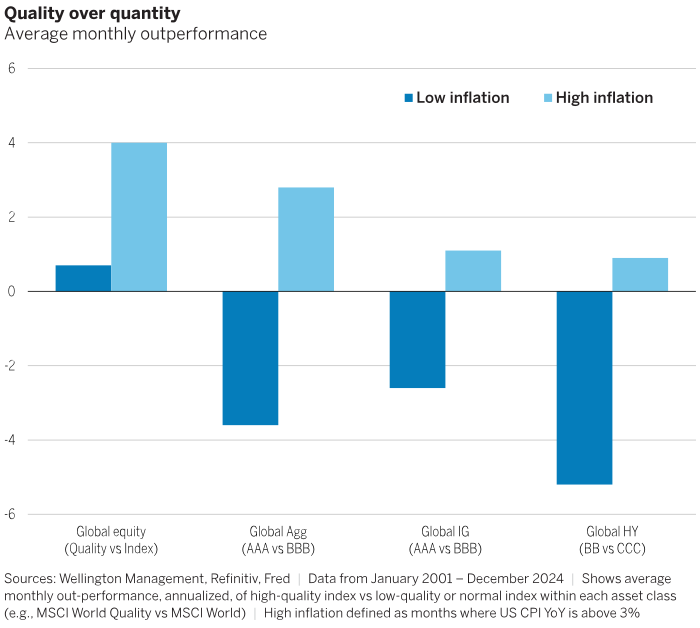
Since 2001, during periods of inflation over 3%, higher-quality stocks and bonds outperformed, suggesting that moving up in quality during such periods may benefit portfolios.
Quality stocks (high return on equity, low leverage, stable earnings) are more resilient. Higher inflation increases credit risk in fixed income, with default risk rising down the quality spectrum.
Experts



Oil is the spark — the cost of capital is the story
Continue readingTech Stocks as an Inflation Hedge: Is the Case Weakening?
Continue readingBy
Oil market update: The long road to normalization
Continue readingThe rally and the reality
Continue readingThe state of commercial real estate
Continue readingURL References
Related Insights
Get our latest market insights straight to your inbox.
Thank you for your registration
You will shortly receive an email with your unique link to our preference center

Oil is the spark — the cost of capital is the story
Higher oil prices are refocusing markets on inflation and the Fed, but the bigger investment story may be a broader shift toward a higher cost of capital and new diversification challenges.

Tech Stocks as an Inflation Hedge: Is the Case Weakening?
Fixed Income Portfolio Manager Brij Khurana explores why US tech stocks may be a less attractive hedge against US inflation and currency debasement and how this could favor bonds.
By

Oil market update: The long road to normalization
As geopolitical tensions in the Gulf region resume, our expert discusses recent oil market dynamics and their potential impact on inflation and the global growth outlook.

The rally and the reality
Can the markets remain resilient in the face of geopolitical disruption and inflation worries? We offer our views on the macro environment, AI-driven earnings, and the implications for equities, bonds, and commodities.

The state of commercial real estate
We explore how macroeconomic, demographic, and sector-specific trends are reshaping commercial real estate, and why selectivity by sector, asset, quality, and capital structure may matter more than broad asset-class exposure.
Warsh’s first FOMC: We have a task force for that
Our experts highlight new task forces, examine evolving inflation and labor dynamics, and contend that the Fed soon may need to choose between growth support and price stability.

The Iran war is changing the bond playbook
Regional wars, inflation, and shifting fiscal priorities are creating new challenges for the bond market. Fixed income portfolio manager Brij Khurana explains why investors may need to look beyond traditional core bond markets for opportunities.
By

Top of Mind: Next-generation diversifiers for a changing market landscape
Multi-Asset Strategist Adam makes a case for a set of “next-generation diversifiers” — asset classes that may help protect portfolios against equity downside and other risks in the market environment investors are likely to face in coming years.

Taking stock of the energy shock: 9 macro and market insights
Macro Strategist Juhi Dhawan looks at the potential effects of the war in the Middle East on economic growth, inflation, policy, and corporate profits.
The Fed’s growing footprint on the market has a cost
Brij Khurana explains what the Federal Reserve's balance sheet expansion may mean for inflation and asset prices.
By
Warsh as Fed chair: Something for everyone
Macro Strategist Juhi Dhawan shares five key takeaways on Kevin Warsh, President Trump’s nominee to be the next Fed chair, including thoughts on interest rates, deregulation, and the market impact.
URL References
Related Insights
© Copyright 2026 Wellington Management Company LLP. All rights reserved. WELLINGTON MANAGEMENT ® is a registered service mark of Wellington Group Holdings LLP. For institutional or professional investors only.
Enjoying this content?
Get similar insights delivered straight to your inbox. Simply choose what you’re interested in and we’ll bring you our best research and market perspectives.