
- Portfolio Manager, Head of Private Real Estate Credit
United States, Institutional
Change
The views expressed are those of the authors at the time of writing. Other teams may hold different views and make different investment decisions. The value of your investment may become worth more or less than at the time of original investment. While any third-party data used is considered reliable, its accuracy is not guaranteed. For professional, institutional, or accredited investors only.
The commercial real estate (CRE) debt risk spectrum presents numerous opportunities to be a lender. From our standpoint, transitional CRE assets may be the most compelling in today’s real estate market.
In this piece, we dive into the transitional lending market, highlighting what makes these assets attractive across market environments. In addition, we explore where transitional CRE debt allocations fit in portfolios.
Transitional CRE lenders typically provide first-lien, senior secured loans to institutional owners of well-located CRE for the purposes of upgrading, leasing, and/or reprogramming1 a property to its highest use to maximize its potential cash flow (and therefore its value). In the current market environment, we believe lenders can expect to receive low-to-mid-teens levered yields for extending credit in this profile, with the added benefit of being collateralized by a hard asset.
Additionally, with today’s macroeconomic uncertainty, we believe there will increasingly be the need and opportunity for lenders to step in and provide customized, flexible solutions to borrowers. Transitional CRE lenders can thereby help borrowers unlock the most value from their assets while potentially providing greater lender returns and lowering lender risk. In our view, the combination of a higher-for-longer rate environment, heightened market volatility, and reset valuations creates an advantageous lending opportunity given tightening underwriting standards and higher yields. Beyond the here and now, transitional CRE lending also offers the broadest opportunity set (Figure 1) within CRE debt because real estate assets are consistently in some period of transition. Within the transitional lending universe, we believe lending on light (e.g. stabilization) to heavy (e.g. development) transitional assets offers the best combination of medium/low business plan risk and strong borrower alignment.
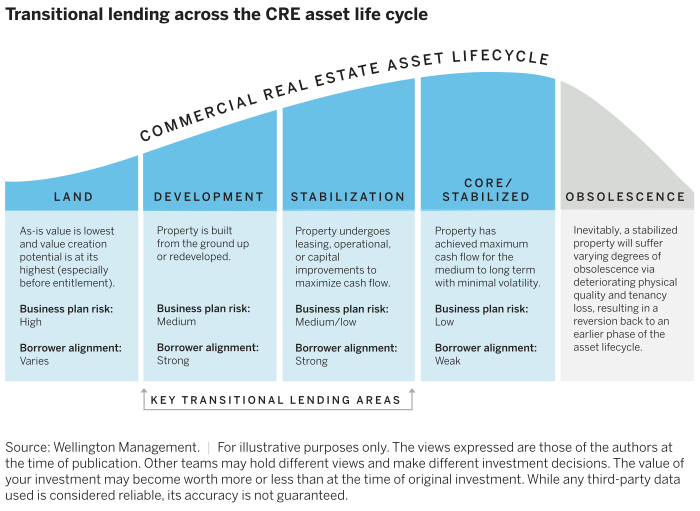
Importantly, transitional lending takes on the risk of business plan execution (i.e., value creation). But when structured correctly, these loans can maintain robust alignment with the borrower even when execution doesn’t go according to plan. In our view, a key strength of transitional lending is that loans are able to bend in times of distress but not break.
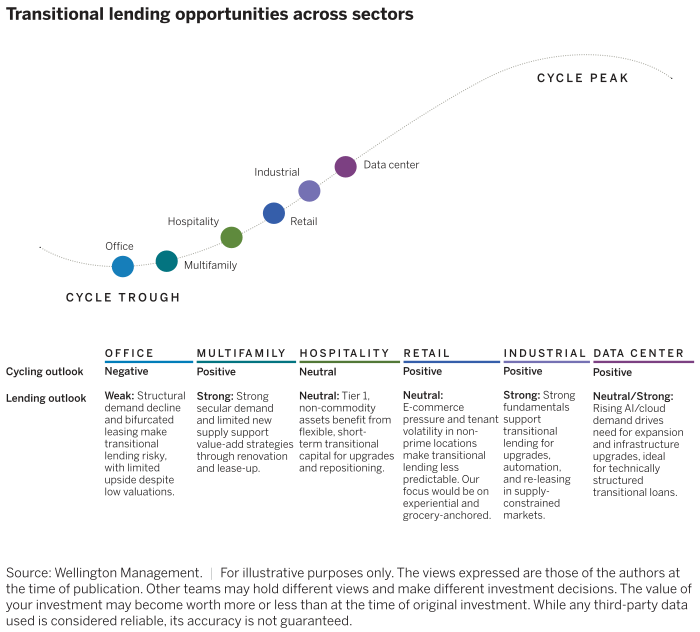
Fundamentals vary significantly across CRE sectors, making it essential to be cycle-aware within each vertical. However, in CRE debt, and especially in transitional lending, we believe there are opportunities across sectors regardless of cycle. From our perspective, the key to navigating CRE as an asset class is knowing where the best relative value is at any point in the cycle (Figure 2). We believe this requires fundamental, bottom-up underwriting expertise at the individual property level (both in its specific micro location and broadly within the property type). Moreover, casting a wide net across property types and markets offers the ability to opportunistically pivot as underlying sectors exhibit their own cyclicality.
Transitional CRE lending is in some ways an antithesis to traditional (i.e., core) lending. Core lending has a backward-looking bias and generally assumes that stabilized core assets will remain competitive into perpetuity. We believe this reasoning has proven challenging for many long-term holders of CRE in the recent market. Over the past three years, the CRE sector at large has experienced a dramatic repricing with macro tides receding to reveal numerous examples of underappreciated risks within core assets. The unfortunate reality for CRE is that many are aging assets susceptible to obsolescence across multiple dimensions, including: (i) deteriorating physical quality or outdated amenities/technology, (ii) cash-flow deterioration due to tenant loss (which could be due to (i) above or shifting dynamics such as work-from-home), and (iii) a shift in highest and best use, such as an outdated office building better suited for conversion to apartments. As the world continues to change rapidly, the way we work, live, and shop will continue to be catalysts for further transitions in CRE.
Generally, obsolescence occurs gradually over time, but a core asset can swiftly become transitional if a single-tenant property loses its sole occupant. By definition, a core asset is also stabilized, which limits its potential for further upside primarily to macroeconomic conditions (i.e., cap rate compression), while the downside risks (i.e., idiosyncratic in addition to macroeconomic) remain inherently larger. Through this lens, we believe transitional CRE lending offers a differentiated risk-reward profile, as the opportunities for value creation are distinct and significantly greater.
Transitional lending carries real risks — from execution missteps to market dislocations — and we believe success depends on how thoughtfully those risks are underwritten. While the asset class offers the potential for attractive risk-adjusted returns, it demands rigorous evaluation of idiosyncratic risks: collateral quality, business plan feasibility, tenant credit, market fundamentals, and sponsor capability.
We believe this is where a bottom-up, owner’s mindset is essential to underwriting. In our view, CRE assets should be underwritten individually to best ascertain intrinsic value, as underwriting to the average can substantially miscalculate the true worth of stronger assets and overvalue weaker ones. Finally, transitional CRE debt’s downside risks can be better mitigated through robust loan structuring and meaningful alignment with borrowers, which begins with sizing of the loan to a defensible basis.
Asset owners who find the transitional CRE debt opportunity set compelling will likely look to understand what roles these allocations typically play in a portfolio. Allocators generally view CRE debt as either a fixed income replacement, a private credit diversifier, or part of a diversified real asset allocation. This is due to four key attributes of the asset class:
The CRE debt market has steadily grown for decades and is a foundational asset class for institutions seeking current income with added downside protections. In our view, within the CRE debt universe, transitional assets offer a differentiated opportunity by historically providing attractive risk-adjusted returns both in uncertain markets like today and through cycles.
1Reprogramming examples can include investing capital into an existing office asset and converting it to for rent residential or converting an existing hotel asset into a student housing project. Other types of reprogramming can include taking a former multifamily rental project and converting it into a condominium project where units are sold to individual owners.
Experts