United States, Institutional
Change

The views expressed are those of the author at the time of writing. Other teams may hold different views and make different investment decisions. The value of your investment may become worth more or less than at the time of original investment. While any third-party data used is considered reliable, its accuracy is not guaranteed. For professional, institutional, or accredited investors only.
The potential breakdown of the negative stock/bond correlation exemplifies why
Recently, I wrote about the rotation from growth to value and why some of my colleagues and I expect volatility, more than a smooth transition of leadership, to define markets. The thesis is rooted in the fact that seismic macro questions loom over markets and are likely to trigger violent fluctuations in investor conviction. Earlier this month, Macro Strategist John Butler dissected one of these questions: Will the negative correlation between stocks and bonds turn positive?
Since the turn of the century, stocks and bonds have maintained a persistent negative correlation. It is a convenient relationship that has shaped modern market dynamics across asset classes. As Portfolio Manager Mark Sullivan noted recently: “Most large asset holders run some form of risk parity based on the assumption bonds will act as an important diversifier in periods of weak growth and economic stress.” Yet, history attests, today’s sustained negative correlation is an anomaly, not the norm. According to Goldman Sachs calculations going back to 1900, a sustained negative correlation has occurred during only two market regimes prior to the late 1990s, and no negative run lasted more than a decade, nor dove as deep into negative territory as experienced over the past two decades.
Since the pandemic began, we’ve seen the rolling 12-month correlation between the S&P 500 and the US 10-year Treasury bond turn positive. If this proves structural (and therefore, lasting), the cross-asset-class implications would be seismic. It could drive investors to reprice risk across bond markets. It could compromise the “buy-the-dip” mentality that has suppressed equity volatility for years. And it could spike demand for alternative and uncorrelated asset classes as investors seek new paths to diversification.
Regardless of the outcome, the takeaway from Butler’s analysis is clear: Volatility is likely inevitable when market-defining dynamics sit on a razor’s edge. It is a high-risk and high-reward environment, which requires creativity and humility. As Portfolio Manager Michael Carmen sagely advised: “Expand your horizons [and] be careful out there.”
The future of the stock/bond correlation hinges on whether inflation proves temporary or persistent. COVID-driven supply bottlenecks have no doubt exaggerated the inflation spike. However, mounting evidence suggests structural forces could continue to constrain supply across global economies, from decarbonization to a rapidly aging developed world to the backlash against globalization. And if constrained supply undergirds persistent inflation, it will trigger a new central bank policy regime. To quote John:
Since 1999, economies effectively oscillated between two worlds — “goldilocks” (recovery and no inflation) and repair (weaker growth and no inflation). Central banks chased growth. And, as central banks chased growth, there was a negative and stable correlation between equities and bond returns… If supply is more constrained going forward, central banks will go back to trying to manipulate demand as a tool to adjust inflation…Central banks, as a result, won’t be as quick to respond to the first signs of weaker demand. Instead, they will need to be confident that weaker demand is slowing inflation. Their policy response will lag turning points. In the new regime, at times, central banks will become a source of volatility rather than a compressor… In [that] world, equity and bond returns will no longer be negatively correlated, but could spend much of the time positively correlated.
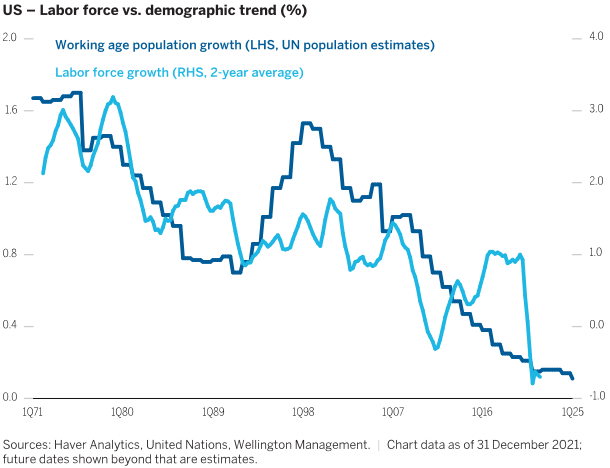
Recently, Macro Strategist Michael Medeiros circulated a chart depicting the staggering collapse of US labor force growth as the pandemic instigated a wave of retirements (Figure 1). As Fixed Income Portfolio Manager Loren Moran noted recently, this alone could trigger a less responsive US Federal Reserve (Fed) sooner than the market anticipates:
I think the market is far too complacent and playing by an old playbook…I don’t think market participants think the Fed would sit on their hands and watch a 10% decline in stocks or a 50 bps widening in IG corporates, but I think they have no choice. In a perverse way, they almost need it to slow inflation and potentially draw retirees/others back into the labor force. And that means that we should be pricing in the risk of a much larger move.
Figure 1
The implications of a less responsive Fed extend far beyond fixed income. In recent weeks, equity market action has suggested the “buy-the-dip” mentality is alive and well. The week ending January 28 saw the 20th biggest divergence between intraday and close-to-close volatility in the last 40 years, according to Derivatives Strategist Gordy Lawrence. ETF investors likely played a role in this extreme intraday market action. As CNBC reported recently, the SPDR S&P 500 ETF saw four to five times its daily average volumes during that same week.
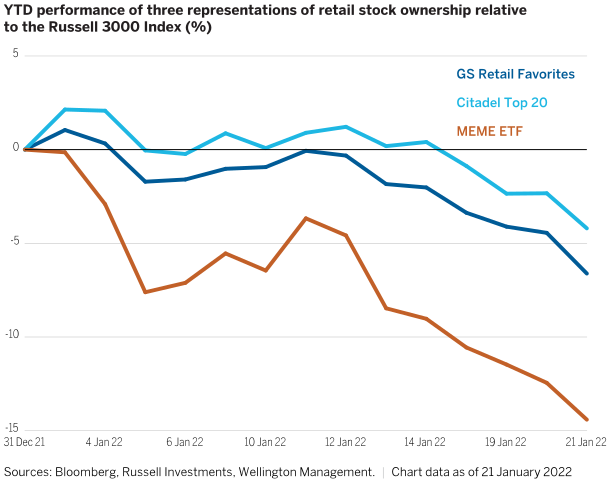
Again, to paraphrase Loren, equity investors are likely “playing by an old playbook.” “Faith-in-the-Fed” has undergirded dip buying throughout the quantitative easing era — the belief that any threat to equity market stability will trigger a Fed reaction, which will inflate risk assets. A less responsive Fed will eventually compromise that faith, especially among retail investors, a cohort whose confidence has no doubt already been shaken by significant underperformance during the growth to value rotation (Figure 2).
Figure 2
To be clear, this is neither a bullish nor a bearish note. As Gordy has written about equities: “Historically, on average, environments like our current one have tended to be followed by positive returns.” And as Fixed Income Portfolio Manager Rob Burn noted about the historical performance of US corporate high-yield bonds heading into Fed tightening cycles: “Spreads not only tightened leading up to the first hike, but also generally continued to modestly tighten after the first hike.”
Nonetheless, with seismic macro questions looming over markets, liquidity appears likely to continue to tighten and volatility to rise. To quote Gordy:
With a long list of sources of macro uncertainty to cite, we find it easy to believe that trading conviction is extremely low and prone to reversals of view, even within the same day. When liquidity contracts, every trade is more impactful, so with trading sentiment shifting rapidly, increased frequency and magnitude of intraday price swings is a natural result.
In the midst of regime change, the key to outperformance is likely less about predictive conclusions and more about asking the right questions. Which models, assumptions, and shortcuts adopted during the post-GFC status quo must be reevaluated now? What assets will benefit if regime change forces risk premia higher and investors to seek new avenues for diversification? How do investors confront their fears and biases while maintaining conviction in their conclusions rooted in fundamentals? Analyst Eunhak Bae recently shared a mantra of a past mentor, which bears repeating: “True risk is inversely correlated to perceived risk.”
Expert
Related insights
Showing
of
Insights Posts
Article
6 min
The convergence of public and private markets — part 2
Continue reading
6 min
Article
2028-10-31



URL References
Related Insights
Read next
Showing
of
Insights Posts

Article
6 min
The convergence of public and private markets — part 2
The convergence of public and private markets is opening new opportunities for wealth and institutional investors — but each will approach them differently. Part 2 of our series explores how evolving investor needs are shaping portfolio construction, product design, and implementation.
6 min
Article
2028-10-31

Video
4 min
Weekly Market Update
What do you need to know about the markets this week? Tune in to Paul Skinner's weekly market update for the lowdown on where the markets are and what investors should keep their eye on this week.
4 min
Video
2027-10-07

Article
4 min
Asset Allocation Outlook
How to evolve your portfolio for the latest market conditions? Explore the latest monthly snapshot of Wellington Solutions' asset class views.
4 min
Article
2027-10-31

Article
10 min
The rally: Refusing to yield?
Find out why we remain constructive but increasingly selective as AI investment supports equities, rising yields create opportunities in government bonds, and geopolitical risks complicate the outlook.
10 min
Article
2027-10-31

Article
6 min
When market cycles create opportunity: a value investor’s perspective
Equity Portfolio Manager Stefan Brugger, Equity Analyst Felix Schroeder and Investment Specialist Fred Owens-Powell discuss why the changing market regime may favour active value investors.
6 min
Article
2027-10-21

Article
5 min
US utilities: What data center politics could mean for investors
Rising US data center electricity demand is fueling new opportunities for utilities as well as political pushback in this US midterm election season. Learn how regulation, affordability, and grid pressures could potentially affect investors.
5 min
Article
2027-09-28

Video
5 min
Rapid fire questions with Jeremy Butterworth on 2026 credit markets
Investment Strategist Jeremy Butterworth discusses why credit markets have remained resilient despite shifting rate expectations, where dispersion is creating opportunities for active investors, and why Asia continues to offer a compelling credit opportunity set.

5 min
Video
2027-09-30

Article
16 min
Top of Mind: Challenging false investment dichotomies
Multi-Asset Strategist Adam Berger takes on three familiar investment debates where rigid “either/or” thinking may not serve investors well: active vs passive, US vs non-US, and public vs private.

16 min
Article
2027-09-09

Article
6 min
AI capex and the new credit cycle
Fixed Income Portfolio Managers Alyssa Irving and Liz Kleinerman, and Head of Investment Grade Private Credit Emeka Onukwugha explore the emergence of an AI investment cycle in credit markets.
6 min
Article
2027-10-05

Article
5 min
IPOs aren’t dead, they’re just napping
Experts from our venture capital and trading teams explore the current IPO landscape. They highlight three challenges and three opportunities for private companies aiming to go public today.
5 min
Article
2026-07-31
URL References
Related Insights