


- European Macro Strategist
United States, Institutional
Change
The views expressed are those of the authors at the time of writing. Other teams may hold different views and make different investment decisions. The value of your investment may become worth more or less than at the time of original investment. While any third-party data used is considered reliable, its accuracy is not guaranteed. For professional, institutional, or accredited investors only.
Following the global financial crisis (GFC), the euro area experienced a prolonged period of low inflation. Policy was run too tightly — austerity dominated the Continent’s fiscal policy decisions and the European Central Bank’s (ECB’s) monetary policy was too restrictive relative to other central banks. Credit growth was constrained following the 2012 sovereign crisis, with a slow resolution of the resulting rise in non-performing loans. The sovereign crisis also forced the euro area’s peripheral countries to accept a period of large, relative disinflation to regain competitiveness.
The euro area’s inability to inflate has long been a given for markets but, much like in the rest of the world, rising inflation is now proving to be far more persistent than policymakers had expected throughout 2021 and early 2022. This prompted the ECB to raise interest rates in its 21 July meeting by 50 basis points for the first time since 2011, despite the increased risks to growth, the war in Ukraine and a collapse in the Italian government. While last week’s rate hike brings the deposit facility out of negative territory back to 0.00%, the ECB’s deposit rate remains a long way from where we think it will eventually end up. Here, we explore the ECB’s likely next steps and the potential future path of inflation and growth in the euro area.
We think that many of the structural headwinds that have held back inflation in the euro area over the last decade are now easing. The labour market is tighter than at any time since the inception of the euro area and wages are starting to accelerate. Credit growth is back to levels we have not seen since before the GFC. We also see a fundamentally different attitude towards deploying fiscal policy — evident in the announcement of a €750 billion European recovery fund but also a major shift in Germany, where government budgets are being used to increase spending in areas such as defence. More generally, governments across Europe are using fiscal policy to shield consumers from the worst consequences of the economic cycle, a prime example being the energy price subsidies enacted earlier this year across Europe.
The persistent overshooting of inflation is not exclusive to euro area, but the question the market is grappling with is how high the region’s inflation will go and when it will peak. We expect headline inflation to top out in September at just above 9%, 4.5x the ECB’s target of 2%, while core inflation could reach 4.5%. The risk to both forecasts is to the upside. The prospect of near-peak inflation is bolstered by some commodity prices, including gas, food and metals, dropping back somewhat from the high levels seen earlier in the year. However, for the reasons described above, we think euro-area inflation is likely to remain more volatile and above the ECB’s 2% target for longer than the central bank expects. Figure 1 shows the ECB’s inflation projections and our own forecasts as of the end of June.
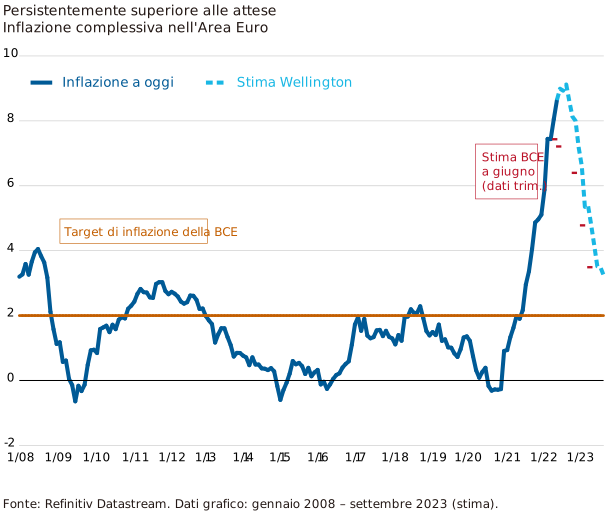
We expect global growth to slow significantly over the next quarter, driven by tighter monetary policy and reduced consumption and investment. However, we believe this slowdown will be a pause in growth rather than the start of a protracted recession, for three key reasons:
1. Russia’s invasion of Ukraine
For the euro area the main risk to our view on growth is Russia stopping the flow of gas to Europe altogether, in what would amount to a significant economic shock to the region. We envisage three broad scenarios:
2. Political uncertainty within the euro area
Another key risk is the renewed dispersion in euro government bond yields we have seen recently, with Italian bond yields in particular coming into focus following the collapse of the coalition government led by Prime Minister Mario Draghi. While, in our view, the centre right/right government that is likely to emerge following snap elections no longer poses a systemic risk to the EU and the euro area, it could nevertheless slow reforms, relax fiscal discipline and hamper further integration. This could mean less support for Italy from the European recovery fund, and it ultimately reduces the ECB’s room for manoeuvre as peripheral spread widening could be exacerbated.
The ECB’s decision to reverse eight years of negative rates is a tangible sign that it is playing catch-up in its battle to tame runaway inflation, with further rate rises to be expected in short succession. To give itself maximum flexibility, the ECB also announced the immediate end of forward guidance and the introduction of a new tool, the Transmission Protection Instrument (TPI), that allows theoretically unlimited intervention to protect the euro area’s cohesion. While the flexible reinvestment policy associated with the Pandemic Emergency Purchase Programme is the first line of defence against significant dispersion (through the purchase of more higher-spread issuance), TPI would be “activated to counter unwarranted, disorderly market dynamics that pose a serious threat to the transmission of monetary policy across the euro area”1. How the TPI would work in practice remains to be seen given the potentially political dimension of such a decision and the medium-term risks it may entail for the ECB’s independence.
Nevertheless, we believe the TPI could provide the ECB with an important safety net as it executes its delicate balancing act of curbing inflation while avoiding core-periphery spreads reaching the levels that triggered previous existential crises for the currency union.
Bar a shutdown of Russia’s gas provision and ECB policy mistakes, we think the euro area can return to stronger growth in the medium term if, as expected, consumers successfully weather the squeeze in real incomes. If our analysis is right, the economic environment will be substantially different, with markedly higher interest rates, looser fiscal policy and structurally higher and more volatile inflation.


China’s biotech surge (and its impact on biotech venture capital)
Continue readingFalse signals? A macro investing playbook
Continue readingThe long-term rewards of a contrarian approach to European equities
Continue readingHow a changing Europe is reshaping credit markets
Continue readingIntegrating end-beneficiary insights into impact investing: Microfinance case study
Continue readingStill opportunities in European equities? Positioning is key
Continue readingURL References
Related Insights

China’s biotech surge (and its impact on biotech venture capital)
China’s biotech sector’s long-term potential is underpinned by lower costs, faster development timelines, and increasingly translatable clinical data. In our new paper, we explore the implications for US and European biotechs.

Asset Allocation Outlook
How to evolve your portfolio for the latest market conditions? Explore the latest monthly snapshot of Wellington Solutions' asset class views.

False signals? A macro investing playbook
Portfolio Manager Arancha Cano shares her insights on interpreting potentially conflicting and unreliable data signals as investors navigate an increasingly uncertain market environment.

The long-term rewards of a contrarian approach to European equities
Portfolio Manager Tom Horsey and Investment Director Thomas Kramer explain why viewing European equities through a contrarian lens could help investors to uncover long-term opportunities in a rapidly evolving Europe.

How a changing Europe is reshaping credit markets
Portfolio Managers Derek Hynes and Konstantin Leidman explore how a changing Europe is reshaping the region's credit markets and identify key takeaways for investors.

Integrating end-beneficiary insights into impact investing: Microfinance case study
Louisa Boltz and Oyin Oduya join with Pranav Sridhar from 60 Decibels to examine best practices for bringing end-beneficiary insights into impact investing.

Still opportunities in European equities? Positioning is key
Macro Strategist Nicolas Wylenzek revisits the case for European equities and discusses why positioning can help optimise exposure to Europe’s accelerating regime change.

Europe: Fertile ground for long/short alpha opportunities
Dirk Enderlein, Eoin O’Callaghan, and Boris Kergall, explore European equity opportunities from a long/short perspective against a backdrop of volatile markets and structural growth shifts.

Europe: a good hunting ground for high yield?
With attractive yields and a low duration profile, high yield can present potentially compelling opportunities for investors, despite the continued volatility.

Fiscal versus tariffs: what wins out for Europe?
Just as investors were starting to explore the potential for growth in Europe, Trump’s tariffs landed. To what extent is the case for Europe still intact?

Sacrificing stocks on the altar of trade
Brij Khurana discusses the Trump administration's new stance on trade and its impact on the US economy, global markets and asset prices.
By
URL References
Related Insights