


- Macro Strategist
United States, Institutional
Change
The views expressed are those of the authors at the time of writing. Other teams may hold different views and make different investment decisions. The value of your investment may become worth more or less than at the time of original investment. While any third-party data used is considered reliable, its accuracy is not guaranteed. For professional, institutional, or accredited investors only.
As the opinion polls predicted, the Union of the Christian-democrat CDU party and its Bavarian sister party, the CSU, won the 2025 German federal elections, with party leader Friedrich Merz poised to become the next chancellor.
However, given the strong showing by the far-right Alternative für Deutschland (AfD) and the significant gains by the far-left Die Linke, the mainstream parties no longer have the required two-thirds majority in Parliament to reform the constitutional debt brake — the tight fiscal rules in place since 2009. Without this reform, Germany may struggle to respond decisively to the structural issues it and, by extension, Europe faces. How the new German government tackles this challenge is therefore a key issue that warrants investors’ attention.
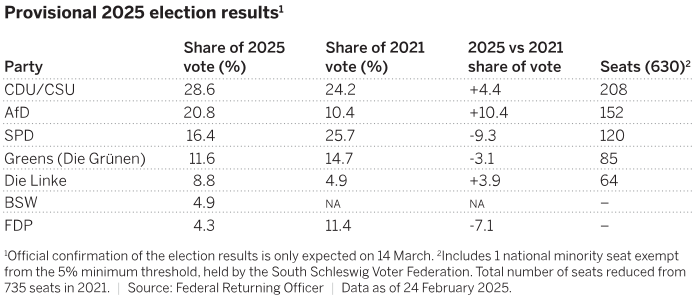
As Figure 1 illustrates, the outgoing coalition of social democrats (SPD), greens and liberals (FDP) were the clear losers in this election. Chancellor Olaf Scholz’s SPD suffered a loss of historic proportions, while the FDP failed to reach the minimum 5% threshold required to enter the Bundestag. By contrast, the AfD continued its steady rise; its 20.8% share of the vote — double what it secured in 2021 and 5% higher than its performance in last year’s EU elections — makes it the second-largest party in Germany. Die Linke also performed well, while Sahra Wagenknecht’s populist far-left BSW failed to make the minimum threshold by only the slimmest of margins.
Figure 1
Historically, it has taken between one and six months to form a government in Germany, but the scale of today’s geopolitical uncertainty and the limited number of viable coalition options imply the need for the rapid formation of a new government. Friedrich Merz has reiterated his ambition to be in post by Easter and will probably seek to build a two-party coalition with the SPD.
Regardless of the eventual outcome of the negotiations, the far right will not play a part in this new government. Nevertheless, the AfD’s continued rise represents a risk for the next election. For now, the cordon sanitaire is holding but the party’s status now as the main opposition could fuel its further rise. Moreover, its dominance in eastern Germany also raises questions about ongoing east/west divisions. Merz will therefore need to make sure his coalition stands for something other than just keeping the AfD out of power. Otherwise, the party could represent much more of a threat at the next election and could make governing Germany increasingly difficult.
Temporary fiscal loosening through an emergency suspension of the constitutional debt brake seems plausible. But the key question is whether Merz will make larger, more permanent changes to the debt brake.
On paper that looks challenging. The mainstream parties don’t have the two-thirds majority required to either create a new constitutionally protected investment fund or to loosen the rules themselves. Die Linke — which has been handed a de facto veto — is not opposed to changing the debt brake but may either block proposals for political reasons or demand unpalatable limits on additional defence spending or support for Ukraine.
There is still a path, however, to more significant fiscal change in Germany in the coming quarters. Merz is reputedly exploring the potential for using the last weeks of the current parliament, in which the centrist parties hold a comfortable two-thirds majority, to pass a new constitutionally protected €200 billion military fund. With that established and out of the way, the CDU/CSU could then try to work with Linke in the next parliament to loosen the fiscal rules. A potential compromise could involve higher social spending.
In short, the outlook for German fiscal policy still feels binary, with fiscal policy either remaining structurally tight with no change in the debt brake or becoming more expansionary than markets currently anticipate.
What happens to the fiscal rules has significant implications for Germany’s growth outlook. The country’s tight fiscal rules are not the root cause of the country’s weak growth, but they are a major contributor to the prevailing malaise. Public investment in Germany is among the lowest in Europe. And structurally tight fiscal policy has made it harder for Germany to transition from an export-led growth model to a more balanced one with a greater role for domestic demand.
The harder Die Linke makes life for the incoming chancellor, the more Merz may look to European solutions. The likelihood of repurposing existing European programmes like the European Stability Mechanism and NextGenerationEU loans has therefore risen. Yet the lack of fiscal flexibility may still constrain Germany’s ability to underwrite new initiatives.
Looking further ahead, this legislature may be the last opportunity for Germany’s centrist parties to convince voters to stick the middle ground and support the European project. Any further strengthening of the AfD and its ability to break through the cordon sanitaire would amplify the existential risk to Europe.
From a fixed income perspective, on our estimates, the market is pricing around a 60% chance the next government will be able to loosen the debt brake — based on how German bonds have traded relative to similar credits and swaps. This suggests there is scope for Germany to sell off further if Merz is successful in pushing through a new military fund and changing the debt brake with Die Linke’s help. On the other hand, if Germany cannot contribute to a strengthening of European cohesion, concerns about the euro area’s viability could resurface and put renewed pressure on its more indebted members.
From an equity perspective, even modest fiscal easing should still help hitherto underperforming assets. While the DAX has remained resilient — returning around 50% over the last two years — this solid performance is mainly due to the index’s international exposure. By contrast, the more domestic MDAX is still trading at a discount to the DAX on a 12-month forward price-to-earnings basis. The last time this happened was at the height of the global financial crisis, suggesting select exposure to domestic German stocks could still offer meaningful potential if the new government is able to present a coherent reform plan. Infrastructure and construction stocks could benefit from increased investment in infrastructure, digitalisation and affordable housing. Defence stocks are another potential beneficiary as military expenditure may be ratcheted up. To a lesser extent, there may also be some upside for the auto and chemicals sectors. While both industries are in structural decline, they remain major employers, and the mainstream parties will be anxious to stem the rise of extremist parties in Germany’s industrial heartlands.
Stay up to date with the latest market insights and our point of view.