Explore our insights
Asset class
Formats

Education

Education
Markets globally have seen major structural shifts in the recent past. Gone is the Goldilocks era of easy policy and globalization. Here to stay, we’d argue, are structurally higher volatility, geopolitical instability, and deglobalization. Yet, despite this backdrop, in 2025, global equity markets marched higher, bolstered by the benefits of AI and plenty of money put to work.
So, how do investors position themselves for a new (if sometimes paradoxical) world economic order? By opening their minds.
There are three ways we think investors can adapt to the times:
1. Approach diversification and asset allocation strategies differently
Despite strong US equity market performance last year, uncertainty lingers. Global geopolitical stress, changing trade and immigration policies, deteriorating US institutional credit quality, and persistent inflation are at the heart of this incongruity. At the same time, other warning signs, such as weakening consumer data and a cooling labor market, have emerged.
Should these dynamics continue or worsen, risk assets like equities could come under pressure. And fixed income isn’t always the complement to equity it once was. Since 2022, equities and fixed income have been marching in lockstep as a result of persistently higher inflation, which tends to push interest rates up and bond prices down while eroding equity valuations.
So, if equities come under pressure and bonds aren’t always up to the job of offsetting equity market downturns anymore, how should investors think about portfolio construction? Investments that are uncorrelated to equities and bonds, such as hedge funds and private markets, could help to enhance diversification and provide differentiated sources of growth.
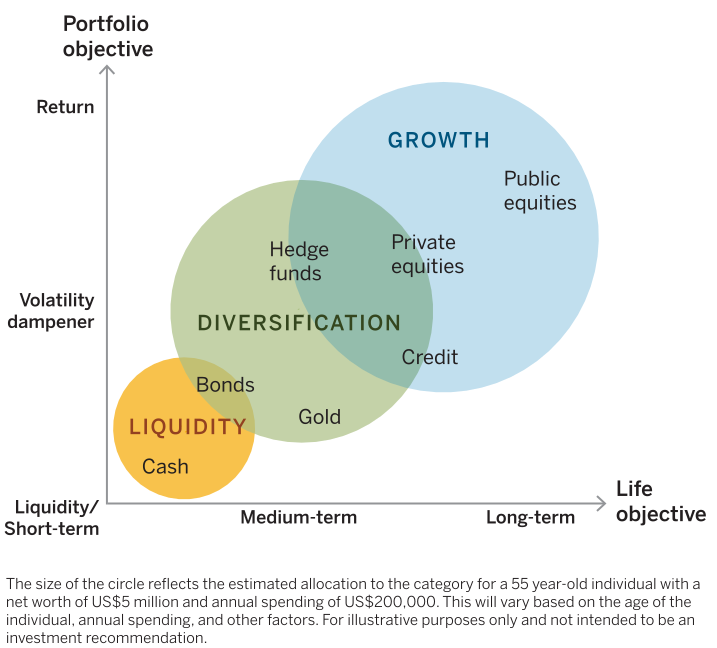
For many investors, these types of strategies are new. They may not be sure how to think about them in the context of a broader portfolio. Before I explore the potential benefits of hedge funds and private markets in more detail, I think it’s important to take a step back and look at portfolio construction holistically. Typically, investors aim to solve for short-term liquidity needs, diversification to help mitigate volatility, and long-term growth drivers. Figure 1 illustrates how an investor might incorporate hedge fund and/or private market allocations (among other strategies) to pursue these portfolio objectives and align with their life goals.
Figure 1
Broadening the investment toolkit could help investors prepare for what’s ahead
Sources: UBS, “UBS Wealth Way,” and Wellington analysis. January 2026.
2. Uncover the potential benefits of hedge funds
Hedge funds have long held a mystique of complexity and exclusivity. But the reality is that they’re practical. These alternative vehicles can use things like leverage, short positioning, and relatively illiquid assets in pursuit of their objectives. These tools aren’t available in your average mutual fund because they come with a higher level of risk — and a higher potential reward (Figure 2).
Figure 2
Source: Wellington Management, January 2026.
Hedge funds tend to be uncorrelated to broad equity and bond markets, meaning they experience different drivers of performance and different risks. Replacing some of a bond allocation with hedge funds could be helpful given the higher-inflation outlook and attendant equity-bond correlation described above.
Another reason to consider hedge funds in today’s environment is the highly concentrated nature of the US equity market. A handful of mega-cap tech stocks continue to dominate the market, but conventional wisdom suggests no company is guaranteed to win forever. Since hedge funds derive their performance differently than the equity market, replacing some of an equity allocation with hedge funds could also help enhance portfolio returns.
What’s more, hedge funds have historically performed better than broad equity markets in times of market volatility, higher inflation, and dispersion among companies — all of which characterize today’s market. Whether as a complement to equity or fixed income, hedge funds bear consideration as part of a diversified investment portfolio.
3. Unpack attractive opportunities and unprecedented access in private markets
It’s a compelling time to consider private markets for several reasons. Not only do they tend to be uncorrelated with traditional public market assets, but the asset class also looks very different today compared to 20 years ago.
The journey for most companies begins in the private sector. As they grow, new enterprises raise capital in the private markets through a series of fundraising rounds. While not all companies aim to move into the public market, many do, through an initial public offering (IPO). At that time, shares of its stock become available to the general public. In the past, tech companies, which could be viewed as a proxy for the broader private sector, usually spent about eight years in the private market before participating in an IPO. Today, they spend closer to 15 years in the pre-IPO phase (Figure 3).
Figure 3
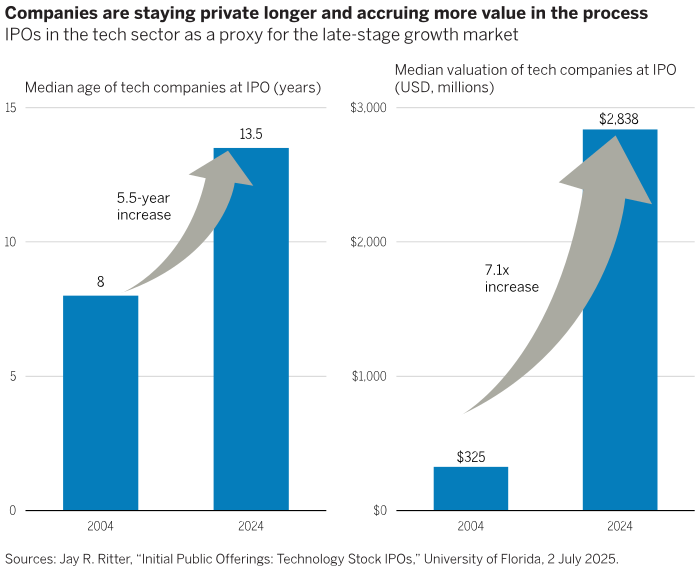
Because companies are staying private for longer, they have more time to grow their assets, so they tend to be larger and more profitable — thus more expensive — when they enter the public market. So, private markets might offer investors not only an attractive diversification option but also compelling value.
What’s more, private markets are home to many companies at the forefront of innovation. For example, many of today’s most promising names in sectors like AI, biotech, fintech, and more are found in private markets. Investors who focus solely on public markets may miss out on early access to what could be tomorrow’s biggest and brightest companies.
In today’s market, previously reliable approaches to investing may not cut it quite like they used to. To manage portfolio volatility, investors may need to diversify differently. To access compelling opportunities for return generation, they may need to look outside of public markets and among alternative investments. Though these alternatives were once the exclusive remit of institutional investors, today they’re becoming more broadly available through new investment vehicles and approaches to portfolio construction. Taking a holistic approach to asset allocation and incorporating these alternatives could be what helps investors manage portfolio volatility and grow their assets in 2026 and beyond.
The views expressed are those of the author at the time of writing. Other teams may hold different views and make different investment decisions. The value of your investment may become worth more or less than at the time of original investment. While any third-party data used is considered reliable, its accuracy is not guaranteed. For professional, institutional or accredited investors only.