



- Head, Investment Grade Private Credit
Explore our insights
Asset class
Formats
Education

Education
The investment-grade private credit market, for decades a core asset-liability matching tool for large US life insurance companies, is undergoing a multifaceted evolution. The asset class is growing, with new investors, an expanding set of transaction types, and private investments increasingly sought out as a driver of public diversification and returns within investment-grade fixed income allocations.
To navigate this changing opportunity set, we believe it is critical for investors to have a wide range of deal sourcing partners, deep underwriting capabilities, and experience across both public and private fixed income markets. Likewise, as the asset class continues to grow and evolve with new opportunity sets and investor use cases, we think it’s crucial for asset owners to understand where it fits in the private credit universe. In this piece, we dive into the most frequently asked questions about today’s investment-grade private credit market.
The investment-grade private credit market primarily includes privately negotiated 4(a)2 investments issued across corporate, infrastructure, and ABS transaction types. Institutional clients traditionally view these allocations as an extension of their core public fixed income exposure with the following potential benefits: incremental spread, enhanced portfolio resilience, and additional diversification. Moreover, the opportunity set appears particularly compelling in the current market environment due to the following:
The investment-grade private credit market has generated approximately US$100 billion in annual issuance1 per year, on average, over the past decade. The average life of the market is approximately 10 years, resulting in an overall market size of about US$1 trillion, compared to the public investment-grade market, which is roughly US$6 trillion in size.1
In 2024, investment-grade private credit deal volumes increased approximately 20% year over year1 – reaching record levels both in terms of overall market issuance and average deal size. Deal volumes in 2025 are on par with those in 2024, and we expect this growth trajectory to persist as investment-grade borrowers continue to seek alternative funding sources outside of their traditional banks.
As its name implies, the vast majority of the market is investment-grade rated (95%+) with a small portion having a below-investment-grade credit profile.1 Corporate entities have long been the most prominent issuers in the market (~60% of issuance on average).2 However, infrastructure and ABS deals have been transacted in the investment-grade private market since its inception, and we are seeing an increase in the supply and demand for these assets.
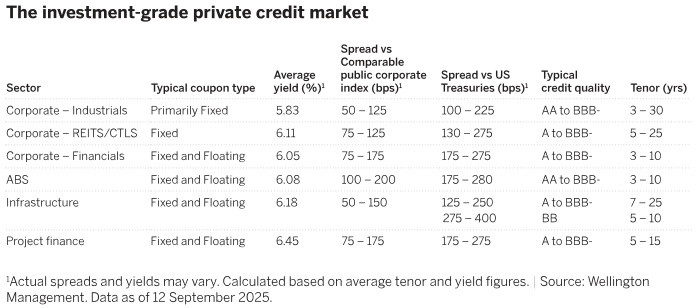
As illustrated in Figure 1, tenors are offered across a wide maturity spectrum, and transactions can be structured with both fixed and floating rate coupons. Historically, investment-grade private credit investments often centered around the 7 – 15-year tenor range. However, the number of short tenor deals has grown as issuers have sought to limit all-in costs in the higher interest-rate environment and as new buyers with shorter-tenor appetites have come into the market. This has benefited investors with diversified tenor appetites, as they have been able to partner with issuers on these attractively priced shorter deals.
Figure 1
Deal access in the investment-grade private credit market is mainly driven by long-standing relationships, similar to other parts of private credit. But unlike traditional private credit, for those with access, deal sourcing may occur across a number of different channels, including the broadly agented market, club/narrow syndications, and direct origination. Club and directly originated transactions offer further diversification, as well as potential structuring and relative value benefits, but participation in these deals often requires specific relationships and structuring expertise. It is important to note that agents do not assist with the credit underwriting process, as is the case with bank loans. Instead, they act purely as intermediaries, bringing issuers and investors together to complete the transaction. This makes credit underwriting expertise across sectors and through multiple credit cycles particularly important in this market.
We believe it is advantageous to have access to each of these channels, as it increases the investable opportunity set, which can be particularly important in periods when illiquidity premiums are compressed or supply declines. For example, in 2020, the agented market was compelling as public markets took a step back and illiquidity premiums were high. Conversely, 2021 was a strong time for club/direct origination.
Though the investment-grade private credit market is traditionally viewed as a buy-and-hold asset class with most of the transactions occurring in the primary market, a secondary market does exist. The overall market experiences approximately US$100 billion annual issuance, on average, with US$2 – 3 billion of that volume occurring in the secondary market.3
Given valuations are not publicly available in this market, an investor’s ability to transact may be tied to their access to pricing information. We’ve partnered with two of the largest secondary trading platforms to value and provide additional insight into pricing and liquidity trends in the market. In addition to liquidity for individual deal transactions, portfolio liquidation events may also occur in the secondary market, as evidenced by the two examples below.4
Notably, investment managers with the ability to offer an open-end fund may also provide regular liquidity through periodic redemptions, natural liquidity via cash flows, and/or diversified portfolio construction (such as amortizing transactions and/or laddering of maturities).
Consistent with public fixed income securities, investment-grade private credit investments are priced using the underlying treasury rate and appropriate credit spread, with an additional illiquidity premium component to reflect the less liquid nature of the asset class. The pricing is typically calculated via a yield analysis methodology, which involves using similar debt instruments (tenor, rating, etc.) to arrive at the appropriate illiquidity premium.
Wellington relies on two leading independent valuation providers to assist in our pricing efforts. Our arm’s-length valuation approach helps us gain comfort with the validity of our pricing data, given their access to the broad market, although we also employ our own internal oversight process as an additional risk lens.
Historically, US insurers have been the primary buyers of investment-grade private credit assets. For regulatory charge reasons and due to their desire for portfolio customization, these asset owners have preferred separately managed accounts when outsourcing the management responsibilities. Importantly, as new investor types have increasingly participated in the market, we have seen interest in both separately managed accounts and commingled vehicles, depending on the asset owner’s objectives and requirements.
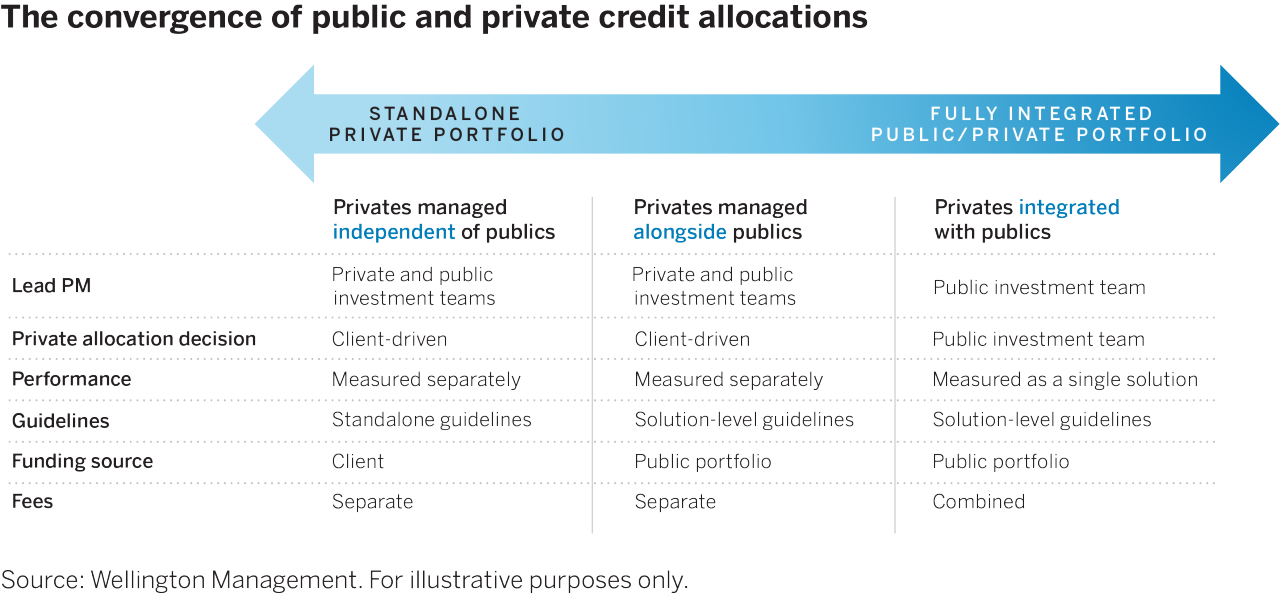
In addition, asset owners are consistently seeking a more holistic approach to their public and private credit exposures. Across client types, this is increasingly leading to the convergence of public and private credit allocations. While the implementation of the solution may differ, the most common drivers for an integrated public/private portfolio include more 1) consistent objectives and guidelines, 2) efficient capital management, and 3) controlled diversification.
Figure 2 shows our framework for evaluating and meeting asset owners’ unique objectives across public and private credit markets.
Figure 2
The investment-grade private credit market is evolving to serve new investor types, provide access to different kinds of transactions, and offer new solutions amid the growing intersection of public and private markets. In our view, investors in this new market can benefit from a combination of broad deal sourcing relationships, strong underwriting capabilities, and expertise across both public and private markets.
1Sources: BofA Securities, Wellington Management, Bloomberg. | 2Based on Wellington Management experience transacting in the market. While many asset managers assign internal ratings to their investments, third-party Nationally Recognized Statistical Rating Organization (NRSRO) ratings are also available for more than 60% of the transactions in the market. This figure may be even higher for non-corporate deals, and we expect NRSRO coverage to increase as demand for these assets continues to grow. Similar to the public market, S&P, Moody’s, and Fitch will provide ratings for investment-grade private credit securities, and we also see ratings from Morningstar DBRS and Kroll. | 3Source: Wellington Management, secondary trading platforms. | 4These examples do not represent Wellington clients or deals Wellington was involved in, but rather are market examples for illustrative purposes only. Past performance is not necessarily indicative of future results.
The views expressed are those of the authors at the time of writing. Other teams may hold different views and make different investment decisions. The value of your investment may become worth more or less than at the time of original investment. While any third-party data used is considered reliable, its accuracy is not guaranteed. For professional, institutional or accredited investors only.
Experts