


- Global Investment Strategist
Explore our insights
Asset class
Formats
Education

Education
The views expressed are those of the author at the time of writing. Other teams may hold different views and make different investment decisions. The value of your investment may become worth more or less than at the time of original investment. While any third-party data used is considered reliable, its accuracy is not guaranteed. For professional, institutional, or accredited investors only.
The US Federal Reserve (Fed) is one of the most influential drivers of global financial markets, so its monetary policy decisions and actions are obviously critically important. Sometimes, however, the market implications may not be as clear-cut as they might seem.
For example, conventional wisdom tells us that as interest rates rise, existing bonds decline in value. But today’s macro environment is more complex than this simple rule because of the current mix of stubbornly high inflation, weakening economic growth, and a not-so-remote risk of recession. Against this backdrop, I believe higher-quality, long-duration fixed income assets may prove resilient even if the Fed keeps raising short-term interest rates for many months to come.
The Fed hiked rates by 75-basis points (bps) at its July 27, 2022 FOMC meeting, as widely expected. By contrast, the Fed’s 75-bp rate hike in June overshot expectations for a 50-bp increase. However, I would argue that the central bank’s “surprise” move in June actually lagged the latest available US inflation data, as it came after an eye-popping headline Consumer Price Index (CPI) reading of 9.1% and a spike in consumer inflation expectations. The takeaway? Neither the market nor the Fed has a crystal ball but if past is any prologue, it is quite possible that the Fed will continue to follow the markets (based on incoming data), not lead them. But that’s not necessarily bad news for bondholders with longer-term investment horizons.
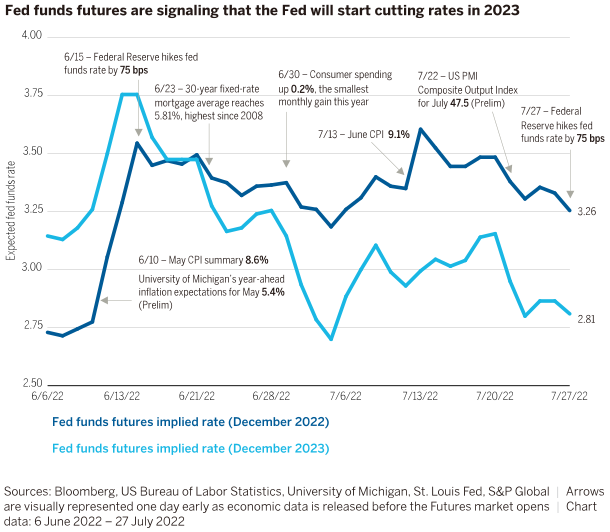
Interestingly, while fed funds rate futures contracts are signaling that the market believes the Fed’s terminal rate for 2022 will be around 3.25%, December 2023 futures contracts are currently trading closer to 2.75%, suggesting a belief that the Fed will reverse course and begin cutting rates by mid-2023 (Figure 1). Optimistic though it may be, if that forecast is indeed correct, it would certainly make a good case for owning US duration — particularly longer-duration, higher-quality bonds. Of course, the market could well be wrong.
But even if the market is wrong, I think the Fed is more likely to hike rates aggressively rather than too timidly. (In the FOMC press conference following the latest 75-bp hike, Fed Chair Powell commented that “doing too little raises the cost if you don't deal with it in the near term.”) In that case, I believe longer-term bond yields will fall as investors foreshadow more meaningful economic slowing in response to Fed tightening. We’ve already seen some early evidence that the US economy is feeling negative impacts from the Fed’s intense focus on “breaking inflation’s back,” even at the expense of growth:
The risk is that the Fed could back off from policy tightening in the face of weak growth, even while high inflation persists. In that case, I think the market would question the Fed’s credibility and signal as much with higher long-term bond yields — not a chance the Fed is willing to take, in my view.

Band-aids, bazookas, and boomerangs: Equity investing in a volatile US rate regime
Continue readingHow AI is impacting the high yield market
Continue readingBy
2026 midyear outlook: Time to rethink EM debt
Continue readingURL References
Related Insights

Weekly Market Update
What do you need to know about the markets this week? Tune in to Paul Skinner's weekly market update for the lowdown on where the markets are and what investors should keep their eye on this week.

AI capex and the new credit cycle
Fixed Income Portfolio Managers Alyssa Irving and Liz Kleinerman, and Head of Investment Grade Private Credit Emeka Onukwugha explore the emergence of an AI investment cycle in credit markets.

Band-aids, bazookas, and boomerangs: Equity investing in a volatile US rate regime
With fiscal pressures and Treasury-market fragilities keeping bond yields volatile, Macro Strategist Juhi Dhawan outlines implications for equity investors.
Monthly Market Review — July 2026
A monthly update on equity, fixed income, currency, and commodity markets.

How AI is impacting the high yield market
Fixed Income Portfolio Manager Blake Huynh examines how AI is reshaping the high-yield market using the latest issuance data. He explores what this transformation may mean for investors.
By

2026 midyear outlook: Time to rethink EM debt
Our expert argues that emerging market debt may merit a fresh look as stronger fundamentals, credible policymaking, and attractive yields challenge outdated assumptions about the asset class.

Growth outlook faces a new test: Inflation
Explore our latest views on risks and opportunities across global capital markets.

Tighter spreads, wider dispersion
Fixed Income Portfolio Managers Campe Goodman and Rob Burn share their midyear outlook for credit markets. They find that tight index spreads do not mean a lack of opportunity.
No rerun of the 2022 rates scenario but flexibility is key
Fixed Income Portfolio Manager Martin Harvey and Investment Director Marco Giordano share their outlook for rates (government bonds) for the second half of the year.
The questions incoming Fed Chair Warsh will need to answer
We examine the key questions that incoming Fed chairman Kevin Warsh may need to confront as monetary policy faces new limits and new risks.
By
A credit investor’s perspective on inflation, fiscal policy, and AI
Paul Skinner, Investment Director, and Connor Fitzgerald, Fixed Income Portfolio Manager. explore the forces shaping the economic landscape today, from the inflation outlook and the evolving role of fiscal policy, to the transformative impact of artificial intelligence on markets and corporate behaviour. Connor shares his perspective on where opportunities and risks are emerging across fixed income and what it all means for investors positioning their portfolios in an uncertain environment.
URL References
Related Insights












Monthly Market Review — July 2026
Continue readingBy