




- Macro Strategist
Explore our insights
Asset class
Formats
Education

Education
The views expressed are those of the author at the time of writing. Other teams may hold different views and make different investment decisions. The value of your investment may become worth more or less than at the time of original investment. While any third-party data used is considered reliable, its accuracy is not guaranteed. For professional, institutional, or accredited investors only.
In the coming months, I’ll be sharing a series of insights on the Trump administration’s efforts to downsize the federal government and what they could mean for the economy, industry, and markets. I begin with Trump’s focus on deregulation. Through the first 30 days of his second term, he signed more than 70 executive orders and, as promised during his campaign, reducing regulations was one of his key objectives. In this note, I look at the state of US regulation from an economic cost standpoint and explain why cutting red tape should yield several benefits, including for growth and inflation. I also touch on some of the potential drawbacks of this approach.
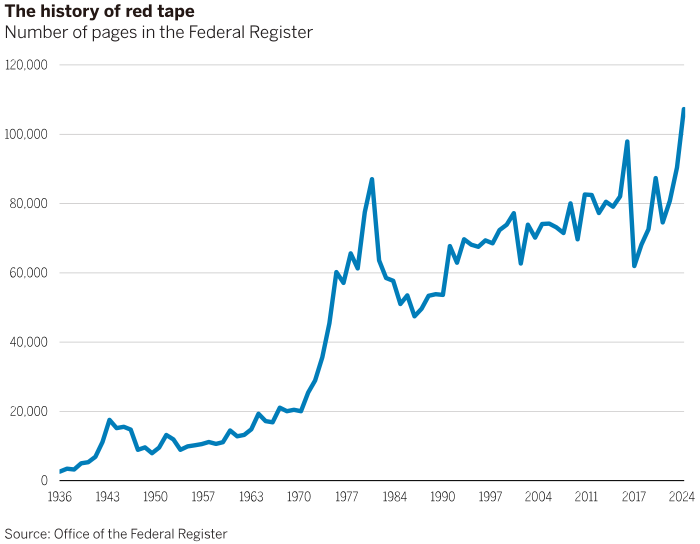
The US government’s Federal Register, a publication that documents all federal rules and regulations, offers a good indication of the growth in red tape over time. The number of pages in the Federal Register has risen steadily since it was first established in the 1930s and only two presidents have overseen a meaningful decline: Ronald Reagan and, in his first term, Donald Trump (Figure 1).
A study by the National Association of Manufacturers estimated the total cost of regulations in the US in 2022 at roughly US$3.1 trillion or about 12% of GDP.1 That marked an increase of US$465 billion from a decade earlier and includes the cost of compliance for businesses, individuals, and state and local governments.
For businesses in particular, the cost of compliance was pegged at US$1.72 trillion or an average of US$277,000 per company — equivalent to 19% of the average firm’s payroll expenses. The cost burden was significantly higher for small companies at almost US$15,000 per employee for a company with fewer than 50 employees versus about US$12,000 for a company with more than 100 employees.
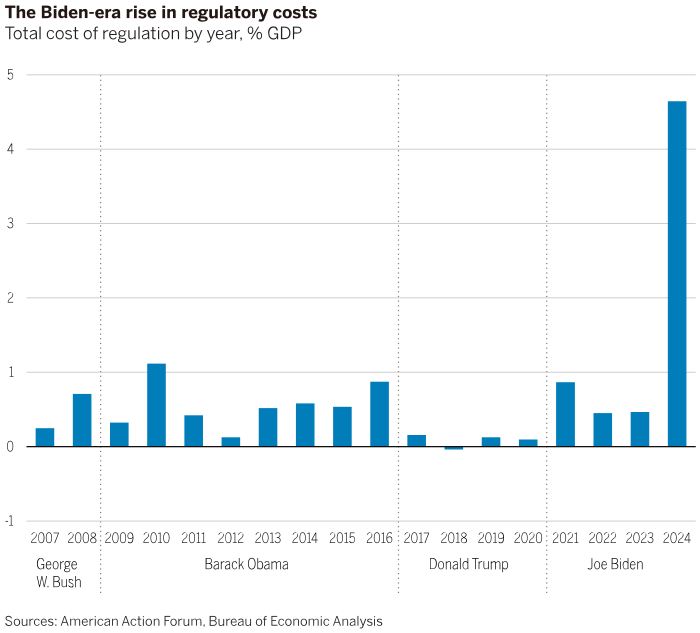
The cost of regulation skyrocketed under the Biden administration, clocking in at 6.5% of GDP over the course of his four-year term (Figure 2). A sizable chunk of this (about one quarter of the total) was driven by stricter auto emissions standards scheduled to take effect in 2027. In contrast, the cost of regulation grew by an average of 0.3% per year during Trump’s first term.
In his first term, Trump issued an executive order requiring agencies to identify two existing regulations for repeal when proposing a single new regulation. Trump’s new Executive Order, titled “Unleashing Prosperity Through Deregulation,” ups the ante significantly with a new “10 for 1” rule. It also mandates that the total incremental cost of all new regulations established in fiscal year 2025 must be “significantly less than zero” — again a more stringent requirement than in Trump’s first term, when he mandated the cost “not exceed zero.”
For the record, Trump did manage to keep the incremental cost of new regulations just below zero in 2018. Thus far in his second term, he has revoked 78 Biden-era orders, including regulations related to DEI, climate, immigration, and COVID-19.
So, what might Trump’s approach mean for businesses? I would expect this deregulation drive to reduce administrative costs, increase efficiency, encourage competition, and possibly spur innovation and investment spending. That said, the administration’s overall policy mix will ultimately determine whether the environment is favorable for new and innovative ventures. For instance, current policy uncertainty is so high that investments may be stalled as companies await clarity in the aggregate policy arc.
On its own, deregulation implies stronger growth and lower inflation over time. However, as with all regulatory shifts, the implementation details will determine the true benefits.
Finally, it’s important to note that there will be some redistributive effects of this shift — that is, there will be some economic winners and some losers. For example, I would expect smaller companies, which have less ability to scale the burden of new regulations, to benefit more than large ones. In addition, the Trump administration’s efforts to undo climate-related regulations will level the playing field between fossil fuels and green energy, with a focus on spurring production of the former (possibly at the risk of emissions standards being achieved later than would be ideal for the economy). And in the financial sector, deregulation could be a positive in the credit creation space for banks, where higher capital requirements have shackled their ability to lend to the real economy, leaving private companies to gain share.
With all of these changes, care must be taken to ensure the pendulum does not shift too far the other way and create an environment in which companies or individuals could be harmed by lax supervision or encouragement of excessive risk-taking.
1Source: National Association of Manufacturers, “The Cost of Federal Regulation to the US Economy, Manufacturing, and Small Business,” October 2023.





















Quarterly Market Review — 3Q26
Continue readingBy