
- Multi-Asset Strategist
Skip to main content
- Funds
- Insights
- Capabilities
- About Us
- My Account
United States, Institutional
Changechevron_rightThank you for your registration
You will shortly receive an email with your unique link to our preference center.
The views expressed are those of the authors at the time of writing. Other teams may hold different views and make different investment decisions. The value of your investment may become worth more or less than at the time of original investment. While any third-party data used is considered reliable, its accuracy is not guaranteed. For professional, institutional, or accredited investors only.
As inflation data has come in higher than expected recently, the number of Fed rate cuts expected by the market in 2024 has fallen from six at the beginning of the year to just one or two. By the end of April, the 10-year US Treasury yield had risen more than 80 bps year to date and the Bloomberg US Aggregate Bond Index had returned around -3%.
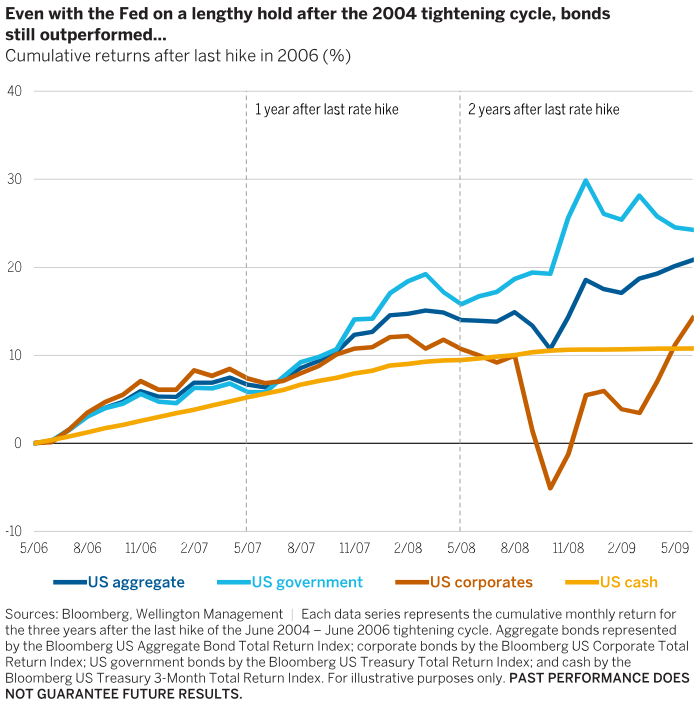
While the Fed decision to hold off on rate cuts for an extended period (it’s been nine months since the central bank stopped hiking rates) may be disappointing to the market, it does not necessarily scuttle the case for owning bonds. We saw a similar situation following the Fed tightening cycle of 2004 – 2006. The Fed hiked rates 17 times during that cycle (versus 11 in the current cycle) and then was “on hold” for 15 months before delivering the first rate cut in September 2007.
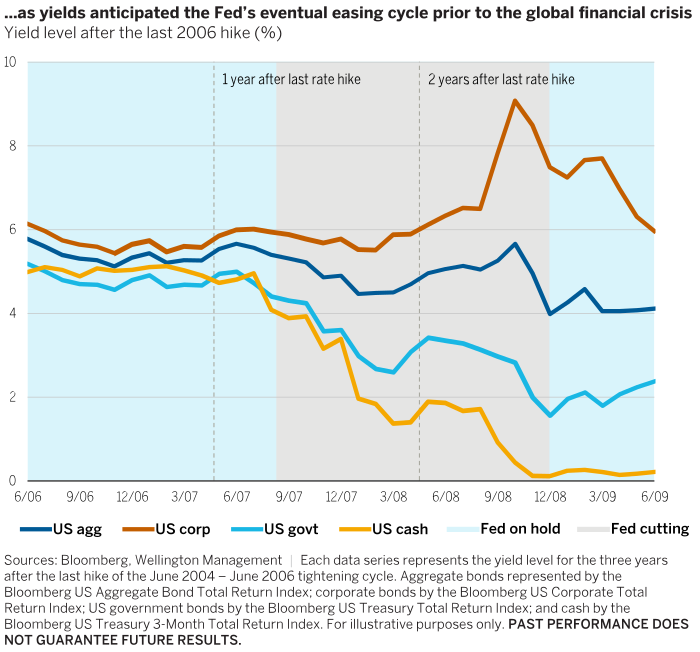
Despite the lengthy delay, bonds outperformed cash over the one-, two-, and three-year periods following the last hike in June of 2006 (Figure 1). For example, over the two years after the June 2006 rate hike, cash returned 9%, but government bonds returned 16%, the aggregate index 14%, and corporate bonds 11%. In Figure 2, we can see that yields bounced around in the year following the last rate hike of 2006 and then declined the following year as the Fed’s cutting cycle began (in September 2007), producing capital gains for bonds.
We would offer three takeaways for investors to consider:
There are risks, of course. Not long after the 2004 – 2006 tightening cycle and the rate cuts that followed, we saw the global financial crisis emerge and corporate bond spreads blow out due to liquidity strains in the financial system. Today, while not impossible, it is difficult to envision rate cuts against a backdrop of a severe recession, given that economic growth and employment are solid and there are few excesses in corporate or consumer balance sheets. We think the more likely risk is the potential for the Fed to pivot back to rate hikes if inflation remains stubbornly above its 2% target. But in his May 1 press conference, Fed Chair Jerome Powell said the Federal Open Market Committee’s working assumption is that the next move will still be a cut given restrictive policy and signs of labor market softening. He did say that it will take longer than expected to get to rate cuts, as policy tightening and other post-pandemic adjustments are working their way through the economy with a lag. But he was also more explicit about possible paths to a rate cut than a rate hike.
Experts
Weekly Market Update
Continue readingBy
JPY intervention: what makes it so important this time?
Continue readingMultiple authors
Top 5 fixed income ideas for insurers in 2026: Give ground on risk, but just a little
Continue readingAnother banner year for emerging markets local debt in 2026?
Continue readingMultiple authors
2026 Insurance Outlook: Cautious optimism and a second bite at the apple
Continue readingTop 5 fixed income ideas for 2026
Continue readingURL References
Related Insights
Get our latest market insights straight to your inbox.
Thank you for your registration
You will shortly receive an email with your unique link to our preference center
Weekly Market Update
What do you need to know about the markets this week? Tune in to Paul Skinner's weekly market update for the lowdown on where the markets are and what investors should keep their eye on this week.
By
JPY intervention: what makes it so important this time?
Fixed Income Portfolio Managers Sam Hogg and Ed Meyi and Investment Director Takashi Nakao explore what’s different about the unconfirmed but likely JPY intervention and why it matters for global investors.
Multiple authors
Top 5 fixed income ideas for insurers in 2026: Give ground on risk, but just a little
With a note of cautious optimism, we consider a range of fixed income ideas for insurers, from investment-grade private credit to emerging market debt.
Another banner year for emerging markets local debt in 2026?
Our experts highlight EM local debt's strong 2025 performance and explain their bullish outlook for 2026.
Multiple authors
2026 Insurance Outlook: Cautious optimism and a second bite at the apple
Members of our Insurance team share their economic expectations, investment ideas, and a regulatory roundup for the year ahead.
Top 5 fixed income ideas for 2026
Which areas in fixed income offer the most promising potential in 2026? Fixed Income Strategist Amar Reganti and Investment Communications Manager Adam Norman share their annual top five ideas.
Monthly Market Review — December 2025
A monthly update on equity, fixed income, currency, and commodity markets.
An active management partner for the near and long term
CEO Jean Hynes focuses on key themes driving our evolving capabilities and client collaboration, including AI's transformative potential and new thinking about equity, fixed income, and alternative allocations.
Opportunity ahead: Optimism or illusion?
Explore our latest views on risks and opportunities across global capital markets.
The spending bubble driving corporate profits looks set to burst
US corporate profits have been fueled by government deficits, low rates, and consumption — drivers now at risk, raising questions about the sustainability of market valuations.
By
FOMC: Easing into uncertainty
Fixed Income Portfolio Manager Jeremy Forster profiles the Fed's December rate cut, labor market trends, inflation pressures, and the role of anticipated changes to FOMC leaders in 2026.
URL References
Related Insights
© Copyright 2026 Wellington Management Company LLP. All rights reserved. WELLINGTON MANAGEMENT ® is a registered service mark of Wellington Group Holdings LLP. For institutional or professional investors only.
Enjoying this content?
Get similar insights delivered straight to your inbox. Simply choose what you’re interested in and we’ll bring you our best research and market perspectives.
Thank you for joining our email preference center.
You’ll soon receive an email with a link to access and update your preferences.
Monthly Market Review — December 2025
Continue readingBy