

- Commodities Portfolio Manager
United States, Institutional
Change
The views expressed are those of the authors at the time of writing. Other teams may hold different views and make different investment decisions. The value of your investment may become worth more or less than at the time of original investment. While any third-party data used is considered reliable, its accuracy is not guaranteed. For professional, institutional, or accredited investors only.
As climate change and the global energy transition reshape the investment landscape, commodities are emerging as a vital inflation hedge and a potentially effective portfolio diversifier. We believe understanding the evolving commodity market dynamics — and the sustainability frameworks that underpin them — is essential for long-term success.
Traditionally, commodities have played a central role in asset allocation, offering protection against inflation and diversification benefits. However, the forces driving commodity prices are shifting. Climate change and the energy transition are now key determinants of supply and demand fundamentals, influencing long-term price cycles and volatility. These forces are creating dislocations that active managers can exploit—unlocking opportunities for returns through active management. We presented our views at the 2025 Climate Week.
Historically commodity sustainability frameworks have often relied heavily on carbon credit offsets, overlooking the physical risks posed by climate change. These frameworks fail to capture the bi-directional impact of commodity production and consumption on the environment. Our goal was to develop a more robust framework that integrates energy transition and physical climate risks, and evaluates the complete investable opportunity set over short and long-term horizons.
Our climate integration framework assesses sustainability from both supply and demand perspectives. We analyze physical factors such as water intensity, supply concentration, and biodiversity scores alongside transition factors like emissions intensity, recycling rates, and transition demand growth. These metrics determine eligibility for inclusion in our opportunity set, ensuring that investments align with broader decarbonization, energy transition and climate resiliency goals.
As Figure 1 ranks transition elements — emissions intensity, recycling rate/content, and transition demand growth — for their ability to impact costs, drive capex needs, and support price appreciation. We evaluate physical elements — water intensity, supply concentration, physical climate risk, and biodiversity score — for their potential to disrupt supply chains and create externalities. We leverage sector-specific weightings (e.g., hydrocarbons, minerals, agriculture, power, carbon), recognizing that transition and physical risks vary by commodity class.
Figure 1
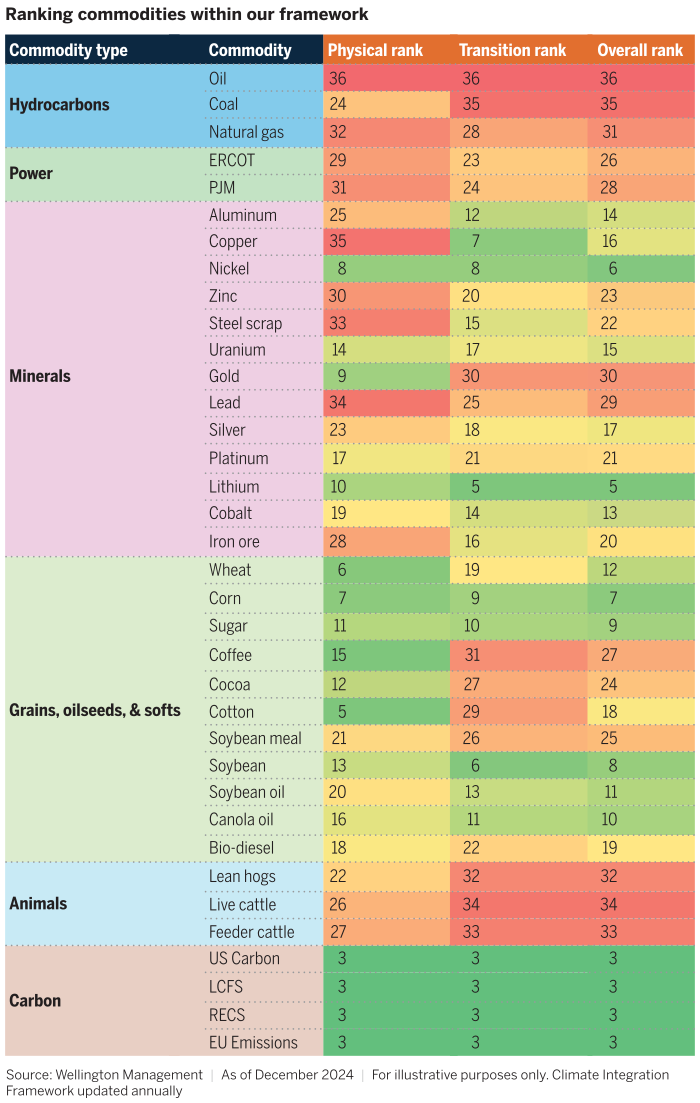
The current output of the framework reveals leaders and laggards. Carbon credits rank highest, reflecting their central role in climate mitigation. Metals such as lithium and nickel — critical for battery production — score well, while gold lags due to limited relevance in the energy transition. In agriculture, corn and soybeans stand out for their use in biofuels. Conversely, petroleum and livestock rank lowest, underscoring the need for investors to reconsider exposure to these sectors. Importantly, our opportunity set is not static. We explicitly look to account for time horizons, recognizing that the relevance of commodities changes over decades. Natural gas, for example, is an important bridge fuel today but may diminish in importance as hydrogen and other clean energy technologies scale. To reflect this, the framework includes both short- and long-term demand and share metrics. Notably, coal, crude oil, and livestock are excluded, reflecting their poor sustainability profiles.
We also re-underwrite our evaluation of commodities through this framework annually, incorporating changes in supply characteristics, technological innovation, and new commodity specifications (e.g., responsibly sourced gas, green aluminum).
Critically, this framework not only guides inclusion but also deepens our understanding of medium-term fundamentals, linking climate-driven supply and demand factors to the investment signals that drive return generation.
This integrated, multi-factor approach to investing in sustainable commodities is meant to be rigorous and dynamic, evolving with market conditions and scientific understanding. For many investors, aligning portfolios with decarbonization and energy transition goals is critical. By integrating transition- and physical-risk factors, and recognizing the limitations of current frameworks, investors can position themselves for long-term resilience and growth in a rapidly changing world.
Experts



















Monthly Market Review — August 2026
Continue readingBy