

- Head of Wellington Solutions
United States, Institutional
Change
The views expressed are those of the author at the time of writing. Other teams may hold different views and make different investment decisions. The value of your investment may become worth more or less than at the time of original investment. While any third-party data used is considered reliable, its accuracy is not guaranteed. For professional, institutional or accredited investors only.
At the start of the year, I shared how I was thinking about balancing a long-term perspective amid shorter-term bumps in the road – or “what ifs”. One of the most significant “what ifs” we were monitoring was around the threat of tariffs from President Trump – a threat that materialised in pretty spectacular fashion on April’s Liberation Day.
While recent trade deals have to some extent reduced headline risk, businesses now face a new normal: tariffs are at their highest levels since the 1930s. However, I’d argue that at this point the impact of tariffs is less important than what they tell us about the world investors are now living in.
2025 has reinforced our view that we are entering a new investing regime — one defined by greater macroeconomic volatility, diverging economic and policy cycles, and far more interventionist governments than we’ve seen since 2008. Over the last few months, we’ve seen volatility spike – caused not by a recession or bank crisis but instead by decisions made by the Trump administration to revisit international trading relationships. This reinforces our view that governments are now far more important actors in market dynamics than they have been for decades.
What makes this even more complicated is that it’s not a clean break from one regime to another. It’s a messy, transitional phase — where some old rules still apply, even as new ones might be emerging. Now we're in the second half of 2025, the real question seems to be: what are these bumps in the road telling us about how we need to evolve for a new market environment?
I use the word ‘evolve’ deliberately, because I do see it as an evolution. In biology, when the environment changes, species must adapt. To paraphrase Charles Darwin, it’s not the strongest that survive – it’s those that are most adaptable. In investing, when market regimes change, we must also evolve — evolve our frameworks, assumptions, and models — to ensure we’re managing portfolios for the world we live in, not the one we’ve lived through.
I think the evolving market environment should prompt investors to rethink three key dimensions: diversification, income, and the public/private market divide.
Diversification is being redefined. For years, a US-centric equity allocation delivered strong results. But as the narrative of US exceptionalism is questioned, investors may wish to consider a wider opportunity set. Here too we see opportunities for those who are able to adapt.
For example, I see European equities as poised to benefit from a supportive fiscal outlook and cooling inflation, but the real opportunity may lie in identifying the sectors and companies that offer the most value. While Japan is exposed to trade-related tensions, structural tailwinds such as ongoing corporate governance reforms and buybacks should not be underestimated. This isn’t to say that US equities are losing their important role within portfolios but we may need to think more carefully about them, with for example, extended strategies potentially being a consideration for investors who have concerns around concentrated markets. These strategies may give managers flexibility to underweight positions based on conviction rather than market cap.
Income has always been a central pillar of portfolio construction. But given higher inflation volatility and a lower growth environment, we need to think about the stability of income. This might prompt investors to think about how they diversify their sources of income beyond bonds. Looking at income with a multi-asset lens, across both traditional and alternative sources, may be helpful, such as dividends from equities, fixed income coupons and potentially options writing.
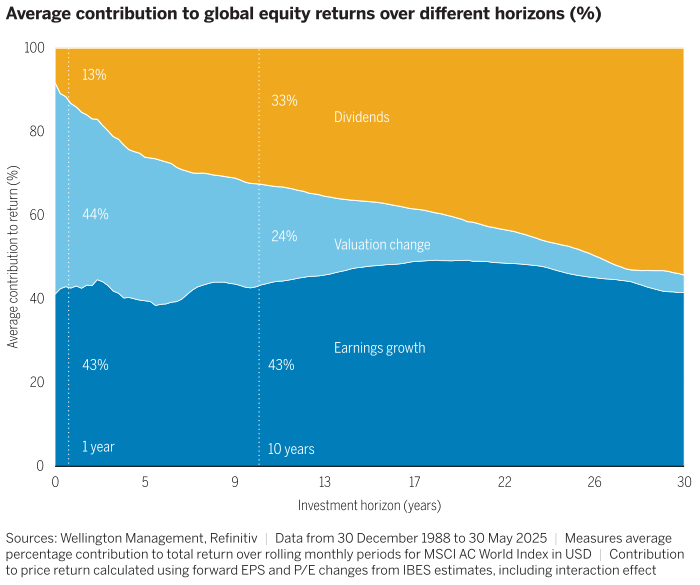
Income is a significant driver of returns for equities, particularly over longer time periods. While over one-year periods, valuation changes and earnings growth contribute roughly equally, over longer periods, dividends and earnings growth dominate, thanks to compounding. (Figure 1).
Figure 1
When trying to generate income in this new environment, we also need to be worried about the downside. Stickier inflation may continue to disrupt the traditional negative bond-equity relationship and so consider leaning into more dynamic fixed income strategies as opposed to the static ones that did so well after 2008. An active risk control process, which seeks to hedge against downside risks, may also be important here.
And then there’s the public/private shift. More of the market is now private as companies are staying private for longer. Private markets are starting to become an important consideration for a broader set of investors who are seeking to achieve multiple portfolio objectives — such as balancing returns, income, diversification and inflation protection — alongside their traditional assets.
Within Wellington Solutions, we learn how companies and governments are adapting to today's shifting environment from deep research - especially through the firm’s global industry analysts and macro strategists. By piecing together the real-world implications of policy decisions that change the outlook for a company or an economy, we gain firsthand insight into how organisations are adapting to this new landscape.
Despite markets being really challenging, our long-term view is a positive one. We’re optimistic, because as humans, we have the ability to adapt and innovate.
Republication or redistribution of Refinitiv content, including by framing or similar means, is prohibited without the prior written consent of Refinitiv. Refinitiv is not liable for any errors or delays in Refinitiv content, or for any actions taken in reliance on such content. Refinitiv’s logo is a trademark of Refinitiv and its affiliated companies. www.refinitiv.com