- Funds
- Insights
- Capabilities
- About Us
- My Account
United States, Institutional
Changechevron_rightThank you for your registration

You will shortly receive an email with your unique link to our preference center.
Stocks and bonds have traditionally held complementary roles in investment portfolios. Historically, the two have been negatively correlated, meaning when stocks have faltered, bonds have risen, offsetting equity declines.
When stocks and bonds experience a positive correlation or move in the same direction ― a defining feature of markets in recent years ― it creates portfolio-construction challenges for many types of investment strategies.
While there are many factors that can influence these relative movements, in my view, inflation expectations are the most important driver today. Prior to the war in Iran, US markets embraced a disinflationary narrative driven by potential labor displacement from continued advancements in AI.
However, the conflict in Iran has triggered an energy shock, pushing inflation expectations higher and reinforcing positive equity–bond correlations. In this environment, rising inflation drives rates higher, pressuring both asset classes at the same time. This limits the effectiveness of diversification. Outcomes become more dependent on direction rather than balance.
That said, we don’t see this as permanent. While inflation may stay elevated near term, the structural disinflationary forces — principally the impacts of AI — remain intact. As they reassert themselves, both asset classes could rally and, over time, more traditional diversification dynamics are likely to return.
Figure 1
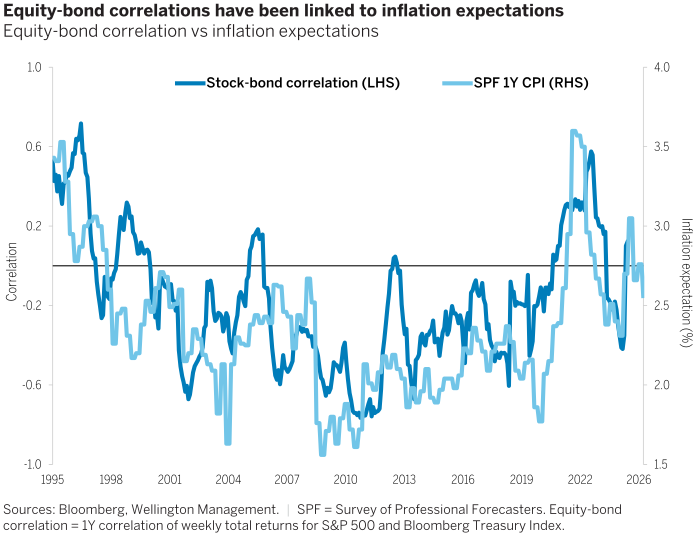
Because today’s backdrop of positive correlations, which renders traditional diversification less effective in the near term, is likely transitory, we believe a flexible, adaptable approach to portfolio construction may be prudent. Actively managed strategies may be well positioned to meet current challenges and pivot if structural disinflation reasserts itself, broadening the opportunity set and restoring traditional diversification dynamics.
The views expressed are those of the author at the time of writing. Other teams may hold different views and make different investment decisions. The value of your investment may become worth more or less than at the time of original investment. While any third-party data used is considered reliable, its accuracy is not guaranteed. For professional, institutional or accredited investors only.
Get our latest market insights straight to your inbox.
Thank you for your registration
You will shortly receive an email with your unique link to our preference center
Read more from our experts
Weekly Market Update
What do you need to know about the markets this week? Tune in to Paul Skinner's weekly market update for the lowdown on where the markets are and what investors should keep their eye on this week.
By
Loans from Federal Home Loan Banks: An opportunity for US insurers to enhance investment yield and total return
Learn why we believe FHLB loans provide compelling potential for insurers to add alpha or increase yield by borrowing at low rates and benefitting from possible favorable treatment by ratings agencies.
The growing capital intensity of the US corporate bond market
Members of our fixed income team explain how AI-driven capital expenditures are reshaping the US corporate bond market and creating potentially attractive opportunities, though selectivity is critical.
Tighter spreads, wider dispersion
Fixed Income Portfolio Managers Campe Goodman and Rob Burn share their midyear outlook for credit markets. They find that tight index spreads do not mean a lack of opportunity.
No rerun of the 2022 rates scenario but flexibility is key
Fixed Income Portfolio Manager Martin Harvey and Investment Director Marco Giordano share their outlook for rates (government bonds) for the second half of the year.
Growth outlook faces a new test: Inflation
Explore our latest views on risks and opportunities across global capital markets.
A credit investor’s perspective on inflation, fiscal policy, and AI
Paul Skinner, Investment Director, and Connor Fitzgerald, Fixed Income Portfolio Manager. explore the forces shaping the economic landscape today, from the inflation outlook and the evolving role of fiscal policy, to the transformative impact of artificial intelligence on markets and corporate behaviour. Connor shares his perspective on where opportunities and risks are emerging across fixed income and what it all means for investors positioning their portfolios in an uncertain environment.
Emerging markets: cyclical recovery or secular opportunity?
In this ActiveViews webcast Portfolio Managers Bo Meunier and Gillian Edgeworth explore whether emerging markets are at a turning point.
Multiple authors
The Iran war is changing the bond playbook
Regional wars, inflation, and shifting fiscal priorities are creating new challenges for the bond market. Fixed income portfolio manager Brij Khurana explains why investors may need to look beyond traditional core bond markets for opportunities.
By
An insurer’s guide to the public/private credit convergence
Our experts explain why insurers are increasingly focusing on integrated public and private investment-grade credit strategies and highlight potential benefits and practical considerations.
URL References
Related Insights
© Copyright 2026 Wellington Management Company LLP. All rights reserved. WELLINGTON MANAGEMENT ® is a registered service mark of Wellington Group Holdings LLP. For institutional or professional investors only.
Enjoying this content?
Get similar insights delivered straight to your inbox. Simply choose what you’re interested in and we’ll bring you our best research and market perspectives.
Thank you for joining our email preference center.
You’ll soon receive an email with a link to access and update your preferences.
Monthly Market Review — May 2026
A monthly update on equity, fixed income, currency, and commodity markets.
By