Explore our insights
Asset class
Formats

Education

Education
This is an excerpt from our Investment Outlook, in which specialists from across our investment platform share insights on the economic and market forces that we expect to influence portfolios.
Heading into the second half of 2026, investors find themselves navigating a market backdrop shaped by geopolitical shocks, persistent inflation pressures, and shifting leadership across asset classes. In this environment, portfolio construction may require an updated playbook. With that in mind, I offer thoughts below on three timely questions about diversification, alternative investments, and global opportunities, with a focus on helping investors stay grounded, selective, and adaptable as conditions evolve.
At the beginning of 2026, few could have predicted the war in Iran and its economic effects, including higher inflation. The conflict, along with other recent geopolitical events, underscores the move we’ve made from a relatively stable market environment to a volatile world that’s subject to more rapid shifts in the economic cycle. And our historical research suggests that changes in the economic backdrop may shape the effectiveness of diversification strategies.
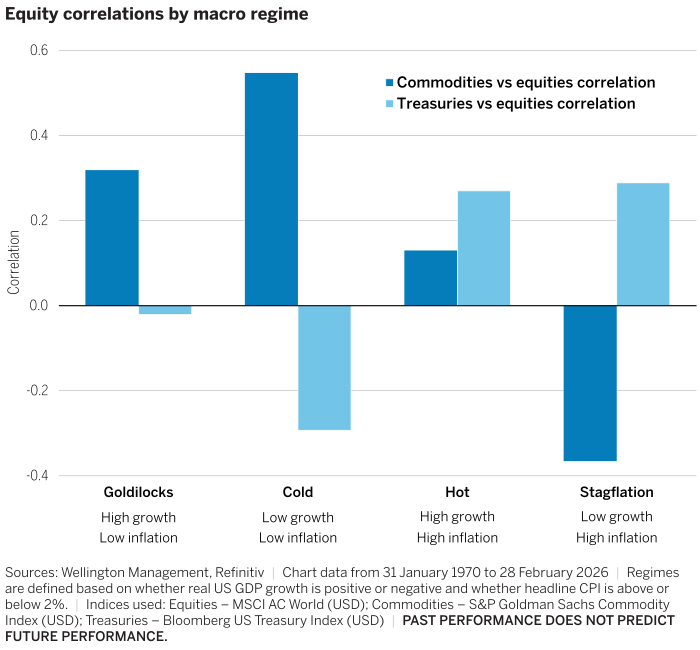
Figure 1 shows the correlations between stocks and bonds (light-blue bars) and between stocks and commodities (dark-blue bars) across various economic regimes, with each regime defined by whether inflation is high or low and whether real economic growth is positive or negative. Lower correlations typically indicate greater diversification potential. As diversifiers, bonds have been more effective in low-inflation environments and less effective in high-inflation environments, with the latter tending to be negative for both stocks and bonds. Commodities, on the other hand, have tended to stand out as a portfolio diversifier when inflation is high.
Currently, data suggests we’re in the “hot” regime shown in the chart, as inflation and growth have both been surprising to the upside. But with all the questions around the economic environment, that could certainly change.
Figure 1
Investment takeaways:
Long used by institutional investors to pursue specific portfolio objectives, alternatives, including hedge funds and private investments, are becoming more broadly accessible through new vehicles and are creating a variety of opportunities to improve portfolios.
Some hedge funds may provide returns that aren’t driven by the same market factors that drive traditional stocks and bonds. Equity long/short funds, for example, are designed to have less equity market exposure (“beta”) than long-only equities, which may help during periods of market stress. This attribute may be valuable at a time when equity market valuations are high and the market’s recent gains have been concentrated among a relatively small group of stocks.
Private investments may offer a number of potential benefits as well. In private equity, for example, investors can expand their opportunity set: Today, about 80% of US companies generating more than $100 million in annual revenue are private.1 Tapping into private equity may also enable investors to capture more of a company’s growth. That’s because companies are often staying private longer than in the past and entering the public market later in their development and at higher valuations. Waiting to invest until a company goes public could mean missing a key phase of its growth trajectory.
For its part, the private credit market has grown tremendously over the past decade or so, creating a much broader opportunity set.
Investment takeaways:
For years, we’ve seen US equities and other assets outperform other countries thanks to strong US economic and corporate fundamentals, as well as a supportive US dollar. During this era of US dominance, diversifying globally generally hasn’t paid off.
But in 2025, the return gap between US and non-US markets narrowed. US stocks were outpaced by European, Japanese, and emerging market equities. And thus far in 2026, we’re again seeing strong results from a variety of non-US markets — though the US market is no slouch.
So, is US exceptionalism still intact? As my colleagues and I argued in a recent article, the answer is yes and no. US earnings remain strong and the market and the economy are benefiting from the strength of the AI theme. But uncertainty about US policy and institutional credibility (e.g., Federal Reserve independence) has put pressure on the US dollar and raised questions about the country's perceived “safe harbor” status.
Investment takeaways:
1Sources: Private company approximate count: PitchBook as of 31 January 2026. Public company count: MSCI ACWI IMI Index as of 31 December 2025. | Number of private companies generating more than US$100 million in revenue: Morgan Stanley, “The Growing Opportunity in Private Markets,” 2026.
The views expressed are those of the author at the time of writing. Other teams may hold different views and make different investment decisions. The value of your investment may become worth more or less than at the time of original investment. While any third-party data used is considered reliable, its accuracy is not guaranteed. For professional, institutional or accredited investors only.