



- Equity Strategist
Explore our insights
Asset class
Formats
Education

Education
This is an excerpt from our Investment Outlook, in which specialists from across our investment platform share insights on the economic and market forces that we expect to influence portfolios.
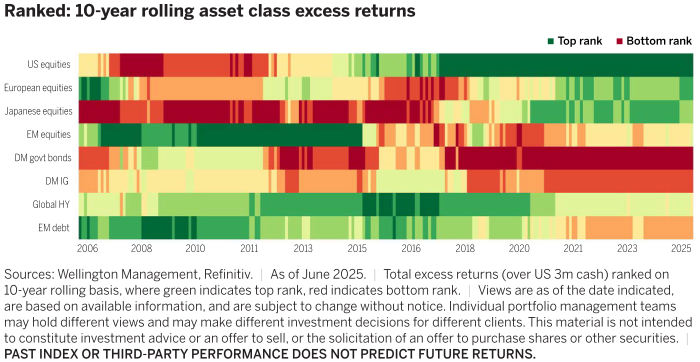
Over the last 15 years, US public companies have achieved superior performance and faster growth than the rest of the world, while also nearly systematically exceeding absolute return expectations. Coupled with favorable starting valuations, these tailwinds have delivered a prolonged period of exceptional returns for US equities, well ahead of other asset classes and markets (Figure 1). For non-US investors, these returns were further enhanced by a consistently strengthening dollar. Now, with valuations at much higher levels and growing doubts about the US’s global leadership, investors have started to ask if this US exceptionalism can persist.
Figure 1
Yet, as we look to the second half of 2026, perhaps the more accurate question to ask is not whether, but how US exceptionalism might evolve? And what can investors do to prepare? The first half of the year offers us some indication. Here we share a few observations.
With the world shifting from multilateralism to unilateralism, dispersion has returned
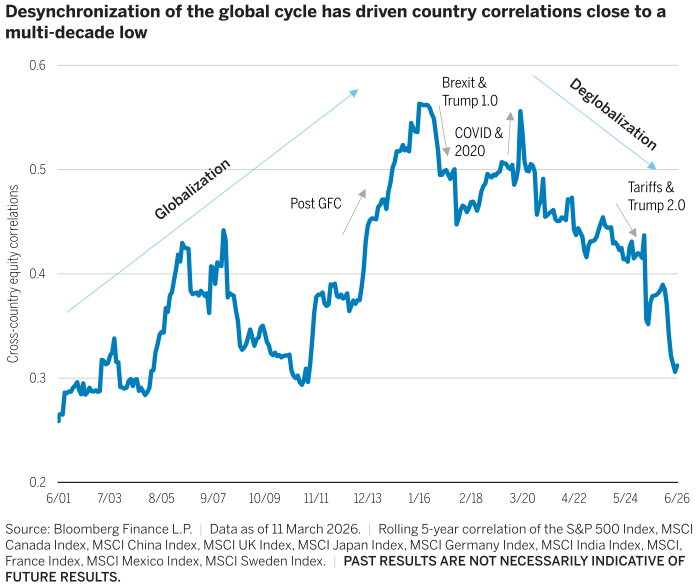
The prior economic regime of expanding globalization was characterized by synchronized global growth, high correlations in economic cycles and equity markets, low dispersion, low inflation, and falling interest rates. In a highly synchronized environment, investors were incentivized to reduce diversification and concentrate exposure into whichever asset class (or market) was delivering the best growth. During this period, anything an investor did to hedge or diversify away from the US equity market or the US dollar generally increased volatility and lowered returns. But as Figure 2 illustrates, global markets are no longer moving together in the same way. The correlation of global equity markets rose steadily from 2000 to hit a peak in 2016 — a period that in retrospect has come to signal the beginning of the fracturing of globalization. The desynchronization of the global cycle has now driven country correlations close to a multi-decade low.
Figure 2
The starting point for valuations does matter
The US equity market today is very different than it was 50 years ago. Then, capital-intensive manufacturing and industrial sectors were the beating heart of the American equity market. When the capital-light tech sector took off, the runway for growth increased exponentially, helping to fuel US exceptionalism. But now, the rapid growth in AI-related capital expenditure is drawing into question the future returns on this invested capital.
Moreover, US equities have historically earned their higher valuations through consistently delivering faster growth and outcomes that beat expectations. Now, valuations imply a bigger hurdle for future beats at a time when the positioning of the US relative to the rest of the world may be changing, while, overall, US earnings expectations remain at a multiyear high.
The US is increasingly not the only AI game in town
Exceptional US companies may continue to excel, but in this nascent stage of AI, we see plenty of room for new competitors — in the US and elsewhere — to grow, succeed, and even displace incumbents. Prudent investors will look for opportunities among new and established companies alike, both in historically dominant markets, like the US, and in others, like Asia, where innovative, new AI-focused companies have long runways to thrive.
It’s worth underscoring that while US megacap technology companies dominate the application and platform layer of AI, Asia plays a critical role in enabling the infrastructure behind it, and the region’s role in the semiconductor ecosystem serves as a good example. The region holds leading positions in materials, memory, and advanced manufacturing capabilities that we think are difficult to replicate at scale. Japan owns a significant proportion of the critical materials and tools, Korea leads memory, and Taiwan still sets the bar in advanced fabrication and packaging.
Earnings growth continues to broaden, even outside of AI-driven growth
While for the most part today’s US market leaders are still expected to deliver superior growth, especially in the broader tech space, there are reasons to look elsewhere, both in the US and beyond. Against a backdrop of stronger-than-anticipated economic growth and ongoing fiscal support, we continue to see signs of a broadening in earnings growth across sectors, market cap, and regions. This points to the potential for a wider set of beneficiaries, suggesting that investors may wish to position for more diversified sources of growth.
The US dollar remains in a tenuous position
One of the major factors supporting US exceptionalism has been a consistently strengthening currency, delivering not just enhanced returns but also “risk off” diversification benefits. This trend of persistent dollar strength has now come to an end as evidenced by the significant weakening we saw prior to the US-Iran conflict. Since then, the dollar has rallied somewhat but, longer term, it remains vulnerable to growing uncertainty about the US’s long-term fiscal position and the role of the dollar as the world’s reserve currency. The attractiveness of the dollar may be further undermined if investors start to view it as a source of risk amplification rather than risk mitigation.
US policy actions continue to drive “reflexive” responses from the rest of the world
Political drivers and objectives are now shaping economic decisions. This means investors increasingly need to look at the direction policymakers are headed in order to understand risks and opportunities.
As US policies shift away from the prior global order, other countries may have reflexive responses that could encourage their own domestic resilience and economic strength. Over time, this could narrow the gap for US growth expectations relative to the rest of the world.
Europe and Japan in particular appear to be stepping up efforts to insulate their economies from external shocks. After decades of relying on external demand, imported energy, and US-provided security, these regions are now reassessing the sustainability of that model. First, both are net energy importers and are likely to accelerate efforts to reduce reliance on fossil fuel imports. Second, Europe and Japan have historically relied not only on the US security umbrella but also on US defense technology. With future US support less certain, domestic defense capabilities are likely to become a greater priority. And finally, as major beneficiaries of globalization, both regions have long depended on exports. However, with China exporting excess capacity and the US raising trade barriers, we are likely to see an increased focus on boosting domestic demand and protecting local industries to offset external headwinds.
In our view, these regime shifts in both Europe and Japan could create winners and losers, potentially expanding the opportunity set for active managers. Moreover, European and Japanese equities are likely to offer improved diversification as their drivers increasingly decouple from the US cycle.
The problem equity investors face now is how to deal with a world in which US exceptionalism appears to be both intact and waning. An 80-year history of US economic, geopolitical, and military dominance — one that’s driven dollar primacy, powered US financial markets and, for the most part, supported global stability — is being challenged. While most of these dynamics still hold, it’s also true that the world and the US face growing turbulence in many forms: expanding regional conflicts, economic instability, and diminishing policy cohesion. The effects of this emerging dichotomy on capital markets are beginning to take shape, and asset allocators need to understand what the two truths of US exceptionalism — namely, it still holds and it’s waning — may mean for them.
Because we believe US exceptionalism remains largely intact, investors should stay invested in US equities but potentially look to broaden their exposure. However, we think that they should also be prepared to accept lower risk-adjusted returns relative to what they’ve grown accustomed to in the last 15 years, but also compared to the rest of the world, especially given high starting valuations. And because US exceptionalism is simultaneously waning, we also believe investors should balance investment in the US with increased allocations to non-US markets, both to effectively diversify US exposure and add to the potential for higher risk-adjusted returns.
The views expressed are those of the authors at the time of writing. Other teams may hold different views and make different investment decisions. The value of your investment may become worth more or less than at the time of original investment. While any third-party data used is considered reliable, its accuracy is not guaranteed. For professional, institutional or accredited investors only.
Experts