

- Fixed Income Portfolio Manager
Explore our insights
Asset class
Formats
Education

Education
The views expressed are those of the author at the time of writing. Other teams may hold different views and make different investment decisions. The value of your investment may become worth more or less than at the time of original investment. While any third-party data used is considered reliable, its accuracy is not guaranteed. For professional, institutional or accredited investors only.
“I don’t see the ‘stag’ or the ‘-flation,’ actually.” — Jerome Powell, 1 May 2024.
At the Federal Open Market Committee press conference in May of last year, US Federal Reserve (Fed) Chair Powell was asked about the risk of stagflation, and the above quote was his reply. He was right to dismiss those concerns at the time. Real GDP has since grown by approximately 2%, while core inflation has fallen from 3.6% to 2.9%.1 While that data doesn’t suggest stagflation, other recent economic indicators (detailed below) signal the rising risk of just such a scenario. In my view, it may be time for investors to consider increasing their allocation to assets that help hedge their portfolios against stagflation.
For the last few years, I have been skeptical that inflation would reaccelerate. My optimism was because the US money supply had been growing far less than nominal GDP, thanks to the Fed’s quantitative tightening (QT) program. During the COVID-19 pandemic, the Fed’s actions, combined with the government’s stimulus measures, increased the US money supply, which contributed to inflation. When the monetary stimulus was removed, inflation subsequently fell.
Two significant changes have occurred since then. First, the Fed substantially reduced its QT program in March 2025, decreasing the Treasury runoff from US$25 billion per month to just US$5 billion per month.2 As a result, the economy’s money supply is growing again, heightening the risk of accelerating inflation. Second, the US dollar has weakened. As the world’s reserve currency and the denomination for trade in commodities and a wide range of goods, a decline in the dollar’s value increases money supply outside the US.
Why does this matter?
Say the Bank of Japan suddenly decided to double the amount of outstanding yen, but the currency depreciated 50% relative to the US dollar. Japan’s purchasing power for commodities and goods would not have improved, and there would be minor impact on global inflation, given the dearth of yen-adjusted demand for goods outside of Japan. In contrast, a depreciating US dollar boosts ex-US money supply, enabling other countries to buy more goods in dollar terms with their own currencies. More money chasing goods is a formula for inflation. According to my calculations, in 2Q24, global money supply in US-dollar terms grew by about 2% year over year, well below the global growth rate. Today, the supply of money is increasing by nearly 7.8%, representing a key inflationary risk.
The August 1 US payroll report indicated that the US labor market is slowing. Private payroll growth has decelerated to its lowest level since the pandemic.3 The weakening in labor demand is offset by a parallel reduction in labor supply, due to immigration policies and an aging US workforce. This combination of factors has meant that despite slow job growth, US unemployment remains very low, at 4.2% as of this writing.
At his most recent press conference, Chair Powell implied that given the Fed’s dual mandate (to maintain maximum employment consistent with stable prices), a low unemployment rate — even if it is because of less supply — indicates a labor market in balance. I believe this view is a hawkish mistake. Less demand for labor, regardless of the amount of labor supply, still represents less economy-wide income, which is itself a threat to growth.
In my August article (also published in Financial Times), I argued that the Fed should focus on lowering policy rates to support the economy’s more interest-rate-sensitive segments, while maintaining a QT approach that slows money supply growth and inflation. Instead, the Fed is more likely to end QT completely and only gradually lower the policy rate in response to the low unemployment rate.
For asset allocators, a stagflationary environment is extremely challenging. Bond values generally decline amid inflation, and stocks tend to struggle given heightened macro volatility. There is one potentially effective category of assets to consider, however. Inflation-linked bonds, whose principal increases with inflation — thus preserving their real value — can help asset allocators hedge against stagflation.
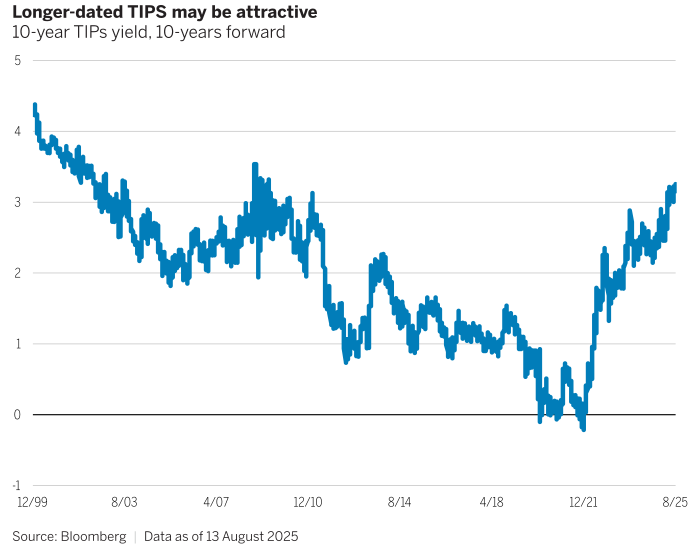
The market-implied yield on 10-year Treasury Inflation-Protected Securities (TIPS) a decade from now is 3.2% (Figure 1). This is the highest level of real (inflation-adjusted) yields since the early 2000s when the TIPS market was first created and investors considered them a cheap novelty. Given the inflation protection that TIPS represent, allocators may want to consider increasing their exposure today.
While gold is also traditionally considered a hedge against inflation (or stagflation), its recent appreciation indicates that this premium may already be included in its price. Inflation-linked bonds, however — particularly longer-dated securities — have underperformed other real assets over the past few years, bolstering their potential for long-term upside.
Today, I see signs of both the “stag” and “-flation.” Although asset allocators have few options for protecting their portfolios, TIPS are a potential solution to consider.
Figure 1
1Bureau of Economic Analysis; U.S. Bureau for Labor Statistics.
2FOMC communications related to policy normalization, Board of Governors of the Federal Reserve System, 11 April 2025 update.
3U.S. Bureau for Labor Statistics.