


- Fixed Income Portfolio Manager
Explore our insights
Asset class
Formats
Education

Education
The views expressed are those of the authors at the time of writing. Other teams may hold different views and make different investment decisions. The value of your investment may become worth more or less than at the time of original investment. While any third-party data used is considered reliable, its accuracy is not guaranteed. For professional, institutional, or accredited investors only.
Investment-grade credit has been true to its core role in 2024, serving as a cornerstone of stability, a reliable source of income, and a vital provider of overall portfolio diversification. Despite elevated volatility in equity and interest-rate markets, corporate credit has remained remarkably resilient. An extension of the credit cycle — a theme we explored earlier in the year — has resulted in an environment where spreads have remained within a range, with gradual spread tightening being propelled by strong fundamentals, a favorable technical environment, and an accommodative macroeconomic backdrop. This supportive backdrop has allowed investors to benefit from the attractive income offered by the asset class, while small, short-lived bouts of volatility have provided further opportunities to rotate portfolio exposures. As we look ahead, we assess the current state of the credit cycle and consider potential sources of opportunity for active credit investors in the year ahead.
We believe that the current environment remains supportive of credit. Companies and consumers have proven resilient to higher interest rates, driven by a private sector that has been reducing leverage since the global financial crisis (GFC). Investment-grade corporate earnings growth remains stable, labor markets are tight, and the consumer continues to show signs of strength. These factors support corporate fundamentals. Although we consider corporate bond valuations relatively elevated on a spread basis, they remain attractive from a yield perspective. Historically attractive yields have enticed a resurgence of yield-motivated buyers to the market, providing strong technical support for the asset class. Taken in aggregate, we are constructive on the cycle and see benefits for credit investors in today’s environment, where we expect spreads to remain rangebound. Looking ahead, we have identified three potential areas of opportunity for investment-grade corporate investors in 2025.
1. Elevated interest-rate volatility
As highlighted by our macroeconomists, developed market governments are embarking on expansionary fiscal policy at a time when central banks have started to cut rates, unemployment remains at historically low levels, and inflation is above target levels. While fiscal stimulus would typically support nominal growth and risk assets, the scale of government deficits represents an underappreciated risk to markets. So far, the negative correlation between yields and credit spreads has remained intact — driven by the presence of yield-motivated buyers in the market — as shown in Figure 1 below.
Figure 1
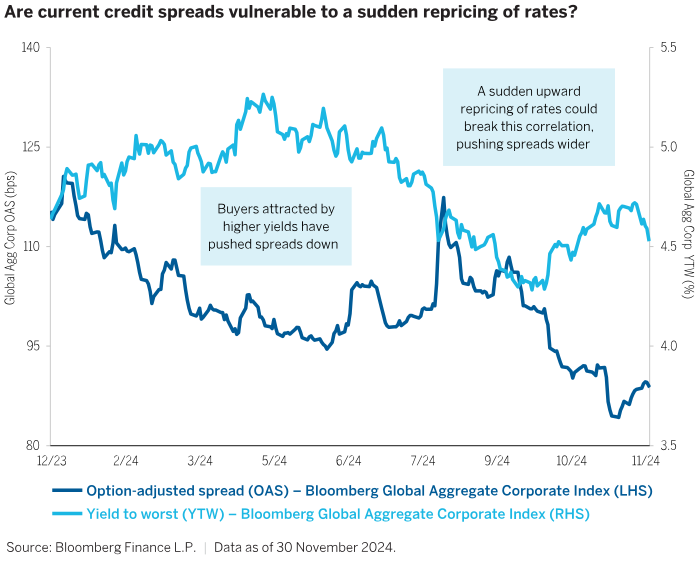
However, the market’s renewed focus on government-debt sustainability could prompt a sudden repricing of government bond yields, driving investors to demand more risk premia to be priced into assets at a time when spreads are tight, causing both an upward move in yields and a widening in credit spreads. In our view, the rate of change in government bond yields will be a key driver of risk-asset valuations. It is our conviction that this new environment calls for a greater emphasis on liquidity but also being active. Having the ability to dynamically adjust portfolio credit exposure over the cycle should help investors weather volatility and take advantage of the attractive opportunities that sudden market adjustments tend to yield.
2. Divergence across developed markets
We expect continued divergence in the growth and inflation outlook across developed market economies, a trend that is likely to be accelerated by a Trump presidency. The probable introduction of tariffs presents a significant negative growth shock to Europe. By contrast, the US stands to benefit from increased fiscal easing, domestic demand, and deregulation. Given the current lack of clarity on the impact of trade policy and the ensuing central bank and government response, we think investors should be selective in where they take risk. For instance, sectors such as European autos, materials, and consumer cyclicals are likely to bear the brunt of tariffs and the slowdown in Europe. On the other hand, we see this divergence as a meaningful opportunity for those investors who can combine local macro expertise with deep, bottom-up, fundamental sector and issuer research.
3. The return of animal spirits
Years of extreme accommodative monetary policy suppressed volatility and dispersion among credit sectors and individual credit issuers. Dispersion is returning and is likely to increase as global growth steadies and companies become more willing to explore avenues for expansion beyond organic growth, including debt-financed M&A. This shift will likely lead to increased issuance, credit-rating changes, and credit-spread volatility. In a market still characterized by tight spreads and relatively low volatility versus history, this reemergence of animal spirits may reward investors for identifying winners and losers through careful bottom-up research.
We believe that the current credit cycle remains robust, supported by strong fundamentals, technicals, and attractive all-in yields. As a result, we think investors can benefit from a pro-credit tilt while exploiting compelling bottom-up sector and security selection opportunities. However, we recognize the potential for bouts of credit-spread volatility. We believe this warrants a focus on resilience, an up-in-quality bias, and a reduction in portfolio cyclicality. We anticipate that credit-spread volatility may present further opportunities in 2025 to rotate portfolio exposures and add risk at attractive valuations.
Acknowledging the potential for increased interest-rate volatility, divergence across developed markets, and the return of animal spirits, we believe a dynamic, research-driven management of credit can help investors capitalize on opportunities as they arise.