

- Fixed Income Portfolio Manager
Skip to main content
- Funds
- Insights
- Capabilities
- About Us
- My Account
Our Funds
Fund Documents
Global Multi-Strategy Fund
United States, Intermediary
Changechevron_rightThank you for your registration
You will shortly receive an email with your unique link to our preference center.
Global Multi-Strategy Fund
The views expressed are those of the author at the time of writing. Other teams may hold different views and make different investment decisions. The value of your investment may become worth more or less than at the time of original investment. While any third-party data used is considered reliable, its accuracy is not guaranteed. For professional, institutional, or accredited investors only.
Anyone who invests in or follows the US credit markets has likely heard some version of the phrase "credit spreads are exceedingly tight" repeatedly in the past year.
What does this mean? When credit spreads are tight, it’s important to evaluate the level of compensation received for lending to a business versus the US government (as represented by US Treasuries), and how this pairs with one’s outlook for the economy and company fundamentals. Figure 1 illustrates the option-adjusted spread (OAS) of the Bloomberg US Corporate Bond Index, a proxy for US investment-grade fixed income, as a percentage of the yield-to-worst, or the lowest potential yield that an issuer can pay on a bond without defaulting, of the index. This demonstrates the relative compensation investors receive by choosing to allocate to this sector compared to US Treasuries — the higher the line is on the chart, the more compensation an investor receives for the additional risk.
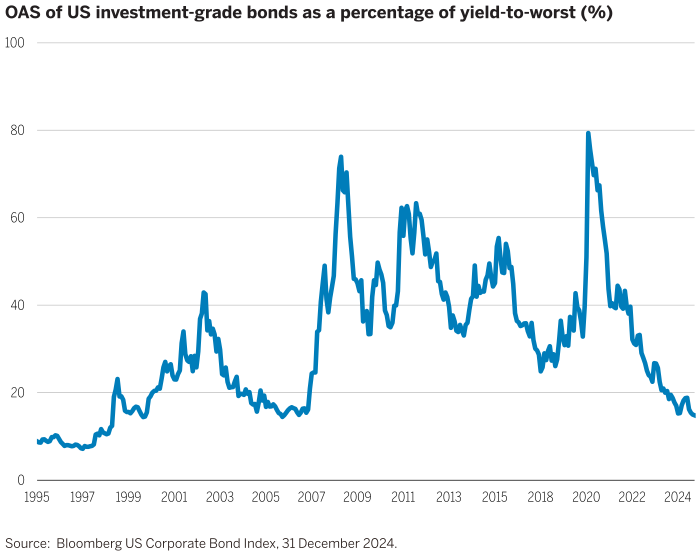
Right now, the additional compensation for lending to investment-grade companies relative to the US government is at levels not seen since before the global financial crisis, in 2007.
For the past three years, we’ve believed US Treasury volatility would exceed the volatility of credit spreads in the US investment-grade corporate market — a dynamic that’s come to pass. However, a key difference between the environment three years ago and today is that in a period such as 2022, when the US Federal Reserve was raising interest rates in an effort to tame inflation, credit spreads were significantly wider to begin with, as concerns about a recession rose. At the time, the additional spread in corporate bonds compensated investors for volatility in US Treasuries because a rise in the Treasury base rate could be absorbed by credit spreads tightening. In today’s environment, unless we are about to enter a level of OAS as a percentage of yield not seen since before the year 2000, we believe there is little scope for credit-spread tightening broadly.
Against this backdrop, we suspect it may be difficult for fixed income managers who must seek to replicate and outperform a benchmark to navigate the market effectively, given the lack of additional premium for investing in corporate bonds. Flexibility to rotate between Treasuries and credit may be crucial to mitigate credit risk in the current environment. As such, we maintain our conviction that benchmark-agnostic fixed income managers who can adjust their allocations more freely may be better positioned to navigate the current market.

Expert
Weekly Market Update
Continue readingBy
JPY intervention: what makes it so important this time?
Continue readingMultiple authors
Another banner year for emerging markets local debt in 2026?
Continue readingMultiple authors
Top 5 fixed income ideas for 2026
Continue readingAn active management partner for the near and long term
Continue readingOpportunity ahead: Optimism or illusion?
Continue readingURL References
Related Insights
Get our latest market insights straight to your inbox.
Thank you for your registration
You will shortly receive an email with your unique link to our preference center
Weekly Market Update
What do you need to know about the markets this week? Tune in to Paul Skinner's weekly market update for the lowdown on where the markets are and what investors should keep their eye on this week.
By
JPY intervention: what makes it so important this time?
Fixed Income Portfolio Managers Sam Hogg and Ed Meyi and Investment Director Takashi Nakao explore what’s different about the unconfirmed but likely JPY intervention and why it matters for global investors.
Multiple authors
Another banner year for emerging markets local debt in 2026?
Our experts highlight EM local debt's strong 2025 performance and explain their bullish outlook for 2026.
Multiple authors
Top 5 fixed income ideas for 2026
Which areas in fixed income offer the most promising potential in 2026? Fixed Income Strategist Amar Reganti and Investment Communications Manager Adam Norman share their annual top five ideas.
Monthly Market Review — December 2025
A monthly update on equity, fixed income, currency, and commodity markets.
An active management partner for the near and long term
CEO Jean Hynes focuses on key themes driving our evolving capabilities and client collaboration, including AI's transformative potential and new thinking about equity, fixed income, and alternative allocations.
Opportunity ahead: Optimism or illusion?
Explore our latest views on risks and opportunities across global capital markets.
The spending bubble driving corporate profits looks set to burst
US corporate profits have been fueled by government deficits, low rates, and consumption — drivers now at risk, raising questions about the sustainability of market valuations.
By
FOMC: Easing into uncertainty
Fixed Income Portfolio Manager Jeremy Forster profiles the Fed's December rate cut, labor market trends, inflation pressures, and the role of anticipated changes to FOMC leaders in 2026.
Financing the AI boom: credit markets at a crossroads
Fixed Income Portfolio Manager Derek Hynes and Fixed Income Investment Specialist Will Prentis examine how the AI financing boom is transforming credit markets and discuss the opportunities and risks it creates for investors.
Low tide, sharp eyes: What to pick up
Fixed Income Managers Campe Goodman and Rob Burn share their outlook for credit in 2026 and discuss how investors can reposition for an environment where opportunities are harder to find.
URL References
Related Insights
© Copyright 2026 Wellington Management Company LLP. All rights reserved. WELLINGTON MANAGEMENT ® is a registered service mark of Wellington Group Holdings LLP. For institutional or professional investors only.
Enjoying this content?
Get similar insights delivered straight to your inbox. Simply choose what you’re interested in and we’ll bring you our best research and market perspectives.
Thank you for joining our email preference center.
You’ll soon receive an email with a link to access and update your preferences.
Monthly Market Review — December 2025
Continue readingBy