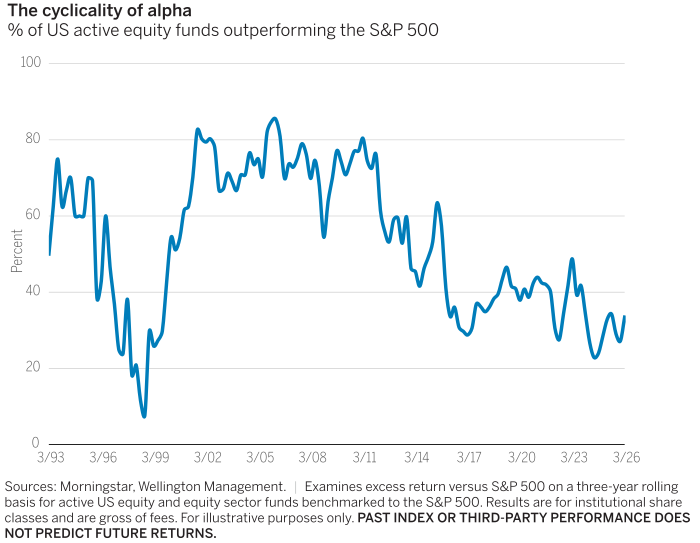
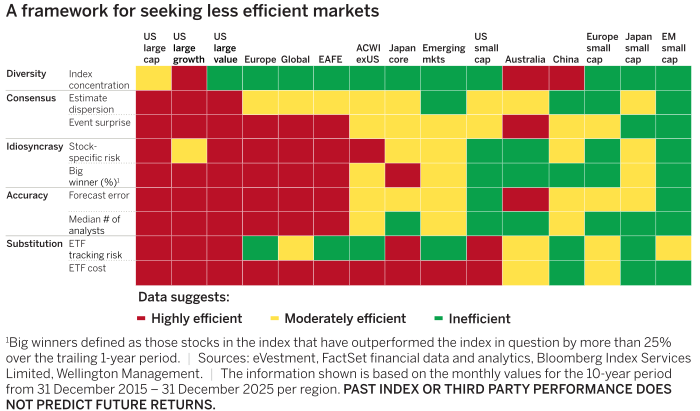
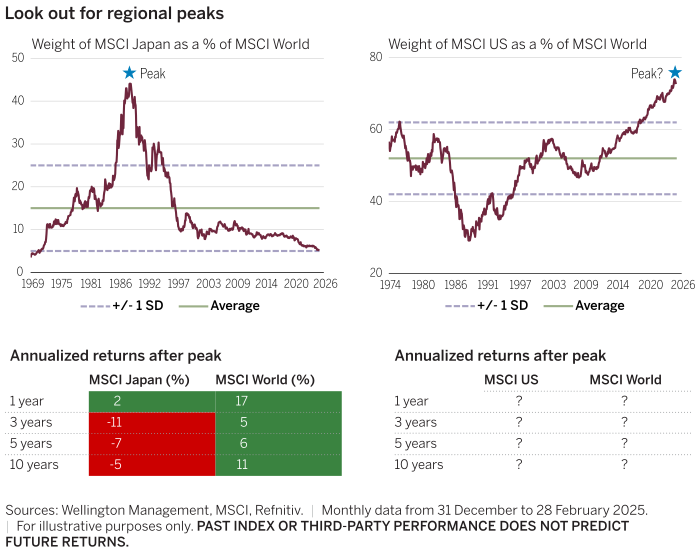
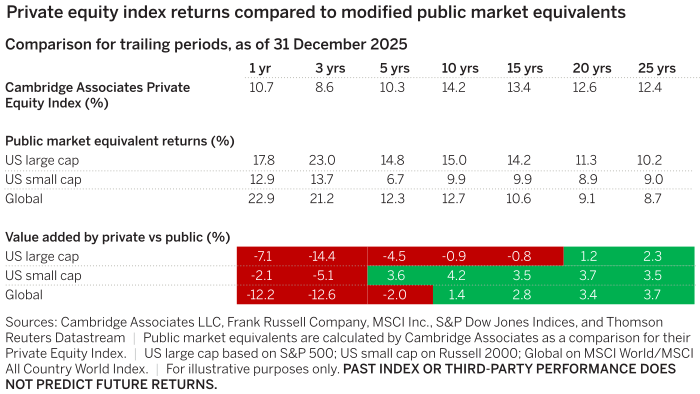
The case for public centers on lower costs, greater simplicity, and liquidity, which makes it easier to rebalance and maintain a portfolio's desired exposures and risk profile. Public investments also offer greater scalability, transparency, and benchmark-ability. And as Figure 4 shows, they can deliver very strong results.
Beyond the false dichotomy: investment ideas
Many investors I speak with see public and private markets as an increasingly integrated ecosystem and, therefore, a blend of public and private assets as the logical path forward. Pairing public and private equity in a portfolio is well established, and the approach is increasingly extending to other asset classes, including bonds, real estate, and infrastructure.
Investors also raise a variety of related implementation questions.
How should I size private allocations?
Several factors should be top of mind when setting strategic allocations to private assets, including:
- The capacity to take on illiquidity and, to a lesser extent, complexity in a portfolio
- The need for excess return beyond what public market investments can provide
- The ability to consistently allocate to top-tier strategies, given the high degree of dispersion in the performance of private equity and private credit managers
How do I maximize my “liquidity budget”?
Investors with illiquidity constraints should consider prioritizing a) private-market assets offering exposures that are difficult to obtain via public markets, and b) private-market assets with the highest potential return premium to their public-market equivalents.
With respect to the latter, they should assess whether that premium will be sustainable over time and whether it’s possible to source managers who can deliver on it. On this basis, I am more skeptical about the potential premium in core real estate and infrastructure compared to other private assets. As a thought exercise, imagine there are two comparable Class A office buildings across the street from each other — one held privately (either directly or through a fund) and the other owned by a REIT. It is difficult to see why the privately held building should deliver a significant return premium. That differs from private equity or private credit, where private ownership may offer greater scope for generating excess returns.
There’s a lot happening in private markets today. Where should I focus?
I’ll share a few of my perspectives:
- In private equity: Given elevated starting valuations in areas like US buyouts, consider niche opportunities and strategies diversified across sectors (including AI- and non-AI related sectors).
- In private credit: With significant capital competing in middle-market direct lending, consider strategies that target less-crowded segments. For example, lingering post-COVID distress may create opportunities in transitional commercial real estate debt.
- In private infrastructure: Recognize that AI-related investments may be more correlated with broad public equities — including mega-cap tech stocks — than traditional infrastructure assets such as toll roads and water utilities. Investors should ensure that allocations to IT-related infrastructure don’t carry the same downside as technology equities but with more limited upside.
Within private markets, how should I think about the role of different assets?
Because private-asset data is limited in history and frequency (and likely subject to more biases than public-market data), traditional allocation approaches based on mean-variance optimization may be less useful in determining where to go private. These approaches also tend to place public and private assets in separate buckets, even when they may serve similar portfolio purposes.
A better approach may be to evaluate each investment according to its intended role, regardless of whether it is publicly traded or privately held. For example, investors might assess public and private strategies using a consistent set of measures tied to roles such as diversification, income generation, and inflation resilience. Relevant measures could include correlation with other holdings, historical yield, and sensitivity to inflation surprises. A role-based framework does not eliminate the need for asset-class expertise or liquidity constraints, but it may help investors compare opportunities on more consistent terms and better assess the trade-offs.
What are some of the options for bringing public and private assets together?
In some cases, asset owners will take a more customized approach to public/private integration (as we see among insurance companies, for example). But I would also highlight several other approaches:
- Hybrid strategies: Managers can shift between public and private exposures based on relative opportunities. In credit, for example, they might favor public markets when spreads are more attractive and private markets when compensation for credit risk is stronger.
- Private-asset proxies: Liquid strategies across different asset classes (e.g., equities, credit, and infrastructure) can seek to replicate the return patterns of private assets. For investors who use traditional capital-call-based private asset exposures, these proxies may serve as a source of liquidity, a place to hold capital before it is called or after it is returned, or a temporary allocation for investors building private-market exposure.
- Private late-stage growth strategies: With more companies staying private longer, investors may use late-stage growth strategies to capture pre-IPO growth and broaden small-cap exposure beyond a shrinking public-market universe. In a sense, this approach uses late-stage growth strategies as “completion portfolios” for a reduced public small-cap universe.