


- Fixed Income Portfolio Manager
United States, Institutional
Change
The views expressed are those of the authors at the time of writing. Other teams may hold different views and make different investment decisions. The value of your investment may become worth more or less than at the time of original investment. While any third-party data used is considered reliable, its accuracy is not guaranteed. For professional, institutional, or accredited investors only.
Liability management exercises (LMEs) are a popular topic in high-yield, leveraged loan, and collateralized loan obligation (CLO) markets. Despite the low level of defaults, recent LME activity has increased. In this piece, we explain how we’re navigating this market dynamic.
LMEs refer to actions taken by companies to manage their liabilities. These actions can include debt refinancing, bond buybacks, and the restructuring of existing debt to improve financial stability, often at the expense of other lenders. In recent years, the market has seen an increased adoption of LMEs by highly levered issuers seeking to avoid traditional bankruptcy proceedings. This behavior is most notable in private equity-backed transactions, with sponsors often seeking to protect their equity positions, or even augment potential returns.
Figure 1 highlights LME activity (referred to as distressed exchanges) over the past seven years. As the chart illustrates, true defaults have remained below historical averages, while LMEs are telling a different story.
Figure 1
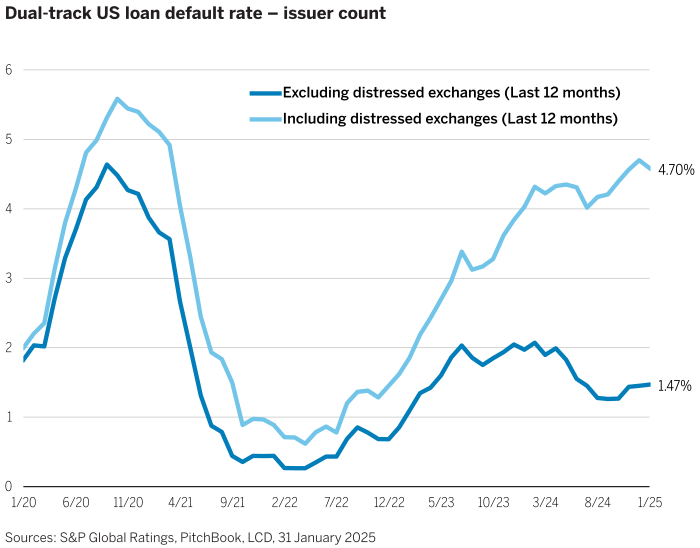
In the high-yield market, the uptick in LME activity has increased volatility among stressed names, as these exercises can materially alter a company’s debt stack (in terms of both quantum and covenants), thereby changing recovery value assumptions. LMEs now constitute more than 50% of high-yield defaults and generally have higher recovery values compared to a traditional bankruptcy. Ex-distressed debt exchanges, default rates are lower than headline figures, underscoring the current health of the high-yield cohort. Over the intermediate term, LME activity is supportive for recovery rates as well.
Currently, the high-yield market is just about the highest quality it’s been in two decades because companies have favored conservative balance management since the pandemic, regulation has constrained traditional banks’ underwriting capacity, and private credit has grown. We think private credit will continue to underwrite the weakest cohort of high yield, creating a fundamental tailwind for the traditional public high-yield market.
It’s worth noting, however, that we remain cautious on the most challenged issuers due to the increased risk of aggressive creditor-on-creditor tactics that may crystalize deep market discounts via LMEs. Fundamental research, including understanding creditor covenants, is imperative in this environment.
Arguably, the increasing prevalence of LMEs has most acutely affected the leveraged-loan market. Over the past few decades, loan covenants protecting lenders have become meaningfully looser, with more than 90% of the Morningstar/LSTA Loan Index classified as “covenant-lite” in 2024. This, combined with a fundamental deterioration in the lower-quality parts of the market, has led to a substantial increase in LME activity.
Looking forward, a potential higher-for-longer interest-rate environment means that borrowers facing liquidity concerns have increasingly engaged in LMEs to preserve liquidity and stave off default. This has required lenders to revisit their recovery assumptions and incorporate a greater dispersion among recoveries in their analyses. We believe this dynamic will endure long term because bank loan credit agreements have become less restrictive and loan investors, sponsors, and financial advisers/attorneys have become more experienced and creative in taking advantage of available options. Bank loan managers need to be increasingly vigilant in these situations and evaluate each situation individually. An investment philosophy emphasizing an up-in-quality approach, nimbleness with a preference for larger/more liquid loans, and security selection could be structurally advantageous in an elevated LME environment.
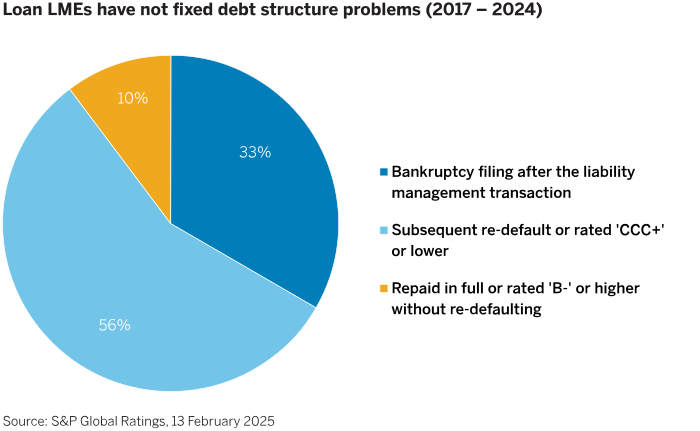
The CLO market is impacted by both the volume and severity of LMEs in the bank loan market. For example, according to S&P, almost all US broadly syndicated CLO managers had some exposure to LMEs in 2024. S&P also notes that recent LME transactions have not fixed issuer debt problems as 33% of issuers filed for bankruptcy post-LME and 56% of issuers either re-defaulted or are currently rated CCC+ or below. Only 10% repaid in full or are rated B- or better without re-defaulting (Figure 2).1
Figure 2
From a fundamental perspective, basic CLO scenario analysis includes assumptions on defaults and recoveries, which are key drivers of the performance of certain tests in the CLO structure, such as overcollateralization and interest diversion. Our view is that lower default rates and higher LMEs are competing forces that need to be factored into modeling going forward. On the one hand, defaults have stayed low because lending to B- and CCC quality issuers has increased on the private credit side. This has removed a cohort of issuers from the broadly syndicated market, which would have otherwise been challenging for CLOs to own. On the other hand, higher LME volume has increased the risk of par burn from more frequent but less severe losses on collateral.
It must be noted that CLO managers are taking steps to mitigate losses from LMEs by forming co-op groups and engaging advisers to protect their interests. LME transactions are also offering lenders equal opportunities to participate in up-tier transactions and less aggressive lender haircuts. This notwithstanding, we think increased LME activity will continue to be an area of focus for the CLO market and managers and investors should be prepared for any unpleasant surprises.
The bottom line is, across high-yield, leveraged loan, and CLO markets, experience, rigorous fundamental analysis, and risk management will likely be key to navigating this environment of higher LME activity.
1S&P Global, “U.S. BSL CLO And Leveraged Finance Quarterly: Credit Fundamentals Mostly Sunny, But Some Clouds Linger,” 13 February 2025.






















Monthly Market Review — September 2026
Continue readingBy