


- Fixed Income Portfolio Manager
United States, Institutional
ChangeUnited States, Institutional
Changechevron_right
The views expressed are those of the author at the time of writing. Other teams may hold different views and make different investment decisions. The value of your investment may become worth more or less than at the time of original investment. While any third-party data used is considered reliable, its accuracy is not guaranteed. For professional, institutional, or accredited investors only.
While stocks and bonds comprise most of the public capital markets, there’s a large, growing universe of securities sitting in between these traditional asset classes. Capital securities — an eclectic group worth more than US$1 trillion globally — include various types of hybrid securities that share both bond and equity characteristics and earn equity capital treatment. Structural nuances of each security determine how much capital treatment they might receive from a regulator or ratings agency, as well as how “bond-like” or “equity-like” each behaves (Figure 1).
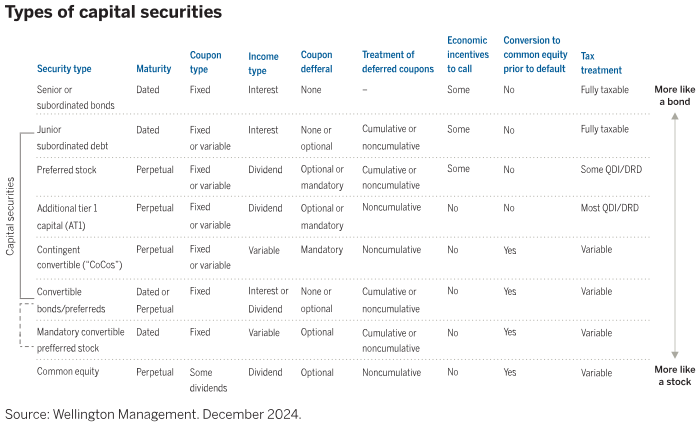
Capital securities markets have grown over the last several years as corporations have diversified their funding sources beyond traditional asset classes. This trend has accelerated recently, particularly in the convertible bond, mandatory convertible preferred, and junior subordinated debt markets.
We believe this broadening of capital markets expands the toolkit available for investors and issuers alike as both parties can opt for the piece of the capital structure best fit for their purpose. Investors can determine whether they prefer more bond-like or equity-like exposure to a certain issuer. Issuers can decide how a given structure optimizes for specific needs, such as lowering interest expense, improving capital ratios, or minimizing dilution (Figure 2).
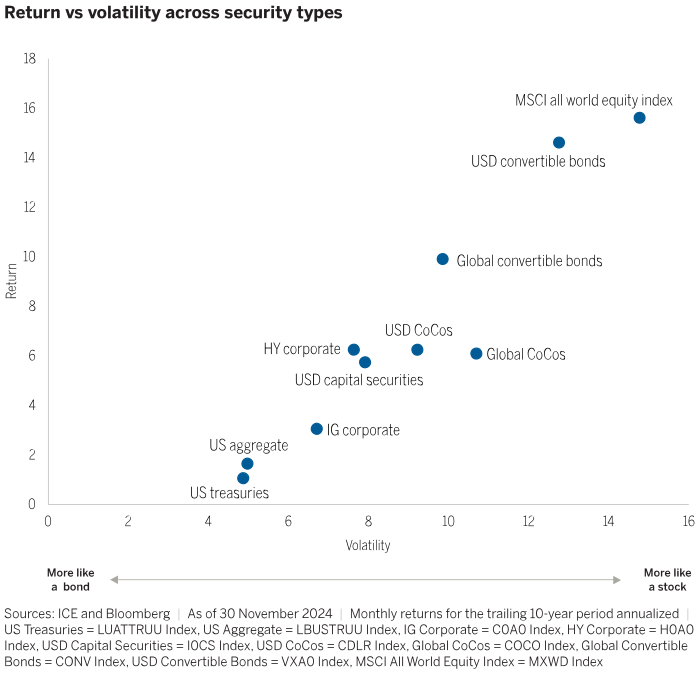
Investors able to move across the capital structure have a distinct advantage because market-specific dynamics can cause prices of certain types of securities to diverge from fundamentals, creating alpha opportunities. We find convertible bonds to be particularly compelling today as their prospect for equity participation compares favorably to the limitations of generally tight spreads and call constraints across most parts of corporate credit. We believe recent issuance trends will continue as both investors and issuers embrace the value in a broader array of capital markets.
Expert

Quarterly Market Review — 3Q26
Continue readingWeekly Market Update
Continue readingResilient growth, rising risks: Investing through the energy shock
Continue readingRapid fire questions with Jeremy Butterworth on 2026 credit markets
Continue readingSeptember FOMC: Doves capitulate
Continue readingEuropean high yield: time for selectivity
Continue readingMultiple authors
URL References
Related Insights
Get our latest market insights straight to your inbox.
Thank you for your registration
You will shortly receive an email with your unique link to our preference center
Read next

Monthly Market Review — September 2026
A monthly update on equity, fixed income, currency, and commodity markets.

Quarterly Market Review — 3Q26
A quarterly update on equity, fixed income, currency, and commodity markets.

Weekly Market Update
What do you need to know about the markets this week? Tune in to Paul Skinner's weekly market update for the lowdown on where the markets are and what investors should keep their eye on this week.

Resilient growth, rising risks: Investing through the energy shock
Macro Strategist Eoin O’Callaghan explores the drivers of resilient growth amid the continued energy shock and discusses why investors need to keep a close eye on evolving macro conditions.

Rapid fire questions with Jeremy Butterworth on 2026 credit markets
Investment Strategist Jeremy Butterworth discusses why credit markets have remained resilient despite shifting rate expectations, where dispersion is creating opportunities for active investors, and why Asia continues to offer a compelling credit opportunity set.

September FOMC: Doves capitulate
For the first time in over three years, the Fed raised the target rate range to 3.75%-4.00% in September. Our team looks at what's driving the shift and what it means going forward.

European high yield: time for selectivity
Portfolio Managers Konstantin Leidman and Thomas Kelly, and Investment Director Jennifer Martin discuss how European high-yield investors should rethink their approach in response to historically tight spreads.
Multiple authors

AI capex and the new credit cycle
Fixed Income Portfolio Managers Alyssa Irving and Liz Kleinerman, and Head of Investment Grade Private Credit Emeka Onukwugha explore the emergence of an AI investment cycle in credit markets.
Multiple authors

Band-aids, bazookas, and boomerangs: Equity investing in a volatile US rate regime
With fiscal pressures and Treasury-market fragilities keeping bond yields volatile, Macro Strategist Juhi Dhawan outlines implications for equity investors.

High asset prices, not low interest rates, are driving inflation
Wealth distribution in the US has rendered the Federal Reserve’s usual tools less effective. The Fed will need to address asset prices head-on in creative ways if it is going to return inflation to target.
By

How AI is impacting the high yield market
Fixed Income Portfolio Manager Blake Huynh examines how AI is reshaping the high-yield market using the latest issuance data. He explores what this transformation may mean for investors.
By
URL References
Related Insights
© Copyright 2026 Wellington Management Company LLP. All rights reserved. WELLINGTON MANAGEMENT ® is a registered service mark of Wellington Group Holdings LLP. For institutional or professional investors only.
Enjoying this content?
Get similar insights delivered straight to your inbox. Simply choose what you’re interested in and we’ll bring you our best research and market perspectives.










Monthly Market Review — September 2026
Continue readingBy