
- Fixed Income Portfolio Manager
United States, Institutional
Change
The views expressed are those of the author at the time of writing. Other teams may hold different views and make different investment decisions. The value of your investment may become worth more or less than at the time of original investment. While any third-party data used is considered reliable, its accuracy is not guaranteed. For professional, institutional, or accredited investors only.
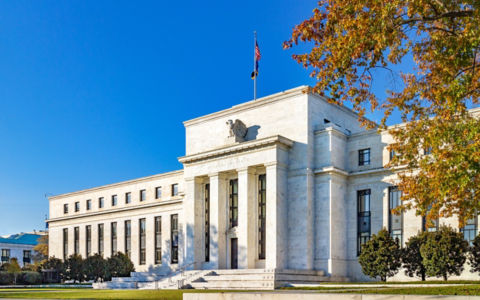
At its June policy meeting, the Federal Open Market Committee (FOMC) held interest rates steady at a range of 4.25% to 4.50%, the level that has prevailed throughout 2025. In its updated projections, the US Federal Reserve (Fed) downgraded its growth forecasts and increased its inflation and unemployment rate forecasts. It now expects inflation to remain above its 2% target through the end of 2027. The median Committee member still expects to cut interest rates twice by the end of this year, closely matching the outlook of market participants, based on futures pricing.
The unemployment rate has held remarkably stable around 4.2% since last July — still likely a touch below the non-accelerating inflation rate of unemployment (NAIRU), meaning tight labor markets are still contributing modestly to inflation pressures, based on my assumptions. Payroll gains have slowed, a trend I anticipate will continue, which should give the Fed more confidence that inflation pressures will ease and enable the central bank to resume cutting policy rates in the second half of the year.
While tariffs pose upside risks to inflation, their timing, magnitude, and duration remain uncertain. In his post-meeting press conference, FOMC Chair Jerome Powell stated that he expects most businesses to pass on at least some tariff-induced price increases to customers, which is the main driver of the increased inflation forecasts. Chair Powell also noted that individual Committee members’ views on inflation pass-through led to the increased dispersion in individual forecasts for appropriate policy rates. While Chair Powell indicated that the Fed is well-positioned to wait to determine tariffs’ impacts on inflation and economic developments in setting appropriate policy, additional clarity should help to narrow the views on such policy, which could range from no change to a 75 bps reduction over the remainder of the year.
Elevated geopolitical uncertainty, driven most recently by escalating tensions in the Middle East, generally doesn’t have much impact on monetary policy decisions. The spike in oil prices to more than US$74/barrel is not yet at levels that would meaningfully reduce consumers’ disposable income and weigh on summer travel plans. However, this is a risk to monitor should the conflict become prolonged. To determine policy, I expect the Fed to look through the recent rise in energy prices and continue to focus on core inflation, which strips out volatile food and energy prices.
I consider the current situation very different from 2022, when oil prices rose above US$123/barrel following Russia’s invasion of Ukraine at the same time the Fed was beginning to hike policy rates. Compared to that period, the current US consumer outlook is more fragile, global supply chains are less constrained, and the starting point on headline inflation is much lower.
My base case is that the Fed will cut policy rates twice this year (by a total of 50 bps). While growth has slowed, inflation remains above the Fed’s target and is set to move higher as a result of tariffs and reduced labor supply from immigration policies. But I think the Fed will prioritize managing against downside growth risks and allow inflation to remain above target, particularly if the unemployment rate is moving higher. Policy is still restrictive — as can be seen in slowing employment and economic growth — and is becoming more restrictive compared to several developed market peers, which should leave scope for the Fed to cut interest rates without triggering excessive easing of financial conditions or an acceleration in demand-driven inflation.
While uncertainty surrounding tariffs and the US budget remains, I see reasons to be optimistic about US growth prospects in the months ahead. The “One Big Beautiful Bill” will add fiscal stimulus, some of the DOGE aspirations appear to be unwinding, and I expect the Trump administration to shift its agenda toward deregulation in the second half of the year. Add to this potential monetary stimulus and I think the Fed remains on track to achieve the elusive “soft landing” for the US economy.