United States, Institutional
Change



The views expressed are those of the authors at the time of writing. Other teams may hold different views and make different investment decisions. The value of your investment may become worth more or less than at the time of original investment. While any third-party data used is considered reliable, its accuracy is not guaranteed. For professional, institutional, or accredited investors only.
Policy and geopolitical risk are rising in almost exponential manners. Policy communication, still-sticky inflation, and rapidly cooling economic data all have added substantial turmoil to markets. In this environment, it’s easy for allocators and end-asset owners to feel powerless amid the chaos.
One potential solution? Consider adding to fixed income allocations.
The problems: Breaking down the backdrop
Over the course of early March, fixed income markets rallied as risk assets sold off. As the new US presidential administration launched the largest tariff increase in nearly a century, markets struggled with which effects — slower growth or higher inflation — would translate into pricing. The answer came as US Treasury yields moved broadly lower, reflecting heavy concerns about slowing growth. To understand these dynamics, it’s necessary to break down the political and economic backdrop.
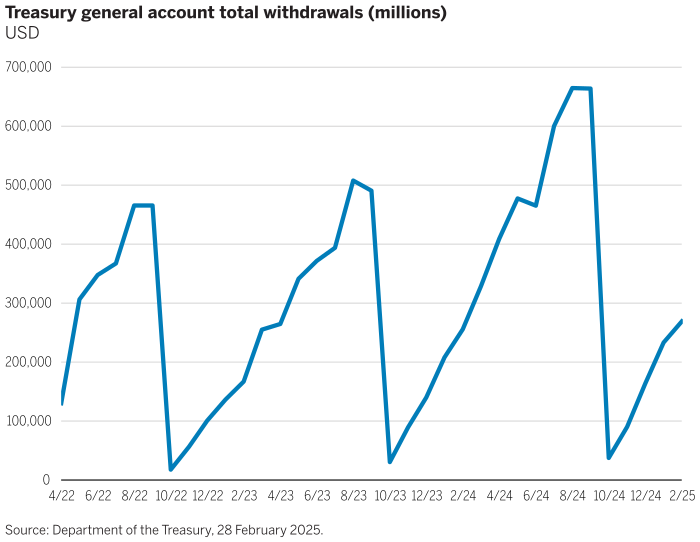
While the stated goal of the second Trump administration is a reduction in government spending, current policy has added a substantial amount of opacity about fiscal outlays. Consumer and business confidence has declined, likely with adverse consequences for spending and capex decisions. Indeed, this pushback on animal spirits occurs at a time when government spending is currently running higher than 2024 levels (Figure 1). Year-to-date spending for the first two months of 2025 was US$269 billion, up from US$255 billion for the same time frame in 2024.
Figure 1
Congress passed a budget resolution that extended current government spending through the US fiscal year ended 30 September 2025. While the resolution averts a government shutdown for the time being, a larger debate still looms as Republicans seek an extension of the 2017 Tax Cuts and Jobs Act (TCJA), set to expire at the end of this year, along with cuts to several social programs.
The tax cuts themselves, which are an extension of policies already in place, are unlikely to produce additional stimulus. Paring back services to pay for them, which the resolution aims to do through reducing Energy & Commerce Committee spending by more than US$800 billion, could have an immediate impact on aggregate demand. This spending is linked to Medicaid, and given the matching state funds that often accompany Medicaid, we’re likely to see a fiscal drag on demand.1
On top of these changes and the increased spending so far this year, the labor market is in stasis and consumer confidence continues to weaken. Labor demand has cooled rapidly so far this year, with layoffs only just beginning and pauses in hiring portending further labor-market deterioration.
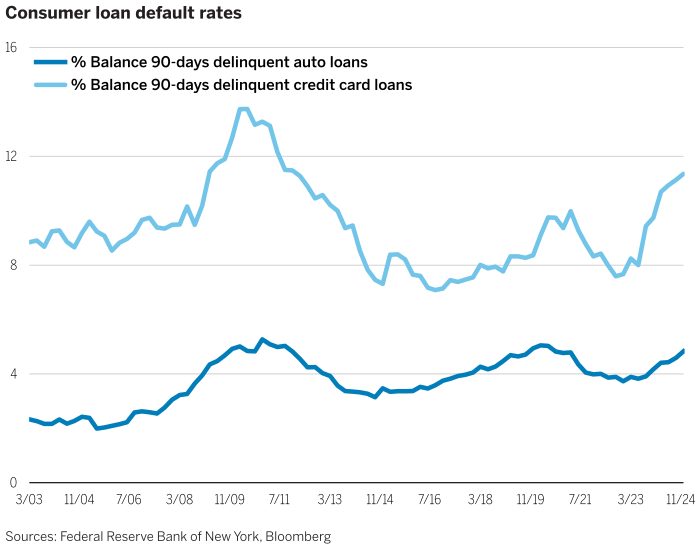
Initial job losses will be reflected in federal employees and contractors. While these represent a small portion of total payrolls, the sheer size and speed of federal layoffs will likely have spillover effects in labor sentiment. This comes at a time when portions of the consumer market are weakening, with 90-day delinquencies rising to multi-decade highs in auto loans and credit card balances (Figure 2). Importantly, tariffs could weaken consumer demand right when the labor market is cooling.
Figure 2
The potential solution: Implementing fixed income
Against this backdrop, we argue that while a fixed income allocation is always a compelling component of a broader investment portfolio, now it’s more important than it’s been in recent memory. But, of course, there’s more than one way to allocate to fixed income. In our view, prudent investors may wish to do the following:
- Be active, be flexible: Adhering to pure benchmarks during a time of volatility and uncertainty is likely to diminish returns rather than enhance them. While growth could slow, inflation could remain sticky, presenting a stagflationary impact. Here, dynamic fixed income strategies will likely fare better than rigid, benchmarked strategies.
- Go global: Bond markets abroad have come alive. Often, when hedged back to US dollars, international fixed income can potentially offer a more attractive return with additional diversification.
- Remember, not all fixed income is created equal: We expect credit markets to continue to perform, but be mindful of issuer and sector selection. This will be critical for risk management.
- Consider yield: Yields are still attractive from a historical perspective and may offer substantial carry and cushion to total return.
The political and economic narrative is likely to see-saw back and forth as policies are announced, withdrawn, and rescheduled, but the net effect is potential market volatility. While the underlying US economy remains in good shape (without the strategic imbalances that were endemic in the era leading up to the 2008 global financial crisis), headwinds exist, and investor vigilance is necessary. We believe that as these new paradigms take root, fixed income could remain a well-yielding harbor.
1The final draft of the bill may include additional tax stimulus either in increasing the SALT cap or having no taxes on tips.
























Monthly Market Review — August 2026
Continue readingBy