


- Fixed Income Portfolio Manager
United States, Institutional
Change
CLO equity has grown in popularity in recent years as asset owners have sought to diversify their portfolios and, in many cases, have turned to specialized credit strategies. Notably, asset owners often have a practical question when considering CLO equity allocations: “Where does it fit in my portfolio?”
This paper explores the role of CLO equity within an asset allocation framework, particularly in relation to three prominent parts of many portfolios: private equity (PE), private credit (PC), and public equity.
What are CLO equity’s key characteristics?
First, it’s essential to understand two characteristics an allocation to CLO equity can bring to a portfolio:
CLO equity's role in asset allocation
So, what do these features mean in practice? In our view, CLO equity can help solve three of today's most common asset allocation challenges: slowing distributions in private equity, falling yields in private credit, and the need to maintain public equity-like returns in the face of high valuations and volatility.
#1 – Slowing distributions in private equity
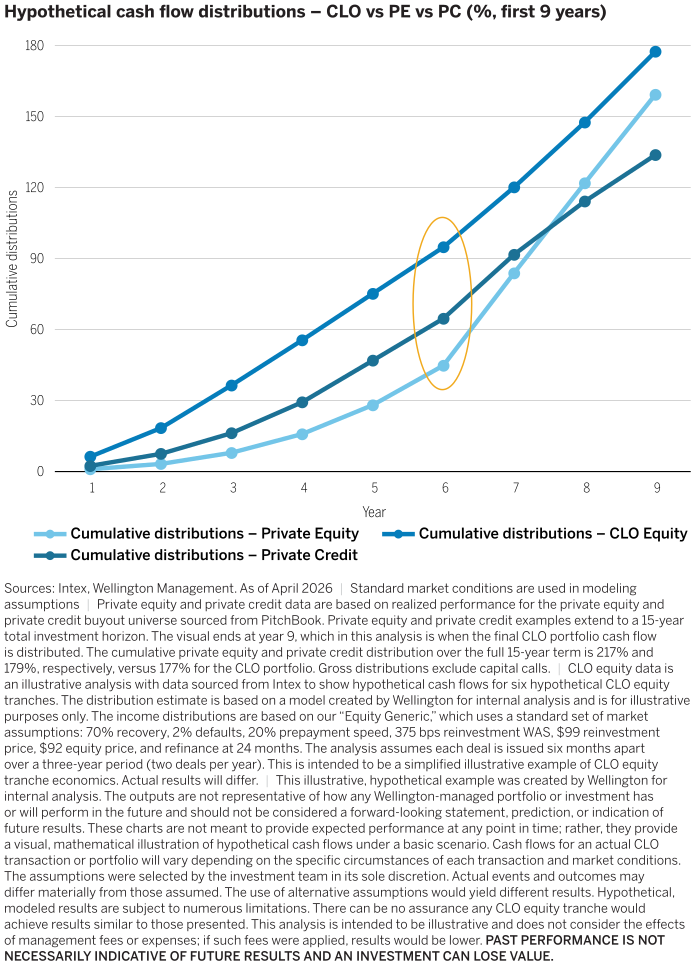
As allocators have seen their distributions slow in the private equity portion of their portfolio, there is a growing desire to increase cash flows in other parts of their portfolio. Critically, PE vintages can be heavily impacted by the exit environment, creating a correlation between realized IRRs and IPO/M&A activity. While forward M&A activity is always hard to predict, we believe the uncertain growth outlook for the US economy over the next 12 – 24 months makes it likely the extension environment could persist.
Conversely, CLO equity returns are driven by a steady source of income, and their realized returns generally have a higher correlation to the difference in spreads between the loan and CLO liabilities markets. Though CLO equity’s historically mid-teen IRRs are lower than some parts of PE, they are higher than many areas of credit. The offset is it also provides higher income and, crucially, income that pays at the highest rate early in the life of the investment.
In our analysis, we model a hypothetical CLO drawdown portfolio hitting a 1.0x distributions-to-paid-in (DPI) by year six versus PE buyout hitting 0.4x by year six (Figure 1). Though the average PE fund has a higher cumulative distribution over the long term, it is over a longer horizon. We believe an allocation to CLO equity can help mitigate this ongoing DPI problem.
Figure 1
#2 – Rate sensitivity of private credit
Direct lending, which is the largest private credit allocation for many asset owners, historically has yields around 10% (versus CLO equity’s roughly 17% over the same period).4 Moreover, direct lending has seen all-in yields decline as short-end rates have come down from peak in 2023/2024 and competition has compressed lending spreads.
For asset owners considering CLOs as a complement to private credit, it’s important to note that direct lending has substantial rate sensitivity. Direct lending’s coupons generally float off the Secured Overnight Finance Rate (SOFR) to which the asset class has a beta of ~0.9.4 SOFR was elevated in 2023/2024 as the Fed was fighting inflation but as it has moved lower, direct lending’s income returns have felt the impact. In contrast, CLO equity has low sensitivity to SOFR and historically has a beta of -0.4.5
We believe that if investors do not have a strong view on the path of short-term rates in the US, CLO equity can provide a reliable way to maintain income, while hedging some of the significant rate sensitivity present in their direct lending allocations.
#3 – The need to maintain equity-like returns
In this environment, to keep up with their liabilities, many asset owners feel it is critical to maintain equity-like returns. But many are understandably contemplating the role public equities play in their portfolio given that forward-looking returns for public equities may be lower than the historical averages. For example, our 10-year capital market assumptions project global equities earning 4.6% annualized (and US equities even lower).6 This is due to the combination of high starting valuations and potential headwinds such as rising interest rates, geopolitical uncertainties, and slowing economic growth. In our view, for investors that can tolerate some illiquidity, CLO equity can mitigate these risks by helping asset owners diversify away from their valuation dependence to a steadier form of income. This more stable income generation can provide an additional layer of diversification on top of CLO equity’s low historical correlation to equity markets.
CLO equity’s potential risks
Importantly, though it can help solve these asset allocation problems, CLO equity is a highly complex asset class and is certainly not without risk. The asset class experiences high mark-to-market volatility and periods of risk-off with meaningful drawdowns. The asset class would not perform well in a period of significant defaults. Manager, vintage, and deal structure can also lead to substantial dispersion in deal outcomes. These are key reasons why we think of it as a complement to other risk assets.
Bottom line on CLO equity in an asset allocation
By positioning CLO equity alongside private equity, private credit (MMDL), and public equity, we believe asset owners can potentially enhance overall portfolio diversification and income potential and address some of today’s biggest portfolio problems.
1Sources: BofA Global Research, PriceServe, Intex. Based on the median annual equity distributions for US Broadly Syndicated CLO equity tranches from April 2014 to 31 December 2025. | PAST RESULTS ARE NOT NECESSARILY INDICATIVE OF FUTURE RESULTS. | 2Diversification does not guarantee profit or protection against losses. | 3Sources: Citi, WMC. Correlation based on gross monthly total returns since inception of the Citi Post Crisis Index 1 January 2013 through 31 December 2025, which shows the monthly total return for the weighted average of outstanding CLO equity tranches. | PAST RESULTS ARE NOT NECESSARILY INDICATIVE OF FUTURE RESULTS | CLO Equity reflects index returns only to illustrate the historical characteristics of the asset class and does not reflect any portfolio managed by Wellington. This does not reflect any fees or expenses associated with investing in a managed portfolio. Indices are unmanaged and cannot be invested indirectly. | 4Sources: BofA, Cliffwater Direct Lending Index. Data reflects total income distributions in 2025. | 5Sources: Cliffwater Direct Lending Index, BofA Global Research; From 31 March 2013 through 31 December 2025. | Reprinted by permission. Copyright © 2025 Bank of America Corporation (“BAC”). The use of the above in no way implies that BAC or any of its affiliates endorses the views or interpretation or the use of such information or acts as any endorsement of the use of such information. The information is provided "as is" and none of BAC or any of its affiliates warrants the accuracy or completeness of the information. | PAST RESULTS ARE NOT NECESSARILY INDICATIVE OF FUTURE RESULTS. | 6This reflects Wellington Management’s Solutions Group intermediate capital market assumptions as of 31 March 2026 for various asset classes. Intermediate assumptions reflect a time period of approximately 10 years. They are assumed nominal returns that are expressed in annualized, geometric terms. Return assumptions are shown for unhedged currency exposure (unless otherwise stated) using the US dollar as the base currency. This is for illustrative purposes only and the returns and other assumptions provided are hypothetical and not representative of an actual account or Wellington Management strategy. As the analysis relies upon assumptions and other expectations of future outcomes, it is subject to numerous limitations and biases including subjectivity. Data does not consider transaction costs, management fees, or other expenses associated with actual investing. ACTUAL RESULTS MAY VARY SIGNIFICANTLY AND AN INVESTMENT CAN LOSE VALUE. Investments cannot be made directly into an index. | Please review in conjunction with the “Important disclosures – Capital market assumptions.” | This material is not intended to constitute investment advice or an offer to sell, or the solicitation of an offer to purchase shares, strategies or other securities. References to future returns are not promises or even estimates of actual returns a client may achieve.
The views expressed are those of the authors at the time of writing. Other teams may hold different views and make different investment decisions. The value of your investment may become worth more or less than at the time of original investment. While any third-party data used is considered reliable, its accuracy is not guaranteed. For professional, institutional, or accredited investors only.
Experts