



- Sector Lead, Asia
United States, Institutional
Change
The views expressed are those of the authors at the time of writing. Other teams may hold different views and make different investment decisions. The value of your investment may become worth more or less than at the time of original investment. While any third-party data used is considered reliable, its accuracy is not guaranteed. For professional, institutional, or accredited investors only.
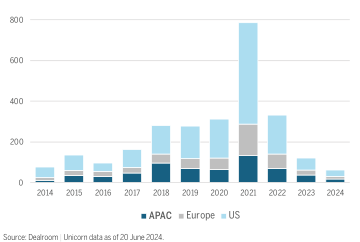
Asian venture capital (VC) markets are undergoing a decade-plus expansion that has seen assets grow 21x from 2011 to 2022 (Figure 1). The surge in available capital has been a driving force for innovation and entrepreneurship across Asia, fuelling the growth of 594 unicorns by 2024 from just nine in 2014 (Figure 2).
But as with any growth story, peeling back a few layers reveals the opportunity set is just as complex as it is exciting. In our view, it is a mistake to assume that Asian VC markets operate in the same way as their Western counterparts, and investors should carefully navigate the key differences between them to translate this growth into strong performance.
Is the power law a fallacy in Asia? Is Asian venture capital overcapitalised? Where do we see VC opportunities in the region? We explore these questions and our recommended best practices for VC investors and private companies in the region.
Notably, this paper covers Asia ex China, which has a distinct venture ecosystem that we believe warrants its own focused analysis.
Figure 1: The growth of the VC market in Asia

Figure 2: Unicorns by region
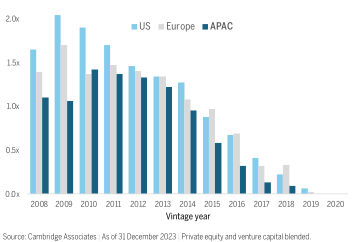
Despite Asia’s rapidly growing ecosystem, the performance of Asian venture capital and private equity funds has generally lagged their Western counterparts. Historically, Asian funds have returned 40% and 20% less than their peers in the US and Europe, respectively (Figure 3). This has ultimately manifested in less money distributed to LPs, seen in distributions to paid-in (DPI) ratios that are 15% – 25% lower than Western funds (Figure 4).
Figure 3: Private equity and venture performance by region

Figure 4: DPI by region
What is driving this relative underperformance? In our view, it is critical to dive deeper than surface-level metrics to identify the unique characteristics that differentiate the Asian VC opportunity set from its Western counterparts.
Is the power law a fallacy in Asia?
The power law of venture capital maintains that a small number of startups deliver the majority of returns for a fund. While this is generally accepted as fact in the US and Europe, we believe that investors may overstate the significance of the power law in Asia. Comparing the five largest venture-backed IPOs between the two regions helps demonstrate this point:
Figure 5: Five largest IPOs by region

The difference in scale is likely due to the regional focus of many venture-backed startups in Asia, which are frequently localised versions of Western successes. These companies can be leaders in their respective regions but often struggle to expand outside of them, resulting in smaller total addressable markets (TAMs). Additionally, these startups frequently compete with global players in their local markets, which in many cases could limit or delay their market potential. For example, Coupang and Amazon competed in the South Korean e-commerce market. Though the former is now the leader in its region, the data above shows it is clearly not to the scale of the latter globally.
In fact, scaling up in Asia generally takes longer, leading to extended times to liquidity events like an IPO. This delay is often due to the need for companies to build underlying infrastructure before achieving significant growth. A simple example would be that of an e-commerce business building out everything from logistics to payments instead of just adding a software layer on top of existing infrastructure available to many Western startups.
Are Asian VC markets overcapitalised?
With these unique factors in mind, we believe many Asian VC funds may overestimate potential investment outcomes, leading to overcapitalisation of startups. This, in turn, further pushes out the liquidity window for companies, potentially contributing to the lower DPI noted above. For instance, a startup valued at US$500 million after raising US$250 million would need to reach a valuation of US$1.5 billion to ensure a successful IPO with sufficient float for its shareholders whereas a company with a leaner capital table would have a much easier path to listing, even at the US$500 million valuation.
Take Southeast Asia (SEA) as an example. The five largest SEA-focused venture funds formed in 2021 – 2022 cumulatively raised ~US$2.5 billion. Figure 6 illustrates the dilemma this presents:
Figure 6: Are Asian VC markets overcapitalised?

The value creation these assets require is a tall task, considering that the combined market value of all VC-backed IPOs in the region over the past five years amounted to US$9 billion.1
While these dynamics may seem like significant challenges, we believe the outlook for Asian venture capital is far from bleak. In our view, numerous markets in Asia offer companies the potential for steady, long-term growth. While fewer companies may experience the extreme growth seen in some US and European startups, they do have the ability to compound steadily over a long period of time.
Moreover, another bright spot appears in the form of regional stock markets like Japan, South Korea, and India, which are emerging as viable alternatives for local listings, and increasing demand for new-age companies. In fact, India has been one of the best-performing public markets over the last 20 years (Figure 7). Growth in these public markets has the potential to change the landscape for Asian venture capital, especially late-stage venture, in the form of improved exit opportunities.
Figure 7: Comparison between US and Indian equity markets

In addition, Asia also appears to be witnessing a deeper pool of liquidity providers. Because it often takes companies in Asia longer to reach scale, the venture ecosystem has a greater need for liquidity providers. Traditionally, this role has been filled by private equity players. However, there seems to be an increasing number of secondary funds that are stepping in through both GP- and LP-led transactions.
To capture Asia’s growing opportunity set and navigate its commensurate risks, we believe asset owners and investors need to better adapt to Asian venture capital’s regional nuances:
Asia’s venture ecosystem has powered wealth creation, employment, and quality-of-life gains, among many other benefits. Moreover, the region’s rapid growth and rate of innovation show no signs of stopping. Critically, as the industry has evolved, many have treated Asian venture capital as a mirror of its Western counterparts. In our view, understanding Asia’s unique performance drivers (and limitations), the need for capital efficiency, the importance of right-sizing allocations, and the role for a deeper liquidity pool will be critical to success in the region. After all, the region’s distinct characteristics are not just risks to be monitored but can also be seen as opportunities for generating value for investors who understand them.
1Source: Pitchbook. Venture exit value from 2H19 to 1H24.

Deep dive on CLO equity investing
Alyssa Irving, Fixed Income Portfolio Manager, discusses the CLO equity asset class, highlighting its diversification potential, risk-return dynamics, and the crucial role of managers.

AI governance for private companies
Explore the critical need for AI governance for private companies, addressing evolving risks, regulations, and best practices for responsible gen AI usage.

The role of commercial real estate debt in an insurance portfolio
We examine how commercial real estate debt fits within an insurance portfolio, from its diversification and income characteristics to key considerations around regulatory classification, capital treatment, and portfolio construction.

Looking beyond mega-caps
We explore how the growing concentration of capital in mega-cap private companies is reshaping the venture and growth opportunity set, and the implications for portfolio construction, manager selection, diversification, and potential return opportunities across private markets.

IPO readiness through a public and private market lens
Our Value Creation Team brings together portfolio company leaders and Wellington investors to explore key issues shaping private markets, with takeaways from a recent IPO market discussion.

The state of commercial real estate
We explore how macroeconomic, demographic, and sector-specific trends are reshaping commercial real estate, and why selectivity by sector, asset, quality, and capital structure may matter more than broad asset-class exposure.

Private biotech investing deep dive
We explore the distinct characteristics of private biotech investing, including how the asset class differs from traditional venture capital and how clinical milestones, specialized underwriting, and portfolio construction shape its risk, return, and diversification potential.

The IPO market inflection
Our late-stage private market experts explore how a small cohort of scaled, AI-driven IPOs could reshape distributions, public-market structure, and exit decisions across the venture ecosystem.

The convergence of public and private markets – a three-part full-picture perspective
In part one of our new series on public and private market convergence, we explore how companies and issuers are navigating a broader set of capital tools across equity and debt, reshaping funding, liquidity, and financing strategy.

Reframing private-equity risk: a fundamentals-based perspective
When it comes to sizing private-equity allocations, a debate has emerged about the best "yardstick" for volatility. Our experts propose an approach that grounds risk assessments in fundamentals and supports a role-based allocation framework.

CLO equity’s role in asset allocation
We discuss CLO equity's role in asset allocation, highlighting its potential income and diversification benefits. In addition, we explore its potential fit alongside private equity, private credit, and public equity allocations.
URL References
Related Insights