
- Co-Head of Multi-Asset Portfolio Management and Portfolio Manager
United States, Institutional
ChangeUnited States, Institutional
Changechevron_right
The views expressed are those of the authors at the time of writing. Other teams may hold different views and make different investment decisions. The value of your investment may become worth more or less than at the time of original investment. While any third-party data used is considered reliable, its accuracy is not guaranteed. For professional, institutional, or accredited investors only.
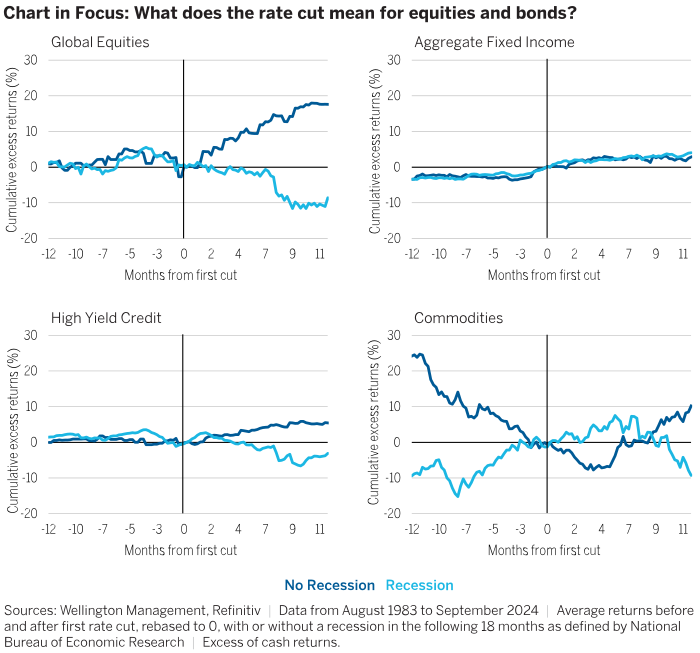
As the Federal Reserve (Fed) recalibrates rates to balance price stability and economic growth over time, markets naturally react. While investors have been eager for the arrival of rate cuts to juice their portfolio returns, the context of the cuts matters. The economic backdrop sets the stage for what plays out in the markets from the Fed’s opening act and performance is not guaranteed.
Most often, cuts are initiated when growth has stalled. However, on the dawn of a new easing era, economic growth appears solid — the victory over inflation is the catalyst for rate cuts. Current worries about increasing recession risk are valid, but with GDP growing at 3% in the US, and with Q3 GDP tracking strong, we believe immediate concerns are overblown.
As a result, history can offer examples of rate cuts facilitating a soft landing. Such periods, such as 1995, were characterized by “mid-cycle adjustments” to policy rates, not weak growth and “late-cycle panic.” Should history rhyme, conviction of a soft-landing achievement should encourage believers to be cautious about big cycle bets or being too defensive; many more cuts are priced than is usual in a mid-cycle adjustment — driven by the rapid disinflation.
Experts



September FOMC: Doves capitulate
Continue readingOil is the spark — the cost of capital is the story
Continue readingBand-aids, bazookas, and boomerangs: Equity investing in a volatile US rate regime
Continue readingDeep dive on CLO equity investing
Continue readingThe state of commercial real estate
Continue readingTaking stock of the energy shock: 9 macro and market insights
Continue readingFOMC: Holding the line amid geopolitical crosscurrents
Continue readingURL References
Related Insights
Get our latest market insights straight to your inbox.
Thank you for your registration
You will shortly receive an email with your unique link to our preference center

September FOMC: Doves capitulate
For the first time in over three years, the Fed raised the target rate range to 3.75%-4.00% in September. Our team looks at what's driving the shift and what it means going forward.

Oil is the spark — the cost of capital is the story
Higher oil prices are refocusing markets on inflation and the Fed, but the bigger investment story may be a broader shift toward a higher cost of capital and new diversification challenges.

Band-aids, bazookas, and boomerangs: Equity investing in a volatile US rate regime
With fiscal pressures and Treasury-market fragilities keeping bond yields volatile, Macro Strategist Juhi Dhawan outlines implications for equity investors.

Deep dive on CLO equity investing
Alyssa Irving, Fixed Income Portfolio Manager, discusses the CLO equity asset class, highlighting its diversification potential, risk-return dynamics, and the crucial role of managers.

The state of commercial real estate
We explore how macroeconomic, demographic, and sector-specific trends are reshaping commercial real estate, and why selectivity by sector, asset, quality, and capital structure may matter more than broad asset-class exposure.

Taking stock of the energy shock: 9 macro and market insights
Macro Strategist Juhi Dhawan looks at the potential effects of the war in the Middle East on economic growth, inflation, policy, and corporate profits.
FOMC: Holding the line amid geopolitical crosscurrents
Fixed Income Portfolio Manager Jeremy Forster discusses the Fed's cautious stance amid geopolitical tensions, inflation risks, and labor market dynamics.

The rising tide of AI: How it could lift US productivity, growth, and profits
From an economic and market standpoint, a lot is riding on the future of artificial intelligence. Macro Strategist Juhi Dhawan sees plenty of reasons for excitement but also a need for patience along the way.

Rapid Fire Questions with Ross Dilkes
In this edition of “Rapid Fire Questions,” fixed income portfolio manager Ross Dilkes shares his views on the Asia credit market—covering the macro outlook, China’s momentum, the most compelling opportunities across the region, and key risks shaping the next 12 months.

What’s the Fed got to do with it? The impact of rate cuts on CLO equity
Our CLO experts discuss the implications of Fed rate cuts on CLO equity, emphasizing its potential to maintain income amidst rate sensitivity challenges in other credit assets.

Commercial real estate debt: Transitional assets deep dive
Our private commercial real estate debt experts explore transitional CRE assets, highlighting their key characteristics, how they differ from other parts of the CRE debt universe, their potential roles in a portfolio, and much more.
Multiple authors
URL References
Related Insights
© Copyright 2026 Wellington Management Company LLP. All rights reserved. WELLINGTON MANAGEMENT ® is a registered service mark of Wellington Group Holdings LLP. For institutional or professional investors only.
Enjoying this content?
Get similar insights delivered straight to your inbox. Simply choose what you’re interested in and we’ll bring you our best research and market perspectives.