

- LDI Team Chair, LDI Strategist, and Portfolio Manager
United States, Institutional
Change
The views expressed are those of the authors at the time of writing. Other teams may hold different views and make different investment decisions. The value of your investment may become worth more or less than at the time of original investment. While any third-party data used is considered reliable, its accuracy is not guaranteed. For professional, institutional, or accredited investors only.
Amid the economic and market volatility of recent months, we’ve seen a growing number of defined benefit (DB) corporate plan sponsors and consultants exploring the potential benefits of adding alternative investments to their portfolios. Over the past 20 years, allocations to alternatives have steadily grown and today represent roughly a quarter of the average plan portfolio. For some plans, however, this remains largely uncharted territory.
To help them map a path forward, this paper offers a role-based framework for aligning different types of alternatives with a plan’s return-seeking and liability-hedging objectives. It also takes a deeper dive on hedge funds and private equity, including their potential benefits in the current investment environment and key considerations for plans establishing an allocation. (We’ve written separately about the role of private investment-grade credit here.)
Lastly, we look at the decision to allocate to alternatives through a liquidity lens, offering a case study to help plans think about stress testing and levers for managing liquidity.
Alternatives are often defined by what they’re not — that is, they are not long-only investments in publicly traded stocks and bonds. But that isn’t especially helpful, as it leaves plans to consider a wide range of strategies that invest across many asset classes and can pursue returns in very different ways. Instead, our framework focuses on the role that different alternative investments can play in a plan’s return-seeking and liability-hedging allocations.
Return-seeking allocations
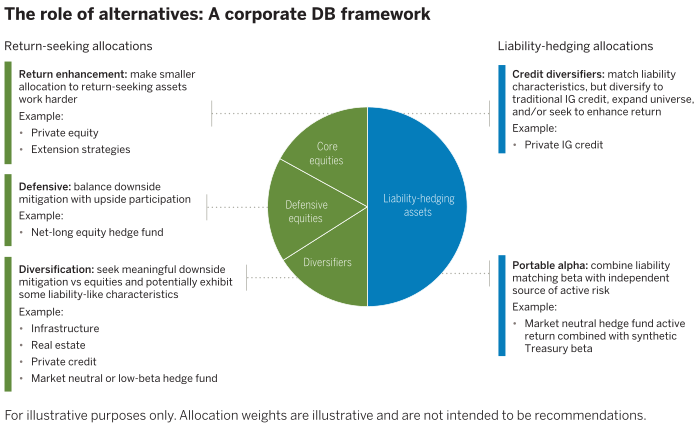
We generally think about three “building blocks” for return-seeking portfolios, and alternatives may play a role in each (left side of Figure 1):
Liability-hedging allocations
Within the liability-hedging allocation (right side of Figure 1), we think credit diversifiers, such as private investment-grade credit, can play a liability-matching role while also expanding the opportunity set beyond traditional public investment-grade credit and potentially enhancing returns. Plans might also consider a portable alpha approach that combines liability-matching beta with independent sources of active risk. This could be implemented, for example, by pairing a market neutral hedge fund with Treasury futures — the aim being to replicate the liability-matching profile of Treasuries while pursuing active return in other markets. (Some plans accomplish this less directly by investing in a market neutral hedge fund on the return-seeking side and using a completion manager on the liability-hedging side to hit a hedge-ratio target.)
Next, we share our perspectives on the current case for hedge funds and private equity, as well as some of the key considerations for plans contemplating allocations to each.
Figure 1
To read more, please click the download link below.

Private credit in the LDI toolkit: What plan sponsors need to know
We explore the potential benefits, trade-offs, and implementation considerations for corporate DB plan sponsors evaluating investment-grade private credit as part of a liability-hedging allocation.

Funded ratios on the rise: A mid-year action plan
With corporate DB plans enjoying strong funded-ratio gains, we propose potential action steps, including refining liability-hedging strategies and choosing a path for surplus assets.
Funded status gains and asset allocation questions: An update on the corporate DB landscape
Members of our LDI Team share key takeaways from their latest analysis of US corporate pensions' funded status, derisking/rerisking activity, and ROA assumptions.
A dedicated cash-balance strategy: Why now?
Members of our LDI Team explain why the time might be right for some corporate DB plans to consider adding a dedicated cash-balance approach to the liability-hedging allocation.

Cash-balance and traditional liabilities: An integrated investment approach
Members of our LDI Team offer ideas on how best to integrate traditional and cash-balance liabilities in a corporate DB plan’s investment strategy.

Choose your own adventure: How to make the most of pension surplus
With many corporate pensions seeing funded ratios improve, questions about how best to invest surplus assets are on the rise. To provide some answers, members of our LDI Team offer a framework with three possible paths and insights on investment best practices for each.

LDI in 2026: 10 questions corporate plan sponsors are asking
Members of our LDI Team address a range of topics that US corporate plans will be thinking about in 2026, from benchmark choices to liability-hedging and return-seeking investment ideas.

Setting ROAs for 2026: A guide for US corporate and public plans
How are pension plans adjusting their ROA assumptions? And how do those assumptions line up with our long-term capital market assumptions? Find out in this annual update.

Corporate versus credit indices: What’s the best match for liability-driven investing?
When selecting benchmarks for LDI needs, corporate DB plan sponsors often ask about the differences between investment-grade corporate and credit indices. In this paper, we compare the composition and performance of corporate and credit indices, as well as intermediate and long maturity indices, and we offer insights on choosing indices that fit a plan’s liability.
The high cost of unfunded duration — and some hope on the horizon
With many corporate DB plans thinking about managing their hedge ratios, members of our LDI Team explain the high cost of synthetic duration, how plans might want to think about this issue when targeting a specific duration profile, and why costs could improve over time.
Flipping the script: Our updated market outlook and the derisking/rerisking decision
Members of our LDI Team share an unusual outlook for equities and bonds and explain what it could mean for US corporate pension plans contemplating either derisking or rerisking moves from here.
URL References
Related Insights