FEATURED EQUITY FUNDS
FEATURED FIXED INCOME FUNDS

Asset classes

FEATURED EQUITY FUNDS
FEATURED FIXED INCOME FUNDS
Asset classes
The views expressed are those of the author at the time of writing. Other teams may hold different views and make different investment decisions. The value of your investment may become worth more or less than at the time of original investment. While any third-party data used is considered reliable, its accuracy is not guaranteed.
In March, US President Joe Biden proposed roughly $4 trillion in infrastructure spending over eight years. More recently, a nearly $550 billion bipartisan bill focused primarily on physical infrastructure spending gained support. Meanwhile, on the progressive Democratic side, Senator Bernie Sanders proposed $6 trillion in spending. In this note, I’ll highlight some of the key themes in the proposals related to physical, technological, and human infrastructure.
At the highest level, I would describe the plans as yet another signal of increased appetite for government spending in the US. While there is a wide range of potential outcomes in terms of the final dollar amounts — given the Democrats’ slim majority in Congress and the complexity of the plans — my expectation is that about $2 trillion – $2.5 trillion of spending will pass Congress by year end and that it will help sustain nominal growth in the US for several years. This is especially important in the context of the post-GFC environment, in which growth has been anemic and has tended to falter in the face of external shocks.
Infrastructure, by its nature, is linked to boosting both immediate economic growth (via investment spending, job creation, and earnings gains) and longer-term growth (by adding productivity-enhancing capacity, generating spillovers from research and development, improving education, and increasing connectivity via broadband access). At the same time, as I’ll discuss, investors will need to consider the impact of the tax hikes required to pay for the spending, as well as some potential unintended consequences of the plans.
1. Funding shovel-ready projects with more immediate impact — Maintenance and transit projects are the focus of the physical infrastructure proposals, with about $650 billion earmarked for highways, transit ports, airports, water and sewer systems, and other needs in the original Biden proposal (the American Jobs Plan) and somewhat less in the bipartisan plan (Figure 1). Public infrastructure spending in the US has been on the decline for decades, leaving a funding gap of more than $2.5 trillion by one estimate.1 From an employment and growth perspective, these shovel-ready projects can have a relatively rapid impact. Their full impact lies in the medium term. According to a recent study, a total of $737 billion in surface transportation over 10 years would add 1.1 million jobs by 2028.2 Every additional dollar invested would create $3.70 in economic growth over 20 years, adding to the productive capacity of the US economy.
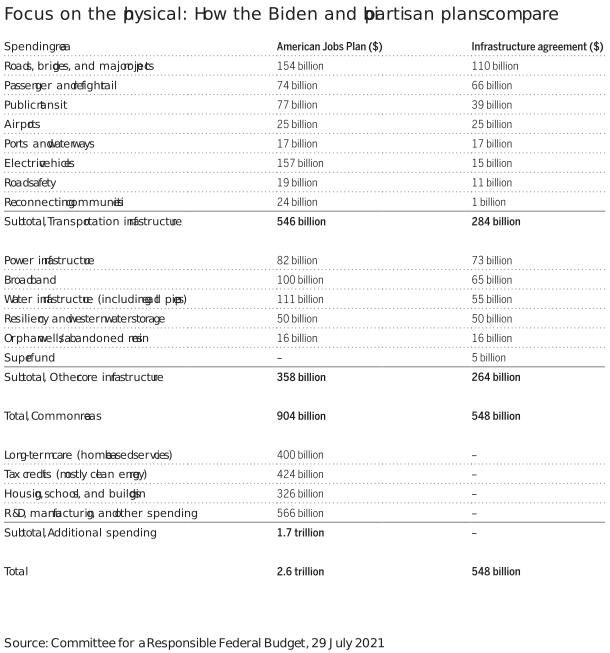
2. Offering technological innovation a helping hand — The original Biden plan includes $100 billion to expand high-speed broadband, while the bipartisan plan includes $65 billion. This is primarily for rural areas of the country where companies don’t have the financial incentive to make the investment themselves. In this case, the economic payoff will be more long term, but for the Biden administration it’s about supporting grass-roots change — and particularly now that the pandemic has made the need for broad-based digital connectivity an obvious imperative. The Biden plan would also lift technology research and development spending (more on this in point 4 below).
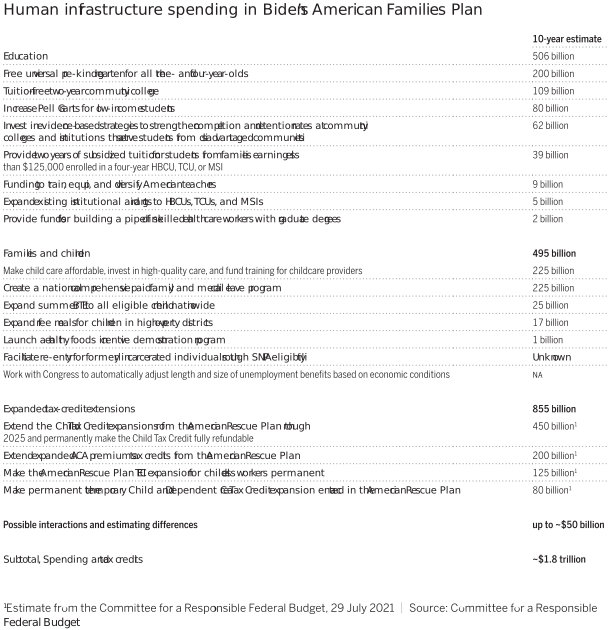
3. Supporting growth across the economic spectrum — The Biden “human infrastructure” proposal (the American Families Plan, Figure 2) includes a host of expenditures aimed at supporting broad economic participation and thereby boosting growth. Among the largest of these are proposals to extend the expansion of the child tax credit that was part of the American Rescue Plan ($450 billion) and to provide pre-kindergarten and two years of community college at no cost ($309 billon). Some 40 million American families began benefiting from the child tax credit expansion in mid-July, putting additional discretionary dollars in the pockets of those at the lowest income level. This increase of 0.5% in spending power for those with a high marginal propensity to consume could offset some of the drop-off in fiscal support when enhanced unemployment benefit payments expire in September.
The education and workforce development proposals will have a medium-term impact. They can create inclusive growth and help those who have lost their jobs to reskill and find gainful employment. This funding could be the start of an increased focus on lifelong learning and a more fundamental shift in education to address skills mismatches — a likely factor behind the record job openings currently not being filled.
One of the key benefits of the human infrastructure proposals may be an increase in the US labor-force participation rate (among the lowest in the developed world), which, could eventually lead to higher growth in the economy. Improved access to childcare and paid leave could help close the gap in labor force participation rates between the US and other developed nations. Finding a path to citizenship for undocumented immigrants and expanding work visas could also boost the labor supply, although support for these proposals is varied.
It is important to note that while there is bipartisan support for physical infrastructure, human infrastructure is solely backed by the Democrats, and the range of asks in the plan reflects disparate priorities within the party. These divides risk disagreements and delays in the passage of a bill, putting the likely timing of a resolution in the fourth quarter of this year. There is also an ongoing discussion about expanding Medicare, another key Democratic objective, although the chances of widespread support for such a move are less clear.
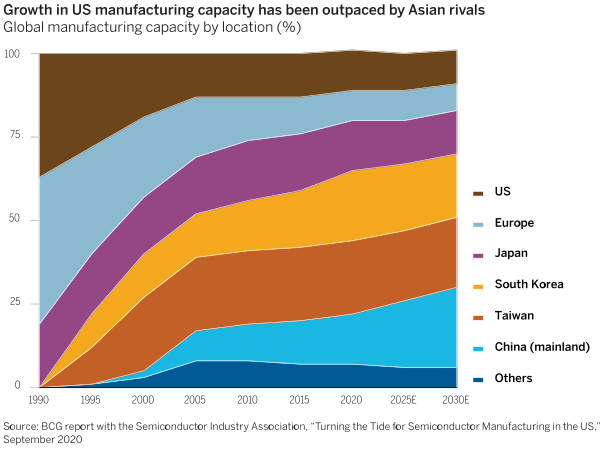
4. Giving “made in America” a boost — The Biden plan called for setting aside $180 billion for technology research and development, including $50 billion to help increase US semiconductor manufacturing. While it is unclear how much will ultimately be pushed through, there is a desire to give domestic manufacturing a boost. The country’s share of global semiconductor manufacturing capacity has fallen from 37% in 1990 to just 10% today (Figure 3). In the coming decade, the US is on track to account for just 6% of incremental new capacity. By offering incentives, the government can beef up the country’s share for strategic reasons, including reviving domestic manufacturing, which has been weak since the GFC, building more resilience into supply chains, and reducing reliance on China. It is conceivable that innovation could get a boost if these programs are designed well.
5. Building up the housing supply — The lack of supply in housing has been forcing prices higher and making it harder for many young Americans to buy a home. The original Biden plan includes $300 billion for housing, schools, and buildings. While there is not much clarity yet about how this money would be allocated, this is an important area to monitor as housing is the single largest budgetary item for most families. If the plan is enacted, we could see the supply of housing rise and prices start to moderate. Some proposals on the table would expand tax credits to incentivize construction and rehabilitation of affordable housing, as well as investments in affordable rental housing.
6. Paving the path to a lower-carbon economy — One of the key differences between Biden’s American Jobs Plan and the bipartisan proposal is the amount allocated to climate-related infrastructure. Since climate change is a priority for the Biden administration, I expect that some funding will be allocated to these areas if the Democrats go it alone or fund a second bill via reconciliation.
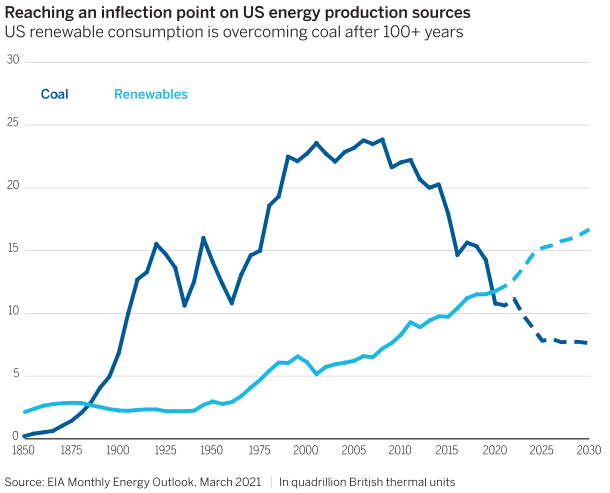
As the world gradually consumes more electricity from renewable sources (and uses more of that electricity for electric vehicles and other new technologies), the power grid will need to be modernized. The Biden plan includes $82 billion to invest in this key phase of the energy transition, while the infrastructure plan includes $73 billion. The Biden plan also proposes an extension of many tax credits that support the renewables industry, in an effort to accelerate the transition to a lower-carbon economy (see Figure 4). Public dollars in clean energy, electric vehicle infrastructure, power grid improvements, and clean manufacturing are all part of the Biden administration’s commitment to steer the economy toward less reliance on fossil fuels.
As large as the dollar amounts in these plans are (and recognizing that the final totals are very likely to be lower), I’ve been asked by some whether the proposed spend is large enough to reverse the effects of the country’s long decline in infrastructure investment. My response is that this spending will come on top of substantial funding for state and local governments in Biden’s already enacted American Rescue Plan. State and local governments fund more than 75% of traditional infrastructure, and thanks to the meaningful grants offered under the American Rescue Plan ($350 billion), more such spending is likely through this channel. (It’s also worth noting that the bipartisan bill is in addition to the surface transportation bill, which includes funding for transit, rail, and other areas of physical infrastructure and is still making its way through Congress.)
Importantly, the kind of infrastructure cutbacks we saw after the last recession are less likely this time around, given a stronger revenue picture and more help from the federal level. For perspective, public spending on infrastructure fell 8% between 2003 and 2017, driven by a 28% decline in capital investment. It is also possible that public-private partnerships will be encouraged, enabling private companies to augment the government’s infrastructure funding, especially as the transition to a lower-carbon economy ensues.
In terms of the overall economic impact of the Biden plans, I’d note that the spending is front loaded over a shorter period and the associated tax proposals (to help pay for the spending) are spread over a longer period. That means the plans are likely to have a more stimulative effect up front, perhaps providing a lift in growth of 50 bps – 75 bps over the next few years (and alleviating concerns of a fiscal cliff). Higher growth, in turn, will put upward pressure on interest rates. If designed well, these investments should also raise US productivity over time.
I would note that as part of the persistent increase in federal spending that we would see, the infrastructure plans risk driving inflation higher once full employment has been reached. In addition, as companies, especially multinationals, are asked to pay their “fair share,” higher taxes will dent corporate profits. I am expecting some increases in the corporate tax rate, GILTI (global intangibles tax rate), and the highest personal income tax rates. An increase in the capital gains rate is also possible.
And then there are what I’d classify as the unexpected outcomes, such as the risk of poor investments given the large dollar amounts at play or the fact that infrastructure development will drive up demand for oil in the next few years — just as the focus is shifting to decarbonization and reduced fossil fuel use — and potentially contribute to an oil price spike. Keeping a close eye on the design of the proposals, including earmarks for specific projects, will be important in the coming months.
While President Biden’s first legislative accomplishment, the American Rescue Plan, was focused on helping Americans weather the pandemic and getting the economy back on track, his infrastructure proposals are geared toward driving longer-term growth. The plans could lift investment spending, shore up the poorest households, and accelerate the transition to a lower-carbon economy. Workforce development, expanded childcare, education, and a focus on technological innovation could improve productivity in the medium term, helping to lift the US economy away from deflationary forces and toward higher nominal growth and a more equitable income picture.
1Source: American Society of Civil Engineers, “America’s Infrastructure Report Card,” 2021
2Source: Business Roundtable, “Delivering for America,” January 2019


AI stocks after the sell-off: why the long-term investment case may remain intact
Portfolio Manager Yash Patodia shares his perspectives on why recent volatility may be a positioning-driven unwind — not a broken thesis — and where selective, long-term opportunities are emerging across semiconductors and the wider AI value chain.
By

Oil market update: The long road to normalization
As geopolitical tensions in the Gulf region resume, our expert discusses recent oil market dynamics and their potential impact on inflation and the global growth outlook.

2026 midyear geopolitical update: What “structural competition” means for investors
Our expert explores how structural geopolitical competition is reshaping markets, raising risk premiums, and creating long-term investment implications across defense, energy, technology, supply chains, sovereign credibility, and portfolio resilience.

The rally and the reality
Can the markets remain resilient in the face of geopolitical disruption and inflation worries? We offer our views on the macro environment, AI-driven earnings, and the implications for equities, bonds, and commodities.

The state of commercial real estate
We explore how macroeconomic, demographic, and sector-specific trends are reshaping commercial real estate, and why selectivity by sector, asset, quality, and capital structure may matter more than broad asset-class exposure.
Warsh’s first FOMC: We have a task force for that
Our experts highlight new task forces, examine evolving inflation and labor dynamics, and contend that the Fed soon may need to choose between growth support and price stability.
The questions incoming Fed Chair Warsh will need to answer
We examine the key questions that incoming Fed chairman Kevin Warsh may need to confront as monetary policy faces new limits and new risks.
By
A credit investor’s perspective on inflation, fiscal policy, and AI
Paul Skinner, Investment Director, and Connor Fitzgerald, Fixed Income Portfolio Manager. explore the forces shaping the economic landscape today, from the inflation outlook and the evolving role of fiscal policy, to the transformative impact of artificial intelligence on markets and corporate behaviour. Connor shares his perspective on where opportunities and risks are emerging across fixed income and what it all means for investors positioning their portfolios in an uncertain environment.

Rapid fire questions with Schuyler Reece on EM debt
In this edition of “Rapid fire questions,” fixed income portfolio manager Schuyler Reece shares his read on the evolving macro backdrop amid the Middle East conflict, why he remains constructive on emerging markets debt, and where he sees the most compelling opportunities and risks across hard currency, local debt and EM currencies.

Iran ceasefire – risk deferred, not removed
The US and Iran have announced a two-week ceasefire. While this reduces immediate tail risk, Geopolitical Strategist Thomas Mucha cautions against mistaking it for a resolution. What should investors be watching now?
FOMC: Holding the line amid geopolitical crosscurrents
Fixed Income Portfolio Manager Jeremy Forster discusses the Fed's cautious stance amid geopolitical tensions, inflation risks, and labor market dynamics.

Perspectives on the Middle East conflict
As the situation in the Middle East continues to unfold, you can find the latest insights from our investment experts here.

How to reposition equity portfolios for recurring AI disruption
With a growing range of industries hit by sell-offs, Multi-Asset Strategist Nanette Abuhoff Jacobson explores how to reposition equity portfolios for recurring AI disruption.
Warsh as Fed chair: Something for everyone
Macro Strategist Juhi Dhawan shares five key takeaways on Kevin Warsh, President Trump’s nominee to be the next Fed chair, including thoughts on interest rates, deregulation, and the market impact.
Oil: The real influencer in the Venezuela intervention
Multi-asset Strategist Nanette Abuhoff Jacobson details the role of oil in the recent events in Venezuela and shares the investment implications.

Rapid Fire Questions with Ross Dilkes
In this edition of “Rapid Fire Questions,” fixed income portfolio manager Ross Dilkes shares his views on the Asia credit market—covering the macro outlook, China’s momentum, the most compelling opportunities across the region, and key risks shaping the next 12 months.

Is all that glitters still gold?
Gold has delivered impressive gains thus far in 2025, but what does that say about market risks and the recent strong returns of stocks? Multi-Asset Strategist Nanette Abuhoff Jacobson offers her take on the precious metal and the case for diversification in today’s market.
Chart in Focus: Is the Fed rate cut positive for risk?
In this edition of Chart in Focus, we examine how the Fed’s long-awaited interest rate cut may influence risk assets.

Chart in Focus: What do higher long-end yields mean?
Long-end yields have climbed on concerns over structural growth and fiscal expansion. In this edition of Chart in Focus, we explore how shifting yield curves are reshaping opportunities across asset classes.
Chart in Focus: Fed rate cuts resume — What’s next for investors?
In this edition of Chart in Focus, we explore the Fed’s return to rate cuts after a strategic pause. We examine how this move, alongside diverging central banks paths, could shape the outlook for risk assets.
Rapid Fire Questions with Tim Manning
In this edition of “Rapid Fire Questions,” equity portfolio manager Tim Manning offers his views on rates, fiscal policy, tariffs, and AI — and shares why he remains constructive on the US equity market.
By
FOMC: Cushioning the US labor market
Fixed Income Portfolio Manager Jeremy Forster analyzes the Fed's decision to cut interest rates at the September FOMC meeting.

Chart in Focus: Are today’s equity returns too high?
In this edition of Chart in Focus, we examine the strength of markets so far this year, placing it in historical context.

Chart in Focus: Where are rates headed?
In this edition of Chart in Focus, we take a look at where rates have been headed and potential implications moving forward.
Chart in Focus: Earnings upgrades fueled the recent US equity market rally
Where are earnings heading? In this edition of Chart in Focus, we address the recent uptick in earnings expectations and its potential impact on equity returns.

Twilight zone: how to interpret today’s uncertain macro picture
Macro Strategist John Butler and Investment Director Marco Giordano explore how to interpret today’s uncertain macroeconomic picture and its key implications.

Chart in Focus: Are higher valuations justified?
Since Liberation Day, a clearer picture on tariffs has begun to emerge and markets have rallied in response. In this edition of Chart in Focus, we revisit cross-asset valuations and examine if the higher valuations are justified.

Chart in focus: What does a weak US dollar mean for global investors?
In this Chart in Focus, we illustrate how the power of the US dollar in 2025 stacks up against the past fifty-plus years. Learn what we're watching and understand the global investment implications of a weaker USD.

China’s changing: Why you should be watching
Macro Strategist Johnny Yu discusses structural shifts in China impacting global investment dynamics. notably diminished importance of the property sector and collapse of imports.
Rapid Fire Questions with Philip Brooks (Part 2)
In part 2 of his “Rapid Fire Questions”, equity strategist Philip Brooks shares his views on 3 key questions, focusing on the topic of Quality and investible opportunities today in US and abroad.
Rapid Fire Questions with Philip Brooks (Part 1)
In part 1 of his “Rapid Fire Questions”, equity strategist Philip Brooks shares his views on 3 key questions, focusing on market outlook and risks.

Facing a new economic reality
We summarize our 2025 mid-year outlooks.

Still opportunities in European equities? Positioning is key
Macro Strategist Nicolas Wylenzek revisits the case for European equities and discusses why positioning can help optimise exposure to Europe’s accelerating regime change.
Severance: The split between the economy and the markets
While markets have bounced back since Liberation Day, policy changes and macro data bear watching. Heading into the second half of 2025, we're focused on relative opportunities across asset classes created by disconnects and divides between markets and economies.

The power of positive and pragmatic thinking
While markets have a lot to worry about, from government policy to geopolitics, Global Investment and Multi-Asset Strategist Nanette Abuhoff Jacobson looks at the world from another angle: What could go right? She offers five reasons for positive thinking and considers the investment implications.

Could the global policy response misfire?
In their mid-year macro outlook, Macro Strategists John Butler and Eoin O’ Callaghan discuss how the global policy response to the trade shock could misfire, with major implications for investors.

Chart in Focus: Did you miss out on the market bounce back in April?
Did you miss out on the market bounce back in April? In this edition of Chart in Focus, we look at market turnaround following the Liberation Day correction, highlighting the consequences of not having stayed invested.

InvestorExchange: Tariffs, Treasuries, and taxes — What comes next?
Fixed income portfolio manager Connor Fitzgerald joins host Amar Reganti to discuss the potential effects of tariffs and other fiscal decisions on the bond market.
InvestorExchange: Credit investing amid today's volatility
Host Amar Reganti talks to Campe Goodman about what's next for bond markets and how investors may be able to navigate today's volatility.
Rapid Fire Questions with Campe Goodman
In this edition of “Rapid Fire Questions”, fixed income portfolio manager Campe Goodman shares his views on 4 key questions in this Q&A session.

Why the US dollar’s “crooked smile” could upend asset allocation
Brij Khurana explores the dollar smile theory's impact on asset allocation and foreign investors' strategies amid currency fluctuations.
By

The yen smile: New economic era upends traditional safe-haven currency relationships
Portfolio Manager Sam Hogg discusses the US Dollar Smile Theory and the Japanese yen's safe-haven status in the context of global trade and monetary policy changes.
By
Tariff wars: The yield awakens
Members of our Insurance team discuss the turbulent economic and market environment and the implications for reserve-backing and surplus fixed income, as well as other major asset classes.

Making the most of the new economic era’s bright spots
Despite uncertainty, there are important factors supporting a more optimistic approach. By focusing on structural trends and considering a wide range of views, investors can position portfolios for positive long-term returns.

Chart in Focus: Patience is power — stay invested through volatility
What does a higher VIX mean? In this edition of Chart in Focus, we explore the historic performance of the global equity market after large bouts of volatility, and the investment implications for equity and fixed income investors amid the US tariff turmoil.

Four investment perspectives on Trump’s first 100 days
Four of our experts across fixed income and equity share their asset-class level insights on the first 100 days of the current Trump administration and analyze the implications for investors.

Fiscal versus tariffs: what wins out for Europe?
Just as investors were starting to explore the potential for growth in Europe, Trump’s tariffs landed. To what extent is the case for Europe still intact?

How China can offset the tariff shock
Macro Strategist Johnny Yu details the approaches Beijing could take to offset the tariff shock, from fiscal strategies to potential retaliatory measures to concessions that Washington may welcome.

Flexibility with focus: how to position fixed income for volatility
Portfolio Manager Martin Harvey and Investment Director Marco Giordano explore how a focused use of flexibility can help position fixed income portfolios for volatility.

Sacrificing stocks on the altar of trade
Brij Khurana discusses the Trump administration's new stance on trade and its impact on the US economy, global markets and asset prices.
By

Early thoughts on historic hike in US tariffs
Macro Strategist Michael Medeiros explores the significant economic and market implications of the latest US tariffs, highlighting potential recession and inflation spikes, and the impact on global trade relations.

What do tariffs mean for portfolios?
Tariffs exceeded market expectations. Now what? Expect short-term volatility, identify concentrations and consider using sell-offs as an entry point to diversify across regions and styles, says Nanette Abuhoff Jacobson, Global Investment and Multi-Asset Strategist.

Could “Liberation Day” trigger a shift in capital flows?
John Butler discusses groundbreaking US tariffs, their impact on capital flows, and the changing investor perception of the US and Europe.
By

Oh baby, baby, it’s a wild world
Just one quarter into the year, many policy and economic assumptions have been turned on their head. What does it all mean for equity, bond, and commodity markets around the world? Members of our Investment Strategy & Solutions Group offer their outlook.

Finding fixed income opportunity in unprecedented times
Brian Garvey and Brij Khurana highlight the importance of diversified fixed income portfolios in managing volatility and seizing opportunities amid economic uncertainty.

Allocating to fixed income in an age of austerity
Amar Reganti and Adam Norman explore how flexible fixed income strategies may offer stability and yield in a volatile market environment.
Monthly Market Review — February 2025
A monthly update on equity, fixed income, currency, and commodity markets.
FOMC meeting: Misery loves company
Fixed Income Portfolio Manager Jeremy Forster explores the Fed's decision to hold rates, downgraded economic forecasts, and the implications of balance-sheet policy changes on inflation and market conditions.

The US equity rotation: Where have all the good vibes gone?
After riding into 2025 on a wave of post-election euphoria, the US stock market has struggled to find its footing so far this year. Global Investment and Multi-Asset Strategist Nanette Abuhoff Jacobson looks at what’s changed in the markets and what it might mean for investors.

Chart in Focus: Can quality hedge against inflation?
Can Quality hedge against inflation? In this latest edition of Chart in Focus, we explore the historic outperformance of high-quality stocks and bonds during periods of high inflation, perhaps offering lessons should inflation surprise to the upside in 2025.

Time for credit selection to shine
Fixed income investors continue to seek answers to an era of volatile rates. Large, static exposures to credit markets no longer cut it. Instead, a nimble and dynamic approach is more likely to create resilient and consistent total return outcomes.

Rapid fire questions with Tim Manning
In this edition of our "Rapid Fire Questions with Portfolio Managers" video series, Tim Manning shares his views on 3 key questions on US equity market outlook.
By

Is your portfolio keeping pace with the changed outlook?
It's been an uncertain few years for investors, but looking ahead, we believe investors can expect a resilient economy, a solid outlook for growth and a positive environment for risk assets. What does a changed outlook mean for investors?

Chart in Focus: Is the “Trump trade” real?
Is this "Trump trade" real?In this latest edition of Chart in Focus, we compare market's reactions to Trump's re-election and his 2016 election, and share our observations.

Time for bond investors to take the wheel?
Volatility makes bond investing less straightforward, but it can also create opportunities, provided investors are in a position to "take the wheel" in order to capitalise on them.

Chart in Focus: Can this equity bull market last?
Can this current equity bull market last? In this latest edition of Chart in Focus, we focus on the indicators of whether it may come to an end or keep running.

What does Trump's US election win mean for bond investors?
During the week of US election, Paul Skinner interviews Connor Fitzgerald, Fixed Income Portfolio Manager, on the market implications and his portfolio positioning following the presidential election results.

It’s different this time: Trump faces challenging geopolitical dynamics
Our expert explores how Trump may approach the heightened geopolitical challenges his second administration faces.

Trump win likely to accelerate macro trends already in motion
The US election results could have significant implications for the global economy and markets. To help you understand these changes, US Macro Strategist Mike Medeiros provides a thorough analysis and discusses the potential market impacts.

What do the US election results mean for investors?
The US election results could have significant implications for the global economy and capital markets. Our panel of experts provides a thorough analysis of what happened and explores potential market impacts.

Chart in Focus: What does the rate cut mean for equities and bonds?
Are rate cuts positive? On the heels of the much-anticipated initial Fed cut, in this article we look to historic precedent for where the markets could go in the coming months.

An active investor’s guide to growth equities
Our experts offer their view on the current economic environment, explore best practices for investing in high-quality growth equities, and highlight where they see opportunity now.

Chart in Focus: The need to differentiate market growth from macro growth
Macro growth and earnings growth have been misaligned for the last 15 years, particularly in the US and China, but in opposite directions. For equity investors, what would be the key to identify real growth?
Rate relief: Fed cuts half point, but says “economy is strong”
Our expert explains the Fed's bold rate cut and some key takeaways for investors.

Four investment perspectives amid a pivotal US election
How can investors reposition portfolios for a pivotal but highly unpredictable US elections? Nick Samouilhan explores potential avenues in conversation with three leading portfolio managers.

Walking a mile in Fed Chair Powell’s shoes
A slow roll on rate cuts by the Fed could frustrate markets and lead to more volatility ahead of the September FOMC meeting. See our take on what to expect for the next few weeks.
By

Massive market sell-off: Justified or an overreaction?
What's behind the global market meltdown, and what should investors consider doing? Global Investment and Multi-Asset Strategist Nanette Abuhoff Jacobson shares her views.

Fork in the road: Slowdown or reacceleration ahead?
Markets seem to expect a much smoother ride in 2024, but are they too optimistic? Members of our Investment Strategy & Solutions Group offer their macro and market outlook, including their latest views on equities, bonds, and commodities.
Sector rotation opportunities for nimble credit investors
Following a credit market rally, Fixed Income Portfolio Manager Rob Burn still sees value in higher-yielding sectors but believes investors should stay nimble.
European equities: a complex story
Macro Strategist Nicolas Wylenzek examines the complex prospects of European equities from both a near-term and structural perspective.

Annual message from our CEO: Forward thinking
After a year of profound economic and market change, CEO Jean Hynes discusses the path forward, including the role of alternatives and sustainability, the firm's investments in talent, and the importance of stability and innovation.

Financial Times Moral Money Summit Asia 2022: Impact investing across public, private and emerging markets
In this replay from the Financial Times 2022 Moral Money Summit Asia, Edwina Matthew discusses key themes in impact investing.




By

By

URL References
Related Insights
Past results are not necessarily indicative of future results and an investment can lose value. Funds returns are shown net of fees. Source: Wellington Management
© 2026 Morningstar, Inc. All Rights Reserved. The information contained herein: (1) is proprietary to Morningstar; (2) may not be copied or distributed; and (3) is not warranted to be accurate, complete or timely. Neither Morningstar nor its content providers are responsible for any damages or losses arising from any use of this information. The Overall Morningstar Rating for a fund is derived from a weighted average of the three, five, and ten year (if applicable) ratings, based on risk-adjusted return. Past performance is no guarantee of future results.
The content within this page is issued by Wellington Management Singapore Pte Ltd (UEN: 201415544E) (WMS). This advertisement or publication has not been reviewed by the Monetary Authority of Singapore. Information contained on this website is provided for information purposes and does not constitute financial advice or recommendation in any security including but not limited to, share in the funds and is prepared without regard to the specific objectives, financial situation or needs of any particular person.
Investment in the funds described on this website carries a substantial degree of risk and places an investor’s capital at risk. The price and value of investments is not guaranteed. The value of the shares of the funds and the income accruing to them, if any, and may fall or rise. An investor may not get back the original amount invested and an investor may lose all of their investment. Investment in the funds described on this website is not suitable for all investors. Investors should read the prospectus and the Product Highlights Sheet of the respective fund and seek financial advice before deciding whether to purchase shares in any fund. Past performance or any economic trends or forecast, are not necessarily indicative of future performance. Some of the funds described on this website may use or invest in financial derivative instruments for portfolio management and hedging purposes. Investments in the funds are subject to investment risks, including the possible loss of the principal amount invested. None of the funds listed on this website guarantees distributions and distributions may fluctuate and may be paid out of capital. Past distributions are not necessarily indicative of future trends, which may be lower. Please note that payment of distributions out of capital effectively amounts to a return or withdrawal of the principal amount invested or of net capital gains attributable to that principal amount. Actual distribution of income, net capital gains and/or capital will be at the manager’s absolute discretion. Payments on dividends may result in a reduction of NAV per share of the funds. The preceding paragraph is only applicable if the fund intends to pay dividends/ distributions. Performance with preliminary charge (sales charge) is calculated on a NAV to NAV basis, net of 5% preliminary charge (initial sales charge). Unless stated otherwise data is as at previous month end.
Subscriptions may only be made on the basis of the latest prospectus and Product Highlights Sheet, and they can be obtained from WMS or fund distributors upon request.
This material may not be reproduced or distributed, in whole or in part, without the express written consent of Wellington Management.

























































10 reasons why China could be the next rerating story
Portfolio Manager Bo Meunier, Investment Director Irmak Surenkok and Investment Specialist Gilbert Chen set out 10 reasons why China could be the next rerating story to watch.
Multiple authors