- Fixed Income and Global Insurance Strategist
Skip to main content
- Funds
- Capabilities
- Insights
- About Us
Asset classes
Singapore, Individual
Changechevron_rightThe views expressed are those of the authors at the time of writing. Other teams may hold different views and make different investment decisions. The value of your investment may become worth more or less than at the time of original investment. While any third-party data used is considered reliable, its accuracy is not guaranteed.
Policy and geopolitical risk are rising in almost exponential manners. Policy communication, still-sticky inflation, and rapidly cooling economic data all have added substantial turmoil to markets. In this environment, it’s easy for allocators and end-asset owners to feel powerless amid the chaos.
One potential solution? Consider adding to fixed income allocations.
Over the course of early March, fixed income markets rallied as risk assets sold off. As the new US presidential administration launched the largest tariff increase in nearly a century, markets struggled with which effects — slower growth or higher inflation — would translate into pricing. The answer came as US Treasury yields moved broadly lower, reflecting heavy concerns about slowing growth. To understand these dynamics, it’s necessary to break down the political and economic backdrop.
While the stated goal of the second Trump administration is a reduction in government spending, current policy has added a substantial amount of opacity about fiscal outlays. Consumer and business confidence has declined, likely with adverse consequences for spending and capex decisions. Indeed, this pushback on animal spirits occurs at a time when government spending is currently running higher than 2024 levels (Figure 1). Year-to-date spending for the first two months of 2025 was US$269 billion, up from US$255 billion for the same time frame in 2024.
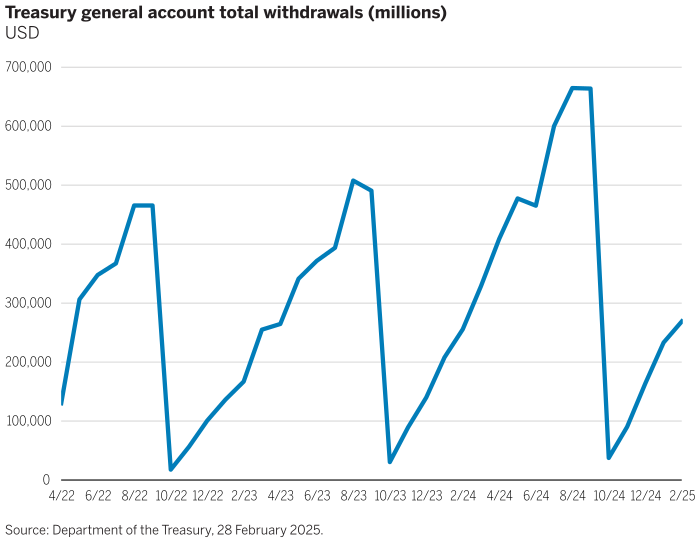
Congress passed a budget resolution that extended current government spending through the US fiscal year ended 30 September 2025. While the resolution averts a government shutdown for the time being, a larger debate still looms as Republicans seek an extension of the 2017 Tax Cuts and Jobs Act (TCJA), set to expire at the end of this year, along with cuts to several social programs.
The tax cuts themselves, which are an extension of policies already in place, are unlikely to produce additional stimulus. Paring back services to pay for them, which the resolution aims to do through reducing Energy & Commerce Committee spending by more than US$800 billion, could have an immediate impact on aggregate demand. This spending is linked to Medicaid, and given the matching state funds that often accompany Medicaid, we’re likely to see a fiscal drag on demand.1
On top of these changes and the increased spending so far this year, the labor market is in stasis and consumer confidence continues to weaken. Labor demand has cooled rapidly so far this year, with layoffs only just beginning and pauses in hiring portending further labor-market deterioration.
Initial job losses will be reflected in federal employees and contractors. While these represent a small portion of total payrolls, the sheer size and speed of federal layoffs will likely have spillover effects in labor sentiment. This comes at a time when portions of the consumer market are weakening, with 90-day delinquencies rising to multi-decade highs in auto loans and credit card balances (Figure 2). Importantly, tariffs could weaken consumer demand right when the labor market is cooling.
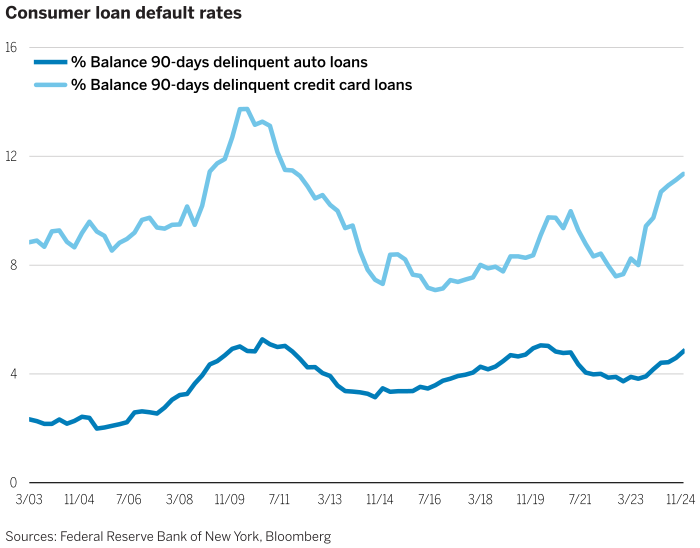
Against this backdrop, we argue that while a fixed income allocation is always a compelling component of a broader investment portfolio, now it’s more important than it’s been in recent memory. But, of course, there’s more than one way to allocate to fixed income. In our view, prudent investors may wish to do the following:
The political and economic narrative is likely to see-saw back and forth as policies are announced, withdrawn, and rescheduled, but the net effect is potential market volatility. While the underlying US economy remains in good shape (without the strategic imbalances that were endemic in the era leading up to the 2008 global financial crisis), headwinds exist, and investor vigilance is necessary. We believe that as these new paradigms take root, fixed income could remain a well-yielding harbor.
1The final draft of the bill may include additional tax stimulus either in increasing the SALT cap or having no taxes on tips.

Experts
Low tide, sharp eyes: What to pick up
Continue readingPractical portfolio considerations for a new economic age
Continue readingRapid Fire Questions with Ross Dilkes
Continue readingChart in Focus: Is the Fed rate cut positive for risk?
Continue readingChart in Focus: What do higher long-end yields mean?
Continue readingChart in Focus: Fed rate cuts resume — What’s next for investors?
Continue readingFOMC: Cushioning the US labor market
Continue readingURL References
Related Insights
Low tide, sharp eyes: What to pick up
Fixed Income Managers Campe Goodman and Rob Burn share their outlook for credit in 2026 and discuss how investors can reposition for an environment where opportunities are harder to find.
Practical portfolio considerations for a new economic age
Solutions Director Andrew Sharp Paul explores practical portfolio considerations for a new economic age, focusing on quality equities, discerning bonds, and local APAC opportunities.
Rapid Fire Questions with Ross Dilkes
In this edition of “Rapid Fire Questions,” fixed income portfolio manager Ross Dilkes shares his views on the Asia credit market—covering the macro outlook, China’s momentum, the most compelling opportunities across the region, and key risks shaping the next 12 months.
Chart in Focus: Is the Fed rate cut positive for risk?
In this edition of Chart in Focus, we examine how the Fed’s long-awaited interest rate cut may influence risk assets.
Chart in Focus: What do higher long-end yields mean?
Long-end yields have climbed on concerns over structural growth and fiscal expansion. In this edition of Chart in Focus, we explore how shifting yield curves are reshaping opportunities across asset classes.
Chart in Focus: Fed rate cuts resume — What’s next for investors?
In this edition of Chart in Focus, we explore the Fed’s return to rate cuts after a strategic pause. We examine how this move, alongside diverging central banks paths, could shape the outlook for risk assets.
FOMC: Cushioning the US labor market
Fixed Income Portfolio Manager Jeremy Forster analyzes the Fed's decision to cut interest rates at the September FOMC meeting.
How a changing Europe is reshaping credit markets
Portfolio Managers Derek Hynes and Konstantin Leidman explore how a changing Europe is reshaping the region's credit markets and identify key takeaways for investors.
Chart in Focus: Where are rates headed?
In this edition of Chart in Focus, we take a look at where rates have been headed and potential implications moving forward.
(Re)emerging markets: 10 reasons for optimism
Our experts identify 10 reasons why now may be the time for investors to reconsider emerging markets.
Multiple authors
Facing a new economic reality
We summarize our 2025 mid-year outlooks.
URL References
Related Insights
Past results are not necessarily indicative of future results and an investment can lose value. Funds returns are shown net of fees. Source: Wellington Management
© 2025 Morningstar, Inc. All Rights Reserved. The information contained herein: (1) is proprietary to Morningstar; (2) may not be copied or distributed; and (3) is not warranted to be accurate, complete or timely. Neither Morningstar nor its content providers are responsible for any damages or losses arising from any use of this information. The Overall Morningstar Rating for a fund is derived from a weighted average of the three, five, and ten year (if applicable) ratings, based on risk-adjusted return. Past performance is no guarantee of future results.
The content within this page is issued by Wellington Management Singapore Pte Ltd (UEN: 201415544E) (WMS). This advertisement or publication has not been reviewed by the Monetary Authority of Singapore. Information contained on this website is provided for information purposes and does not constitute financial advice or recommendation in any security including but not limited to, share in the funds and is prepared without regard to the specific objectives, financial situation or needs of any particular person.
Investment in the funds described on this website carries a substantial degree of risk and places an investor’s capital at risk. The price and value of investments is not guaranteed. The value of the shares of the funds and the income accruing to them, if any, and may fall or rise. An investor may not get back the original amount invested and an investor may lose all of their investment. Investment in the funds described on this website is not suitable for all investors. Investors should read the prospectus and the Product Highlights Sheet of the respective fund and seek financial advice before deciding whether to purchase shares in any fund. Past performance or any economic trends or forecast, are not necessarily indicative of future performance. Some of the funds described on this website may use or invest in financial derivative instruments for portfolio management and hedging purposes. Investments in the funds are subject to investment risks, including the possible loss of the principal amount invested. None of the funds listed on this website guarantees distributions and distributions may fluctuate and may be paid out of capital. Past distributions are not necessarily indicative of future trends, which may be lower. Please note that payment of distributions out of capital effectively amounts to a return or withdrawal of the principal amount invested or of net capital gains attributable to that principal amount. Actual distribution of income, net capital gains and/or capital will be at the manager’s absolute discretion. Payments on dividends may result in a reduction of NAV per share of the funds. The preceding paragraph is only applicable if the fund intends to pay dividends/ distributions. Performance with preliminary charge (sales charge) is calculated on a NAV to NAV basis, net of 5% preliminary charge (initial sales charge). Unless stated otherwise data is as at previous month end.
Subscriptions may only be made on the basis of the latest prospectus and Product Highlights Sheet, and they can be obtained from WMS or fund distributors upon request.
This material may not be reproduced or distributed, in whole or in part, without the express written consent of Wellington Management.
We seek to exceed the investment objectives and service expectations of our fund investors and their advisers worldwide
© Copyright 2025 Wellington Management Singapore Pte. Ltd. All rights reserved.
WELLINGTON MANAGEMENT FUNDS ® is a registered service mark of Wellington Group Holdings LLP.
Wellington Management Singapore Pte. Ltd., a private limited company incorporated in the Republic of Singapore. Address: 8 Marina Boulevard, Tower 1 #03-01 Marina Bay Financial Centre 018981. Licensed and regulated by the Monetary Authority of Singapore.