FEATURED EQUITY FUNDS
FEATURED FIXED INCOME FUNDS

Asset classes

FEATURED EQUITY FUNDS
FEATURED FIXED INCOME FUNDS
Asset classes
The views expressed are those of the author at the time of writing. Other teams may hold different views and make different investment decisions. The value of your investment may become worth more or less than at the time of original investment. While any third-party data used is considered reliable, its accuracy is not guaranteed.
As the narrative of US exceptionalism is beginning to wane — illustrated by the number of global fund managers trimming their US equity exposure1 — investors are increasingly asking: where next? While the answer is likely to be multifaceted, we think it should encompass China. Despite signs of a peak in US equity dominance, foreign investors have yet to meaningfully re-engage with Chinese markets. Allocations to Chinese equities remain 53% below their 2020 highs, even after a modest uptick in early 20252. In our view, this disconnect offers attractive potential, even if further tariff volatility cannot be excluded in the short term. Here’s why we believe time has come to revisit Chinese equity exposures.
1. Attractive valuations with upside potential
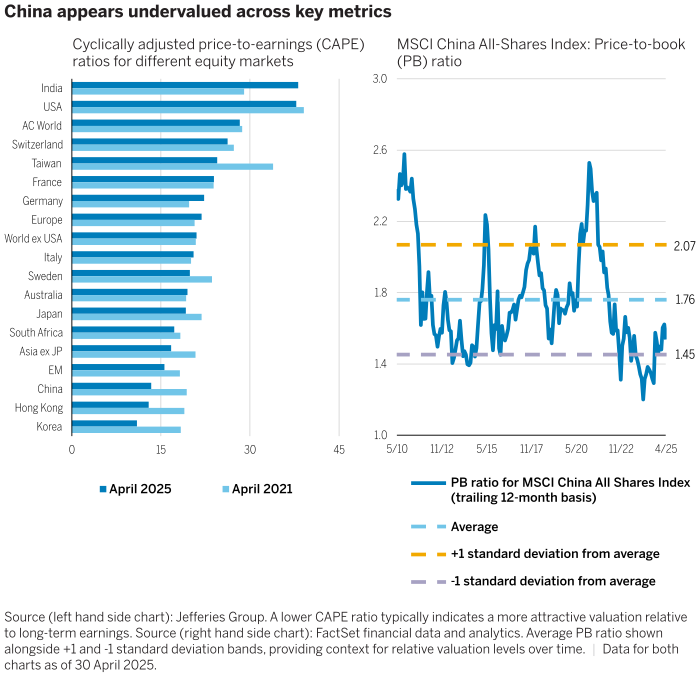
On a relative and historical basis, Chinese equities are today trading at potentially compelling valuations (Figure 1). With early signs of an earnings inflection and foreign ownership still low, renewed international interest could act as the catalyst for the next leg up.
Figure 1
2. Improving fundamentals
Companies are improving capital allocation in line with global best practices as evidenced by rising dividend payouts, share buybacks and a more disciplined approach to debt management. Regulators are also encouraging listed companies to enhance transparency and return capital to investors. These shifts not only improve balance-sheet resilience but also signal a maturing market environment where corporate strategies are more aligned with investor interests. For long-term investors, this trend enhances the appeal of Chinese equities as a source of sustainable returns.
3. A more resilient economic model
We believe that the ongoing deleveraging of the Chinese property market and a growing willingness by the Chinese government to use its policy levers has started to reduce systemic financial risks, particularly in the banking sector, thus strengthening the country’s financial foundations.
4. Pro-private sector policy shift
Chinese policymakers now appear increasingly supportive of private enterprise and the need to foster innovation and accelerate the transition to a knowledge-based economy.
5. Countercyclical consumer strength
Consumer confidence, while still recovering, is showing signs of improvement. Chinese households maintain high savings rates, providing dry powder for consumption.
6. Property market stabilisation
The worst of the property downturn appears to be over, with growing signs of stabilisation and even some green shoots emerging in key urban markets.
7. Fiscal support from local governments
With local government finances now on a more stable footing, we expect increased local government bond issuance to support infrastructure and consumption, providing a tailwind for domestic demand.
8. Diversification benefits
Chinese equities tend to exhibit low correlation with global markets, making them a valuable portfolio diversifier. We expect this divergence to accelerate over time as deglobalisation gathers pace.
9. Strategic decoupling from the US
Chinese companies are systematically reducing their reliance on US capital markets and shifting their listing to the domestic market or Hong Kong, creating additional opportunities for diversification.
10. Deepening global trade ties beyond the US
China is proactively looking to diversify its trading partners, notably with a pivot towards Europe in particular. In early 2025, China and the EU agreed to deepen economic and trade relationships. While friction points will be hard to resolve, Chinese officials emphasised their willingness to address these “differences” constructively in an acknowledgement of European policymakers’ concerns.
While investor sentiment towards China remains understandably cautious amid geopolitical and tariffs-related uncertainty, the underlying fundamentals point to a more positive long-term story rooted in domestic structural improvements rather than external dependencies. From a more resilient economic model and pro-private sector reforms to deepening trade ties beyond the US — especially with Europe — China is increasingly positioning itself to thrive even in a more fragmented global order, a shift not yet reflected in valuations. For investors willing to look beyond the headlines, China may well be the next major rerating story.
Neither MSCI nor any other party involved in or related to compiling, computing or creating the MSCI data makes any express or implied warranties or representations with respect to such data (or the results to be obtained by the use thereof), and all such parties herby expressly disclaim all warranties of originality, accuracy, completeness, merchantability or fitness for a particular purpose with respect to any of such data. Without limiting any of the foregoing, in no event shall MSCI, any of its affiliates or any third party involved in or related to compiling, computing or creating the data have any liability for any direct, indirect, special, punitive, consequential or any other damages (including loss of profits) even if notified of the possibility of such damages. No further distribution or dissemination of the MSCI data is permitted without MSCI’S express written consent.
1 Bank of America Global Fund Manager Survey. Data as of May 2025. | 2 Ibid.
Past results are not necessarily indicative of future results and an investment can lose value. Funds returns are shown net of fees. Source: Wellington Management
© 2026 Morningstar, Inc. All Rights Reserved. The information contained herein: (1) is proprietary to Morningstar; (2) may not be copied or distributed; and (3) is not warranted to be accurate, complete or timely. Neither Morningstar nor its content providers are responsible for any damages or losses arising from any use of this information. The Overall Morningstar Rating for a fund is derived from a weighted average of the three, five, and ten year (if applicable) ratings, based on risk-adjusted return. Past performance is no guarantee of future results.
The content within this page is issued by Wellington Management Singapore Pte Ltd (UEN: 201415544E) (WMS). This advertisement or publication has not been reviewed by the Monetary Authority of Singapore. Information contained on this website is provided for information purposes and does not constitute financial advice or recommendation in any security including but not limited to, share in the funds and is prepared without regard to the specific objectives, financial situation or needs of any particular person.
Investment in the funds described on this website carries a substantial degree of risk and places an investor’s capital at risk. The price and value of investments is not guaranteed. The value of the shares of the funds and the income accruing to them, if any, and may fall or rise. An investor may not get back the original amount invested and an investor may lose all of their investment. Investment in the funds described on this website is not suitable for all investors. Investors should read the prospectus and the Product Highlights Sheet of the respective fund and seek financial advice before deciding whether to purchase shares in any fund. Past performance or any economic trends or forecast, are not necessarily indicative of future performance. Some of the funds described on this website may use or invest in financial derivative instruments for portfolio management and hedging purposes. Investments in the funds are subject to investment risks, including the possible loss of the principal amount invested. None of the funds listed on this website guarantees distributions and distributions may fluctuate and may be paid out of capital. Past distributions are not necessarily indicative of future trends, which may be lower. Please note that payment of distributions out of capital effectively amounts to a return or withdrawal of the principal amount invested or of net capital gains attributable to that principal amount. Actual distribution of income, net capital gains and/or capital will be at the manager’s absolute discretion. Payments on dividends may result in a reduction of NAV per share of the funds. The preceding paragraph is only applicable if the fund intends to pay dividends/ distributions. Performance with preliminary charge (sales charge) is calculated on a NAV to NAV basis, net of 5% preliminary charge (initial sales charge). Unless stated otherwise data is as at previous month end.
Subscriptions may only be made on the basis of the latest prospectus and Product Highlights Sheet, and they can be obtained from WMS or fund distributors upon request.
This material may not be reproduced or distributed, in whole or in part, without the express written consent of Wellington Management.