







- Global Investment Strategist
FEATURED EQUITY FUNDS
FEATURED FIXED INCOME FUNDS
Asset classes

FEATURED EQUITY FUNDS
FEATURED FIXED INCOME FUNDS
Asset classes
The views expressed are those of the authors at the time of writing. Other teams may hold different views and make different investment decisions. The value of your investment may become worth more or less than at the time of original investment. While any third-party data used is considered reliable, its accuracy is not guaranteed.
This is an excerpt from our Investment Outlook, in which specialists from across our investment platform share insights on the economic and market forces that we expect to influence portfolios.
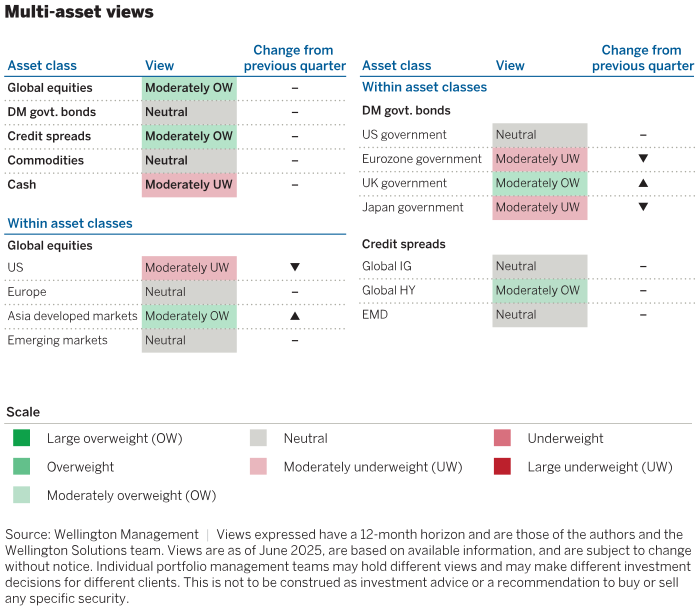
Since President Trump shook the markets with his Liberation Day tariff announcement in early April, risk markets have climbed the proverbial wall of worry, with stocks bouncing back from double-digit sell-offs. Multiple rounds of tariff threats and walk-backs taught markets that the pattern of threat/détente will probably continue but the worst-case scenario may be behind us. Meanwhile, consumers and businesses are hanging in there. Lower-income consumers are under some stress, but higher-income consumers continue to spend. And first-quarter corporate earnings surprised to the upside, especially in technology. The wake-up call from the US administration to other nations to boost spending has resulted in more fiscal stimulus in Europe and Japan. Finally, the inflation bogeyman has not come out yet, perhaps because demand is easing.
Against this backdrop, we have a slightly pro-risk stance on equities and credit, assuming a base case of slower growth and sticky inflation. Our caution stems primarily from policy uncertainty, which is weighing on economic activity, but also from the less-discussed impact of immigration restrictions that have shrunk the labor force, a reversal relative to the past few years. We see better value in regional plays in equities and credit and are particularly focused on these relative opportunities. With a nod to the TV series Severance, we are on the lookout for markets with “innies and outies” — that is, disconnects between the economy and markets. For example, recent narrow gains in US equities on the back of better-than-expected mega-cap tech earnings have returned valuations to “priced for perfection” levels, so we have an underweight view on the US relative to other regions where we expect the valuation gap to narrow. While Europe has enjoyed the best performance among developed markets year to date, we think it’s Japan’s turn to rise, with substantial fiscal stimulus already enacted and more good news on corporate governance. We are also more open to the potential for EM equities to outperform the US, driven partly by improvements in China, where technology innovation and investments in green industries are shifting the economy’s growth engine away from real estate at the same time stimulus for households is showing signs of raising consumption.
Turning to government bonds, we are most interested in the disparate stances of central banks, as each region’s domestic economy is being affected differently by tariffs. We think the market is overly bearish on the UK’s fiscal situation and favor duration there relative to Europe, where the European Central Bank (ECB) has already delivered 175 basis points (bps) of rate cuts over the past year, yet markets expect even more. We prefer a short duration stance in Japan, where we think the Bank of Japan (BOJ) will finally deliver rate hikes in response to higher inflation, even as more fiscal stimulus could add to inflationary pressure. Despite tight spreads, we stick to our overweight view on high yield, which is supported by continued low default rates, higher-quality names, and limited supply.
We retain our slight overweight view on global equities. We still expect positive earnings growth across all major regions and believe downward earnings revisions have likely bottomed out, but we are cautious on valuations. The current tight equity risk premium suggests excessive optimism, in our view, and implies that tail risks are underpriced. While there are reasons for optimism, as noted earlier, the market seems to assume that tariffs and other policies will avoid causing any economic damage, and it is incorporating little geopolitical risk premium as well.
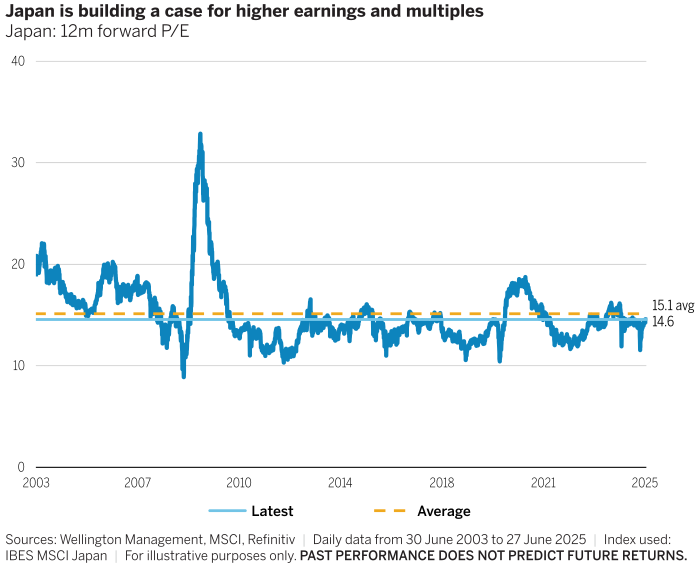
We maintain an overweight view on Japan relative to the US, thanks in part to the valuation gap between the two. Governance reforms in Japan are gaining momentum, boosting both return on equity (ROE) and corporate balance sheets. Japan has historically lagged in ROE compared to global peers, but this is changing and strengthening the argument for higher price-to-earnings multiples (Figure 1). Along with Europe, Japan has one of the highest levels of cash return to shareholders, through both dividends and buybacks. Policy — and specifically the potential for yen strength — could be a headwind, however, preventing us from taking a larger overweight stance against the US.
Figure 1
High US valuations and the post-Liberation Day performance reversal reflect a skew to the most positive scenarios and contribute to our moderately underweight view. Moreover, US market gains continue to be driven by the outperformance of a narrow group of the largest companies. We would prefer to see broader earnings growth and price trends, but expectations for that broadening have been pushed out as companies no longer have the flexibility to pass through all the tariffs and could be forced to absorb some of the higher costs, denting margins.
We have a neutral view on European equities. We are positive on prospects for economic multipliers from the fiscal expansion underway in Germany, which provides some support for European equity valuations. However, earnings-per-share (EPS) growth may take time to materialize, particularly with currency strength weighing on foreign earnings, and key uncertainties remain, including progress in trade negotiations.
We also have a neutral view on emerging markets. The US dollar remains soft, which typically supports EM assets. The likely peak of US-China trade headwinds, coupled with additional Chinese stimulus, provides upside. Inflation is largely under control in many EM economies, giving central banks room to ease policy and cut rates. However, we would want to gain more conviction on global growth developments, tariffs, and geopolitical developments before we turn positive here.
Within sectors, we have an overweight view on utilities, financials, industrials, and consumer discretionary, against underweight views on information technology, materials, and energy. Utilities and financials are our highest-conviction overweight views, driven by fundamental tailwinds including infrastructure spending and a more favorable regulatory environment for banks. On the other hand, macro headwinds to materials and energy equities persist, with our energy sector underweight view complementing our new underweight view on oil.
Pity the central bankers who must figure out how fiscal and trade policy moves will impact their economies! The consensus appears to be that tariffs will drive growth lower and inflation higher in the coming months. While we await definitive evidence of these outcomes, we don’t see a big opportunity in being long or short overall duration. Federal Reserve Chair Powell has articulated a similar case for patience on interest rates, arguing that as long as the US economy is solid, the right thing to do is stick with the current policy stance and learn more over the summer. Signs of labor market weakness are surfacing, and we think the Fed is more likely to tilt in favor of its employment mandate and cut rates sometime this year, trusting that above-target inflation will ease. This expectation is priced in by markets.
That said, central banks around the world are dealing with varied regional dynamics that require different policies (Figure 2), so “severance” between economies and markets abounds. In the euro area, as noted, markets expect the ECB to cut rates beyond the 175 bps already delivered. We see upside risks to longer-term yields, including tentative signs that euro-area demand is picking up from looser financial conditions and fiscal policy and that inflation assumptions are too low. The details of a US-European trade deal will be important as well, and we think the risk skew favors a hawkish scenario in which growth and inflation pick up and 10-year yields rise.
Figure 2
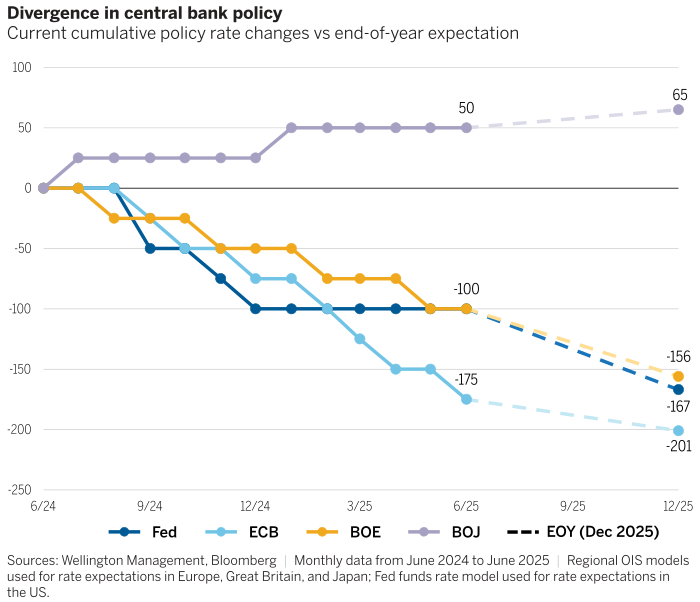
In Japan, inflation is becoming a problem. First-quarter nominal GDP was running above 5% year over year, so 10 times the policy rate of 0.5%. Business conditions are strong, especially among domestically oriented sectors, while labor markets are tight and inflation expectations are accelerating. The BOJ should be hiking rates, but tariffs, which could cut into GDP and reduce confidence, remain a concern. Election uncertainty is also muddying the picture: Upper House elections happen on July 20 and the candidates are effectively competing on who can loosen fiscal policy more. Poor demographics are always pulling real yields in the other direction, yet we think the combination of inflation and fiscal risks will bias longer-term yields higher.
Where do we see opportunities relative to these concerns about Europe and Japan? We think yields could decline in the UK, where worries about fiscal slippage caused a spike in the term premium that we believe is overdone, while the employment picture appears to be weakening.
Credit spreads “roundtripped” the widening we saw in early April and are back to historically tight levels. Given that our base case is no recession, balance sheets are healthy, and supply/demand technicals are still solid, we retain our slight overweight view on credit spreads. This is expressed in US high yield, which provided an all-in yield of 6% – 7% as of June 24 that we think will continue to attract carry-seeking allocators. We also continue to highlight the secular improvement in the quality of the US high-yield index, as well as the alternative financing options available to issuers via the private credit markets, which have kept the default rate low. While spreads are tight, we also know that spreads can stay tight for a long time.
What could go wrong? The risk is that the combination of tariffs and an oil shock could increase the odds of a recession and weigh on risk assets in general. However, so long as inflation doesn’t spike, a slower growth outlook should not be problematic for spreads.
We maintain our neutral view on commodities. Structural tailwinds remain favorable for gold, including the geopolitical environment and flows from EM central banks and retail investors. The prospect of an acceleration in central bank efforts to diversify their reserves may provide an additional kicker. That said, we see a case for pausing to wait for a more favorable entry point for a long position in gold, within what we acknowledge is a strong uptrend (albeit with some volatility). A recent geopolitical premium has provided what we believe is a short-term boost to prices, and structural tailwinds remain, but valuations are extreme (the highest since 1980).
We moved to a small underweight view on oil following the recent spike in geopolitical concerns. While the situation in the Middle East is fluid, there is already a significant geopolitical risk premium in the oil market despite the fact that prices have come down since the US strikes on Iran. Given that we see a low probability of a significant supply disruption, we think higher prices give producers the opportunity to hedge 2026 production, which could reverse the trend of capex and production discipline. We agree with the consensus view that there will be oversupply by the end of the year, creating a potentially attractive entry point for shorting crude, with the primary risk being the substantial negative carry drag.
Consider maintaining a slight pro-risk stance — We believe we are past peak uncertainty but trade policy uncertainty remains relatively high. Given our base case of no recession, we see a case for maintaining some risk in both global equities and credit. Within global equities, we favor utilities and financials. Against those, we have underweight views on materials and energy, with the latter reflecting our expectation that oil supply will lead to lower prices.
Position for equities outside the US to potentially outperform — With the recent rebound, US equities remain narrowly concentrated in the mega-cap tech stocks. We have seen comparable earnings growth outside the US at lower valuations. We also expect continued foreign flows away from the US into other regions. We think allocators should consider shifting some of their US equity exposure to other developed markets and emerging markets.
Watch for fixed income opportunities resulting from divergent policies — While we do not currently have a strong overweight/underweight view on global duration, we see regional duration opportunities that can potentially add alpha to portfolios. In particular, yields in the euro area and Japan look expensive relative to the UK given our expectation that fiscal stimulus, improving growth, and rising inflation expectations will push yields higher in the former markets.
Stay steady in spreads — Given a no-recession base case, we maintain our slight overweight view on credit spreads, specifically in US high yield. Fundamentals and technicals continue to be supportive, and we think the all-in yield of 6% – 7% is still attractive.
Experts


Past results are not necessarily indicative of future results and an investment can lose value. Funds returns are shown net of fees. Source: Wellington Management
© 2026 Morningstar, Inc. All Rights Reserved. The information contained herein: (1) is proprietary to Morningstar; (2) may not be copied or distributed; and (3) is not warranted to be accurate, complete or timely. Neither Morningstar nor its content providers are responsible for any damages or losses arising from any use of this information. The Overall Morningstar Rating for a fund is derived from a weighted average of the three, five, and ten year (if applicable) ratings, based on risk-adjusted return. Past performance is no guarantee of future results.
The content within this page is issued by Wellington Management Singapore Pte Ltd (UEN: 201415544E) (WMS). This advertisement or publication has not been reviewed by the Monetary Authority of Singapore. Information contained on this website is provided for information purposes and does not constitute financial advice or recommendation in any security including but not limited to, share in the funds and is prepared without regard to the specific objectives, financial situation or needs of any particular person.
Investment in the funds described on this website carries a substantial degree of risk and places an investor’s capital at risk. The price and value of investments is not guaranteed. The value of the shares of the funds and the income accruing to them, if any, and may fall or rise. An investor may not get back the original amount invested and an investor may lose all of their investment. Investment in the funds described on this website is not suitable for all investors. Investors should read the prospectus and the Product Highlights Sheet of the respective fund and seek financial advice before deciding whether to purchase shares in any fund. Past performance or any economic trends or forecast, are not necessarily indicative of future performance. Some of the funds described on this website may use or invest in financial derivative instruments for portfolio management and hedging purposes. Investments in the funds are subject to investment risks, including the possible loss of the principal amount invested. None of the funds listed on this website guarantees distributions and distributions may fluctuate and may be paid out of capital. Past distributions are not necessarily indicative of future trends, which may be lower. Please note that payment of distributions out of capital effectively amounts to a return or withdrawal of the principal amount invested or of net capital gains attributable to that principal amount. Actual distribution of income, net capital gains and/or capital will be at the manager’s absolute discretion. Payments on dividends may result in a reduction of NAV per share of the funds. The preceding paragraph is only applicable if the fund intends to pay dividends/ distributions. Performance with preliminary charge (sales charge) is calculated on a NAV to NAV basis, net of 5% preliminary charge (initial sales charge). Unless stated otherwise data is as at previous month end.
Subscriptions may only be made on the basis of the latest prospectus and Product Highlights Sheet, and they can be obtained from WMS or fund distributors upon request.
This material may not be reproduced or distributed, in whole or in part, without the express written consent of Wellington Management.