




- Co-Head of Multi-Asset Portfolio Management and Portfolio Manager
Asset classes

Asset classes
The views expressed are those of the authors at the time of writing. Other teams may hold different views and make different investment decisions. The value of your investment may become worth more or less than at the time of original investment. While any third-party data used is considered reliable, its accuracy is not guaranteed.
What does the changing market environment — elevated interest rates and inflation, greater volatility and more frequent cycles — mean for income investing?
In a less certain market environment, we think the case for income only gets stronger. Income isn’t just for income-seeking investors; it’s also an important component of total returns for those focused on building wealth over time (Figure 1). Our research1 suggests that even for a standard 60% equity/40% bond portfolio, income can potentially contribute more than half of the returns over a five-year investment horizon. If investors choose asset classes with a higher income profile, such as credit or high-dividend-income equity, that proportion increases, reaching as much as 80% in some cases.
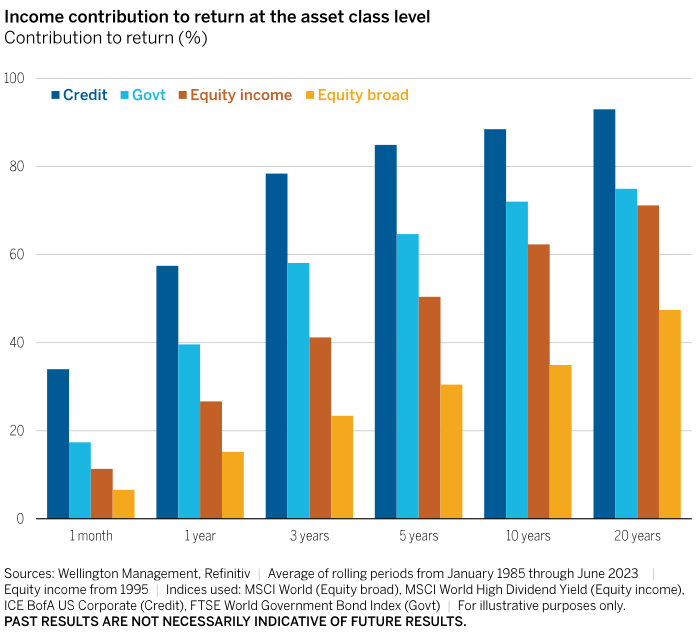
Income’s ability to not only generate consistent income streams but also act as a powerful driver of returns makes it a crucial component in today’s investment portfolios, where the path to returns may be rockier than it has been in the past.
Despite the benefits of income investing, many investors remain wary of the asset class most often associated with income — bonds. This is perhaps understandable, given fixed income’s record underperformance in 2022. The fact that cash is yielding more than some bonds is, for many, another mark against fixed income. Add to this a mixed economic outlook, uncertain monetary policy and a tense geopolitical environment, and it’s not really surprising that significant numbers of investors are choosing to hold cash while waiting for a clearer trajectory to emerge.
The problem here is that waiting for more certainty before moving out of cash and into bonds could come at a cost, in the form of a lower total return. Based on our analysis of the past six US Federal Reserve interest-rate-hiking cycles, when interest rates are at (or near) their peak, moving from cash into fixed income has been rewarded with higher total returns. We ran the same research for the Bank of England and the European Central Bank and found similar results, with global fixed income being more compelling than cash, even after considering the cost of hedging the currency exposure. Crucially, being early had a positive impact on returns, capturing the market’s tendency to prematurely price in rate cuts.
Income’s ability to contribute significantly to long-term returns, alongside other benefits, means that, in our view, investors should continue to keep income front of mind when building portfolios. This is especially true in a more volatile investment landscape, where consistency of returns may be challenged.
However, this doesn’t mean that investors should only target the highest-yielding income-producing asset classes in an effort to generate as much income as possible. While higher-yielding asset classes can have their place in a portfolio, maintaining a well-diversified portfolio is crucial. Some asset classes may not produce much income but bestow other benefits for income-seeking investors, such as capital growth or inflation mitigation.
While bonds are currently an attractive source of income and return enhancement, today’s macroeconomic environment should, however, also prompt investors to diversify into other areas, such as equity income, high-yield bonds, property or REITS, or potentially call option writing strategies. These asset classes can provide income alongside other desirable portfolio characteristics. Equity income is a good case in point. While on the surface, a yield close to 5% in government bonds might look superior to the dividend on high-income equities, we believe an allocation to equity income can help to serve the dual objective of income and capital preservation. What’s more, in environments of rising inflation expectations, equity income has historically been a better hedge than nominal bonds.
In a more uncertain and volatile world, we expect growing divergence between regions and countries, as increasingly dyssynchronous economic cycles lead to an inconsistent global policy landscape, with central banks at different stages of the cycle. In this environment, regional allocations may provide more significant potential for diversification than they have in the past.
For this reason, many investors may benefit from a dynamic investment approach, retaining an element of flexibility so as to navigate new opportunities when they arise.
1Sources: Wellington Management. Average of rolling periods from January 1985 to June 2023.
Republication or redistribution of Refinitiv content, including by framing or similar means, is prohibited without the prior written consent of Refinitiv. Refinitiv is not liable for any errors or delays in Refinitiv content, or for any actions taken in reliance on such content. Refinitiv’s logo is a trademark of Refinitiv and its affiliated companies. www.refinitiv.com