The total portfolio approach: A mindset, not a mandate

•
13 min read
2028-09-30
Archived info
Archived pieces remain available on the site. Please consider the publish date while reading these older pieces.
Multiple authors
1270814168

Key points

  • TPA is best understood as a flexible mindset and decision-making framework, rather than a fixed methodology.
  • A reference portfolio, top-down active risk budget, and clear taxonomy of goals — among other TPA “best practices” — may help allocators anchor to long-term objectives and risk while allowing for more dynamic capital-allocation decisions.
  • Elements of TPA can help deploy risk more deliberately, evaluate public and private assets on a common footing, and concentrate active risk where it is most likely to be rewarded.
  • Full adoption may not be practical or necessary; allocators can introduce selected practices incrementally, provided they have clear decision rights, appropriate analytics, and well-defined accountability.

The total portfolio approach (TPA) to asset allocation has gained prominence among institutional investors, particularly following its formal adoption by CalPERS, the largest US pension plan. Yet TPA does not need to be an all-or-nothing proposition: Even allocators who are not positioned to adopt it fully may be able to apply selected principles to specific portfolio challenges, either across or within asset classes. Drawing on Wellington’s experience designing and managing multi-asset solutions, we examine the rise of TPA, some of the problems it may help solve, and ways in which allocators can integrate key elements of the TPA toolkit.

An evolutionary path to total-portfolio thinking

TPA has gained traction at a time when investment portfolios have become more complex and traditional asset-allocation frameworks need to evolve. Allocators are seeking more flexible ways to deploy capital across public and private markets, manage liquidity and other risks at the portfolio level, and direct capital toward the most compelling opportunities. At the same time, disappointing or unexpected outcomes — from uneven active-management results to liquidity pressures in private-market programs — have prompted some allocators to reconsider fixed asset-class targets and siloed decision making.

Against this backdrop, TPA offers a different lens for portfolio construction. Rather than beginning with a set of asset-class allocations and managing each largely in isolation, it evaluates investment decisions according to their expected contribution to the portfolio’s overall objectives.

TPA may be best understood as a mindset and decision-making framework, as opposed to a specific methodology. Taking a holistic portfolio perspective does not, in and of itself, dictate a particular organizational structure, governance model, or investment process. And in practice, institutions commonly associated with TPA differ meaningfully in how they organize investment teams, assess new investment ideas, and arrive at decisions. Their approaches may share broad themes, but there is no single TPA blueprint.

That creates both a challenge and an opportunity. Simply declaring an intention to adopt TPA provides limited practical guidance. In fact, the framework may be clearer about what allocators are trying to move away from — rigid “boxes and buckets” and static policy weights — than about the precise model they are supposed to be aiming for. Yet the absence of a single standardized policy also gives allocators room to tailor the approach to their objectives and investment capabilities.

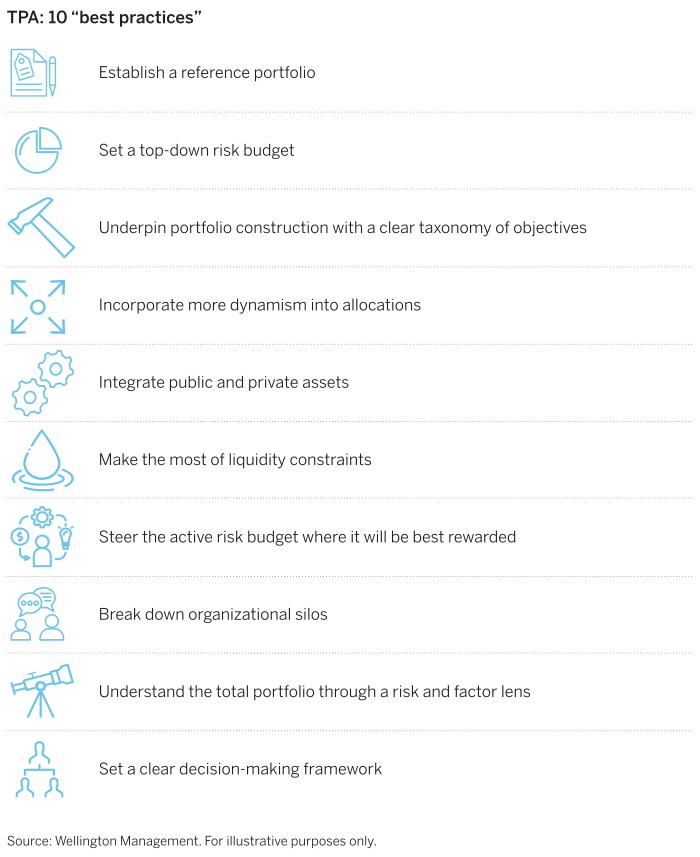
For many allocators, the most practical path may therefore be evolutionary rather than transformational. Some may already be using elements of TPA without applying the label — and may have been doing so for years. Others may selectively leverage TPA “best practices” that address a particular opportunity for improvement in their existing process. In Figure 1, we offer our take on these best practices.

Figure 1

TPA “best practices”

Applying TPA to key client challenges

To help put theory into practice, we’ll highlight a few common asset allocation challenges that the principles of TPA can potentially address.

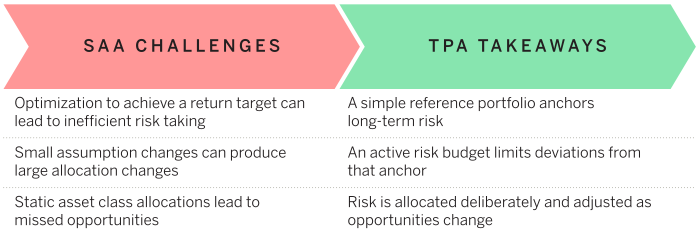
Challenge 1: Sub-optimal SAA

Traditional strategic asset allocation (SAA) provides a disciplined long-term policy framework, but the standard inputs of expected return, volatility, and correlation may not capture the full breadth of roles and characteristics that allocators want. Objectives such as inflation sensitivity, return consistency, or income can influence the optimal portfolio structure.

In addition, SAA outputs are only as effective as the assumptions and processes behind them. For example, the long-term capital market assumptions used in SAA are only estimates and unlikely to be spot-on. At the same time, relatively small changes in expected returns, volatility, or correlations can lead an optimization model to recommend meaningfully different allocations.

The challenge becomes more pronounced when optimizing to a fixed return target. If the expected payoff from taking risk is modest, the model may recommend a very risky portfolio simply to reach the target. When risk is well-compensated, the same process will likely suggest a low-risk portfolio, as that is sufficient to achieve the desired return. Perversely, this approach leads to portfolios taking more risk when it is less well-compensated and less risk when it is more likely to be rewarded.

Long time horizons introduce another complication. An allocation may ultimately prove correct, but only after an extended period in which markets move in the opposite direction. For the allocator and any stakeholders, the challenge is maintaining conviction in an investment mix that produces years of disappointing results.

How TPA can help: Anchor risk, then allocate it deliberately

The implication of these limitations and drawbacks is not that allocators should abandon SAA. It’s that they should be deliberate and thoughtful about how much risk they take over the long term and how they allocate that risk. In each of these respects, TPA practices may have a role to play.

At the top of the list is a reference portfolio: a simple, transparent mix designed to represent the allocator’s long-term risk tolerance and expected return. Rather than prescribing the final portfolio, it establishes a baseline for risk taking and acts as a point of comparison for the value-add decisions made in the portfolio.

The allocator can then set an active risk budget that defines how far the portfolio may deviate from that baseline. Deviations from the reference portfolio may include strategic allocation tilts, shorter-term tactical positions, or manager- or security-selection decisions. By sizing each deviation within a shared risk budget, the trade-offs can be made more explicit rather than allowing them to emerge indirectly from a collection of one-off decisions.

A clear taxonomy of objectives can strengthen the process. Instead of asking how much to allocate to equities or bonds, the focus is on what the allocator is seeking from the portfolio. We typically focus on portfolio “roles” — such as capital growth, income, downside mitigation, diversification, or inflation sensitivity — and consider how an allocation can support those objectives. But others might use factors, themes, or measures of economic sensitivity to guide decisions. The key is to break down asset class and organizational silos by framing how each allocation aligns with the portfolio’s broader goals. Equally important is recognizing that each allocation brings a bundle of beta (market) and alpha (active) risk. TPA forces allocators to have a clear understanding of both and to consider each allocation through its contribution to the portfolio’s total market and active exposure.

The mix of assets can also evolve, as TPA typically encourages more dynamic asset allocation. A high-conviction cross-asset view may justify taking more risk in one asset class or another, for example. When certain regional opportunities appear especially attractive, a greater share of the capital might be tilted to those areas. If active management opportunities in one strategy are compelling, the portfolio can increase its exposure — potentially hedging out the beta to focus on the alpha.

clear taxonomy of objectives

Challenge 2: Allocating between public and private assets

Determining the appropriate mix of public and private assets can be particularly challenging with a traditional SAA approach. Private-market return histories often look unusually attractive partly because appraisal-based valuations smooth reported results. (Substituting public-market volatility is not a better approach as it can overstate the mark-to-market risk that private investors actually experience.) These measurement issues make comparisons difficult and can lead a traditional optimizer to recommend an impractically large private allocation.

Liquidity further complicates the decision. A private-market target must account not only for expected return, but also for liquidity-related issues such as a portfolio’s capacity to fund commitments or to meet liability needs. Yet many allocation processes do not translate these considerations into an explicit portfolio-level illiquidity budget.

Finally, a fixed private-market target can become a challenge, as investment teams may feel compelled to “fill” the allocation even when relative value is less compelling or suitable managers are scarce. Conversely, a rigid allocation may prevent an asset owner from taking advantage of an unusually attractive private-market opportunity.

How TPA can help: Focus on the role, not the label

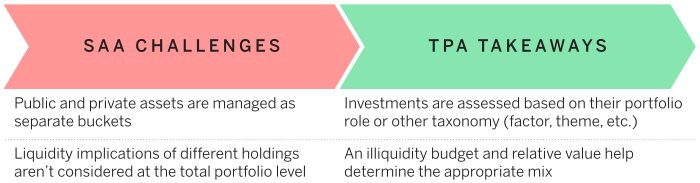
The underlying issue is that public and private assets are often treated as separate buckets, even when they may provide similar benefits and carry similar risks. A clear taxonomy of objectives, as described earlier, can help allocators look beyond these labels and assess how public and private investments can complement one another in meeting the needs of the total portfolio.

This encourages allocators to adopt a more deliberate modeling approach to private assets. In sizing positions in private equity, for example, this may mean favoring risk measures based on underlying company fundamentals rather than relying on either smoothed private returns or “unsmoothed” public-equity volatility. Using this lens can help address challenges that arise from allocating between public and private equity based solely on return relative to realized volatility. (Read our team’s research on this topic.)

To further illustrate the point, private and public equity may look quite different when viewed through mean-variance-based SAA modeling. But through a role-based framework, they may appear similar — in their return-generating potential and their exposure to downside risk. That makes sense: Both seek to access economic growth through the same part of the capital structure. Similarly, a mean-variance optimizer assessing an infrastructure investment based solely on return and volatility may miss out on the ability of its contractual cash flows to act as an inflation hedge.

TPA practices also encourage making liquidity decisions more explicit. For example, an illiquidity budget may help set an upper bound based on expected cash flows, commitments, or stress testing. Within that budget, private opportunities can compete for capital according to the expected premium over comparable public assets, among other factors.

total-portfolio-approach_fig3

Challenge 3: Disappointing alpha

Generating consistent alpha is not easy, and the opportunity set is not equally attractive across markets or over time. Market efficiency and breadth, fees, and the availability of skilled managers, among many other factors, can influence the potential payoff from active management. In recent years, for example, equity-market concentration has created a particularly demanding backdrop for many long-only managers, as a small number of large benchmark constituents have accounted for an outsized share of returns.

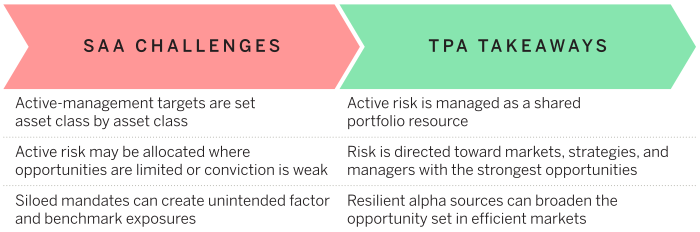
A traditional asset allocation process can compound the problem by treating active-management exposure as another set of boxes to fill. An allocator may search for active managers in every asset class or market segment simply because each has an active target, committing capital where structural inefficiencies appear limited or manager conviction is weak while missing opportunities to lean more heavily into areas where the potential payoff is more attractive. The result can be a collection of individually reasonable mandates that does not make efficient use of the portfolio’s aggregate active risk — and fee — budget. In addition, when managers are assembled within separate sleeves, their factor exposures and benchmark over/underweights may accumulate in unintended ways at the total-portfolio level.

How TPA can help: Make active risk count

TPA reframes active management as a total-portfolio decision. As noted earlier, allocators can establish a common active risk budget and direct it toward the markets, strategies, and managers where conviction is strongest. A market-efficiency framework can help inform that judgment by considering factors such as the breadth of the opportunity set, the dispersion of security outcomes, and the prevalence of stock-specific risk (read more about market-efficiency frameworks).

In relatively efficient markets, the answer need not be a binary choice between conventional active management and passive exposure. Instead, allocators can steer the risk budget where it may be best rewarded, including leaning into resilient alpha sources. This can include what we’ll call core 2.0 strategies, which emphasize disciplined portfolio construction and efficient use of the risk budget. While some of these strategies are strictly quantitative, allocators can diversify with complementary fundamental strategies.

Extension (e.g., 130/30) strategies may also have a role to play. By allowing short positions alongside long holdings, these strategies can give managers more flexibility to express both positive and negative views, expand the opportunity set, and help manage benchmark concentration while still maintaining a core market exposure.

Portable alpha goes a step further by separating the choice of market exposure from the source of excess return. Allocators can maintain a desired beta exposure through a liquid, often derivative-based implementation while seeking to source alpha from strategies operating in different or less-efficient opportunity sets.

Across these approaches, the TPA principle is the same: Do not spread active risk evenly simply for the sake of completing an allocation structure. Concentrate it where there is confidence that expected alpha can justify the associated risks and fees.

total-portfolio-approach_fig4

More TPA best practices

There are a few other TPA best practices allocators may want to consider adopting. As noted, the spirit of TPA lies partly in breaking down silos between asset classes and, often, between the investment teams that oversee them. For some, this may not come naturally. After all, a core precept of investment management is that focus is essential to long-term success. At the same time, “tunnel vision” is not good for any investor, and a key to avoiding it may be to promote more dialogue across asset class specialists. Equity investors may glean insights from credit experts — and vice versa. At Wellington, we see the benefit of cross-asset and cross-sector dialogue all the time in our Morning Meetings.

Allocators who do not have access to robust portfolio analytics may also want to consider enhancing their ability to assess their overall portfolio through a risk and factor lens. Aggregating the full complement of portfolio holdings data into one system can be challenging, but the rewards — when combined with creative portfolio and risk analytics — can be substantial.

Investment teams that can take a holistic view of the portfolio will have a clear, real-time understanding of what they own (and do not own). Combining this aggregate, top-down view with stress tests and exposure analysis allows for more deliberate decision making. It also opens the door to adjust the risk posture — across the portfolio or within specific assets and strategies — in line with the team’s confidence in those investments at any point in time. This capability typically falls into the category of behind-the-scenes infrastructure, but its portfolio impact — it’s potential “alpha” — may be meaningful.

Finally, we think the TPA programs best positioned for success are those that recognize that turning a “mindset” into a portfolio requires a clear decision-making framework. That includes accountability for portfolio decisions, especially for how the top-down risk budget is defined and ultimately translated into specific allocations of capital. The final decision may rest with an individual or a committee, and — even under TPA — different responsibilities can be delegated to different individuals or teams. But ultimately, these decisions require clarity, transparency and, above all, a well-defined process.

Take what you need from the TPA toolkit

For all its appeal, a fully integrated TPA framework may not be practical or necessary. TPA typically asks boards to set broad objectives and risk limits while delegating more day-to-day allocation authority to investment staff. This approach may not be for everyone.

Team size is also a potential sticking point. A smaller team may find it easier to bring the relevant decision makers together, compare ideas, and act quickly — but it may struggle with data and analytics. A larger organization may have more of the necessary specialist expertise and better risk management technology — but also more layers of governance that make decision making slower and more complex.

Ultimately, many allocators may be best served by adopting elements of TPA like those discussed in the examples above. Selected practices can be introduced incrementally and within existing governance structures. Pilot programs, cross-team forums, and total-portfolio dashboards can allow an institution to test the approach before making broader organizational changes. For some, a hybrid model blending selected SAA and TPA practices may offer a more workable balance.

Again, the goal is not to adopt TPA for its own sake, but to identify practices that can effectively strengthen the portfolio and the investment process. We would welcome the opportunity to help allocators determine which elements best fit their objectives, governance, and capabilities, and translate those choices into action.

The views expressed are those of the authors at the time of writing. Other teams may hold different views and make different investment decisions. The value of your investment may become worth more or less than at the time of original investment. While any third-party data used is considered reliable, its accuracy is not guaranteed. For professional, institutional or accredited investors only.

Experts

Get our latest market insights straight to your inbox.

Read more from our experts