



-
Amy Trainor
, FSA
- LDI Team Chair, LDI Strategist, and Portfolio Manager
Explore our insights
Asset class
Formats
2026 Midyear Investment Outlook

2026 Midyear Investment Outlook
Thanks to strong equity market returns, the aggregate funded ratio for corporate DB plans was 109% as of July 17 — an impressive year-to-date increase of six percentage points (Figure 1) and the highest level achieved this century.1 What’s more, 34% of plans are estimated to have a usable surplus (>110%).
Given these gains and bearing in mind the many sources of uncertainty currently coloring the market outlook, we’ve assembled a checklist of action steps for plans to consider as we move into the second half of 2026.
Figure 1
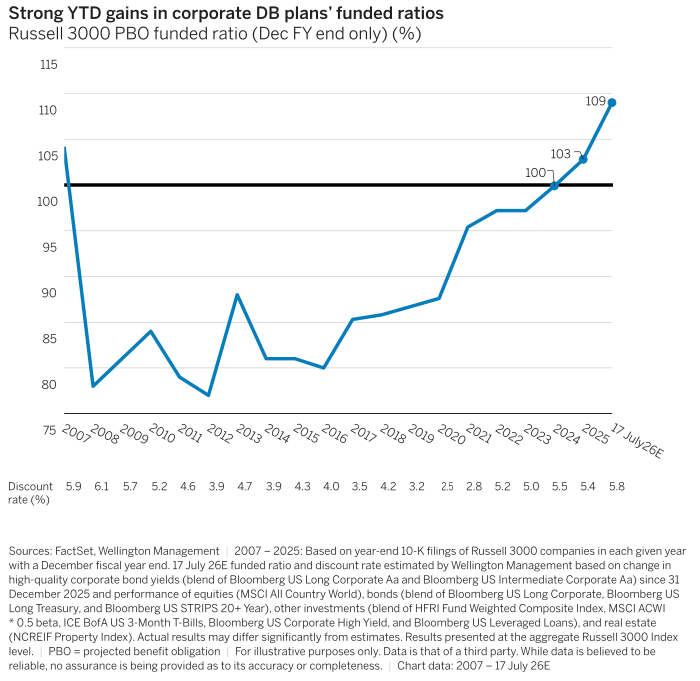
We recommend plan sponsors update their funded-ratio estimates, if they have not done so recently, and compare them against their glidepath. A six-percentage-point gain like we’ve seen at the aggregate level might well be enough to move some plans to their next derisking trigger. For plans without a glidepath, it might be worth assessing whether the gains incrementally shift objectives toward protecting funded ratios versus generating return, and what that might mean for portfolios.
We’ve generally advocated for a disciplined derisking approach, incrementally locking in some gains as funded ratios improve. History has shown that such improvements are sometimes short-lived. Short-term market returns (e.g., over a one-year horizon) are often driven by sentiment and macro conditions, making them difficult to predict.
In the current environment, we note several uncertainties based on our Macro team’s views. While they still expect above-trend growth and loose financial conditions in the second half of 2026, they see the potential for less constructive policy settings, including uncertainty around the Fed's policy framework under a new Chair, a weaker fiscal impulse, and neutral regulatory and trade developments.
In addition, geopolitical tensions continue to loom over the market, and upcoming US elections will only add to policy uncertainty. Read more in our Midyear Outlook series.
When plans reach a derisking trigger, it may present an opportunity to review both time-tested and newer liability-hedging ideas:
Credit and Treasuries — Plans generally hold a mix of credit and Treasuries, but the composition might evolve with derisking activity.
Liability-hedging diversifiers — As discussed in this paper, we think investments in investment-grade private debt, return-seeking fixed income, and long-duration securitized assets can potentially help pursue a variety of objectives, from seeking to bolster returns with manageable funded-ratio volatility impact to mitigating downside credit risk and managing issuer concentration.
As funded ratios improve and plans move toward an end-state, we think they should consider this key question: When it comes to hedging against interest-rate risk, should the focus be on immunizing a plan’s dollar surplus or its funded ratio from rate changes? Ideally, the answer would be “both,” but mathematically, it’s not possible to fully hedge both the surplus and the funded ratio unless a plan is exactly 100% funded.
Plans can run simulations to quantify the trade-offs of prioritizing one objective over the other and consider these in the context of their overall philosophy and objectives. In general, we observe that plans focused on the balance sheet and income statement tend to prioritize hedging the surplus, and those focused on contribution requirements, including PBGC variable rate premiums, tend to prioritize hedging the funded ratio. For more, see our paper, Extra credit for corporate plans: Advanced topics in LDI implementation.
With many plans seeing their funded ratios improve, questions about how to invest surplus assets are on the rise. To help, we’ve designed a framework with three possible paths:
For more on this framework, read our recent paper.
We think underfunded plans should seek opportunities to maximize returns but with an aim to mitigate erosion in funded status along the way. In particular, plans may want to consider complementing core equities in their return-seeking portfolio with liability-aware diversifiers — assets that may offer lower equity correlations and unique, more bond-like return streams that can also serve as an implicit liability hedge. Among the ideas we favor in this area:
Plans across all funding levels may also want to lean into active management to seek to bolster returns via approaches such as equity extension strategies and market neutral strategies (hedge funds or liquid vehicles), which can be implemented standalone or ported over the desired beta.
1Compared to funded ratios at calendar year’s end. Based on estimated changes in yields and asset returns since reported funded ratios and discount rates at year-end 2025. Year-end data based on year-end 10-K filings of Russell 3000 companies in each given year with a December fiscal year end. July 17 estimate based on funded-ratio and discount rates estimated by Wellington Management based on change in high-quality corporate bond yields (blend of Bloomberg US Long Corporate Aa and Bloomberg US Intermediate Corporate Aa) since 31 December 2025 and performance of equities (MSCI ACWI), fixed income (blend of Bloomberg US Long Corporate, Bloomberg US Long Treasury, and Bloomberg US STRIPS 20+ yr), other investments (blend of HFRI Fund Weighted Composite Index, MSCI ACWI * 0.5 beta, ICE BofA US 3-Month T-Bill, Bloomberg US Corporate High Yield, and Bloomberg US Leveraged Loans), and real estate (NCREIF Property Index). Actual results may differ significantly from estimates. Results presented at the aggregate Russell 3000 Index level. Sources: FactSet, Wellington Management.
The views expressed are those of the speaker at the time of filming. Other teams may hold different views and make different investment decisions. The value of your investment may become worth more or less than at the time of original investment. While any third-party data used is considered reliable, its accuracy is not guaranteed. For professional, institutional, or accredited investors only.