
Explore our insights
Asset class
Formats
2026 Midyear Investment Outlook

2026 Midyear Investment Outlook
Historically, public and private credit have been viewed as distinct allocations. Today, however, we're seeing an evolution among investors toward an integrated approach that’s open to opportunities across the public/private spectrum in pursuit of a potentially more attractive risk/return profile — and especially in the investment-grade sector. In a recent poll, we found that 27% of insurers allow their investment-grade credit portfolio managers to hold both public and private exposures, while 39% allocate to both public and private credit but do so independently. Another 11% plan to integrate the asset classes within the next two years.1
In this article, we offer insights to help insurers along in this journey, including:
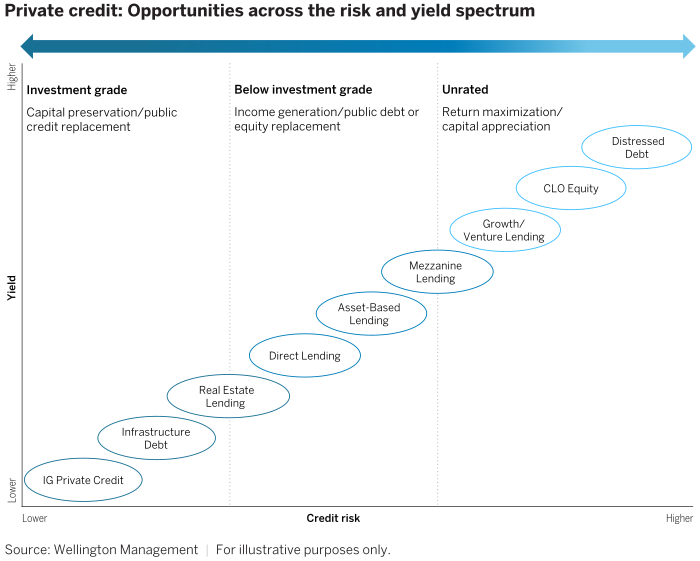
The direct lending market tends to get a lot of the media attention, but private credit includes a wide range of asset types, which vary greatly by credit quality and yield (Figure 1). Among insurers, including those taking a more integrated approach to public and private assets, the focus tends to be on investment-grade private credit (lower-left oval), where credit risk is generally similar to the investment-grade public credit and corporate markets.
Figure 1
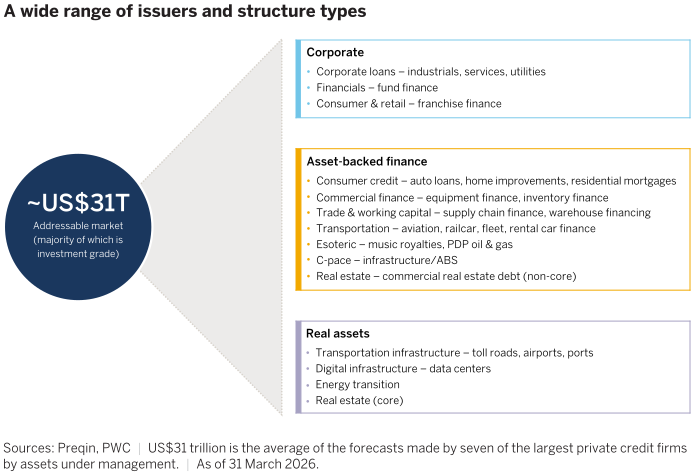
The investment-grade private credit market has been around for decades, but in recent years it has expanded to represent the lion’s share of the addressable market, with significant growth across issuers and structure types (Figure 2). In fact, the investment-grade market now dwarfs the more traditional middle-market direct lending space, and we expect both issuance and investor interest to remain strong.
We believe this evolution in the private credit market aligns well with the needs of insurance companies. The fact that much of the issuance is investment grade has made the asset class a potentially attractive complement to investment-grade public market exposure within an insurer’s core reserve allocation. In addition, while long-dated issuance in the space has for years fit the needs of life insurance companies, growth in the intermediate part of the curve today may hold appeal for a broader universe of insurers, including health and property & casualty insurers.
Figure 2
We see several reasons for insurance companies to consider pairing investment-grade private credit with their core public credit allocations:
Enhanced income and relative value opportunities — By adding investment-grade private credit to the mix, insurers may be able to enhance the income delivered by the overall portfolio, while maintaining a similar credit quality. That potential premium compensates investors for the reduced liquidity and the deal complexity in the private credit market. It reflects the buy-and-hold nature of the market, where every document is bespoke and negotiated.
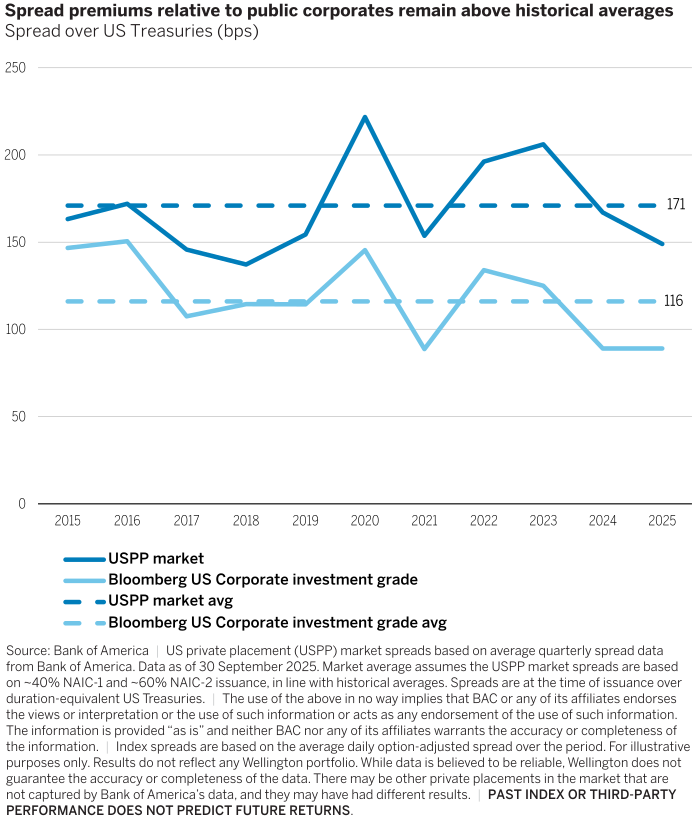
This premium has stood the test of time, averaging more than 50 basis points for syndicated deals over the past 10 years (Figure 3). What’s more, with interest rates having risen and made investment-grade public yields attractive relative to recent history, issuers in the private credit market have had to pay up, which has helped push private credit illiquidity spreads above historical averages. Importantly, we think managers with the ability to be selective and look for deals outside the syndicated market can target an even higher spread premium.
Figure 3
An integrated allocation also enables a combined assessment of public and private markets, creating the potential to capture relative value opportunities across the full investment universe.
Diversification2 — Pairing public and private markets broadens the opportunity set. As noted earlier, the investment-grade private credit market includes a unique set of issuers, sectors, and structures. There are financial and corporate issuers, of course, but we also see a wide range of non-corporate issuers, such as sports teams, higher education institutions, and health care institutions.
As a result, investment-grade private credit can offer different exposures that may complement public investments and potentially help reduce concentration risk. It can also offer geographic diversification, since about half of annual issuance comes from outside the US, and a wide range of maturities from 3 to 30 years, as well as some non-standard maturities.
Operational efficiency — Coordinated management across public and private assets can enable consistent positioning and risk management at the total portfolio level. It also allows for more efficient processes to manage capital deployment and cash flows between allocations, reducing operational complexity (we share more on this topic in the next section).
Potential for downside protection and increased portfolio resilience3 — At a time when there are some questions about credit quality in the broader private credit market, we think it’s critical to understand a couple of distinguishing features of the investment-grade private credit market. First, as noted, it should be viewed as a core buy-and-hold asset class, not an opportunistic, swing-for-the-fences asset class.
Second, deals in this space involve credit-protective covenants and prepayment provisions that can help mitigate downside risk. These structural protections may provide investors with a seat at the table if there’s a material change in the issuer during the investment, and give them the ability to renegotiate, reprice, or even force prepayment of the bonds depending on the situation.
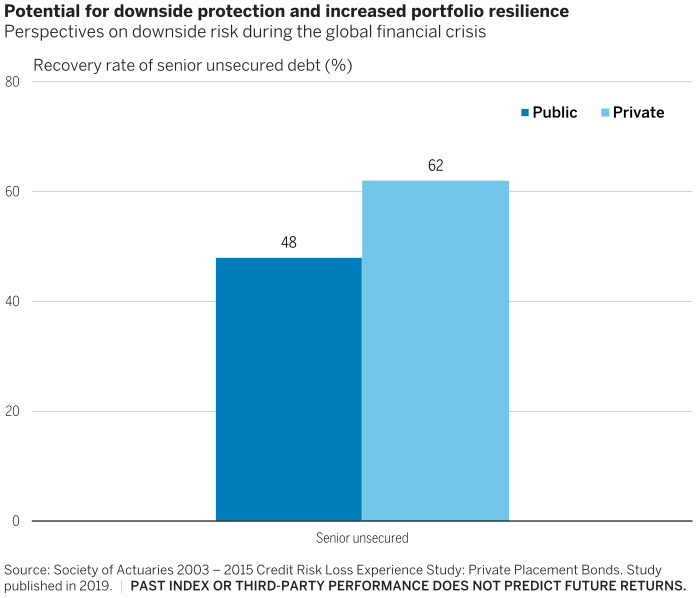
Research by the Society of Actuaries demonstrates the potential advantage investment-grade private credit may offer in minimizing economic losses. Over the period shown in Figure 4, which includes the global financial crisis, private bonds had a higher recovery rate than public bonds.
Figure 4
Finally, insurance industry regulation can provide an additional layer of protection. Many securities in the investment-grade private credit market have credit ratings issued by a Nationally Recognized Statistical Rating Organization (NRSRO), such as S&P and Moody's. But in determining risk-based capital charges for a private security (which will be the same as for a public security with the same rating), the National Association of Insurance Commissioners (NAIC) and its Securities Valuation Office assign their own ratings, as well. And because these securities are typically held in an SMA, on balance sheet, the regulator has direct visibility on the holdings.
As we noted, life insurers have long been attuned to the potential benefits discussed above and they’ve often taken a holistic approach to the management of public and private investment-grade allocations. But now we think insurers more broadly should be focused on this convergence opportunity and the ways in which it can be tailored to their specific needs. In that context, we’ll touch next on some of the key implementation and operational considerations.
As indicated by the survey results shared earlier, insurers are thinking about the integration of public and private credit in several different ways — from a stand-alone approach with independently managed public and private portfolios on one end of the spectrum to a fully integrated approach, where a lead portfolio manager owns the private allocation decision, on the other end (Figure 5). In practice, we find that many insurers are somewhere in the middle.
Figure 5
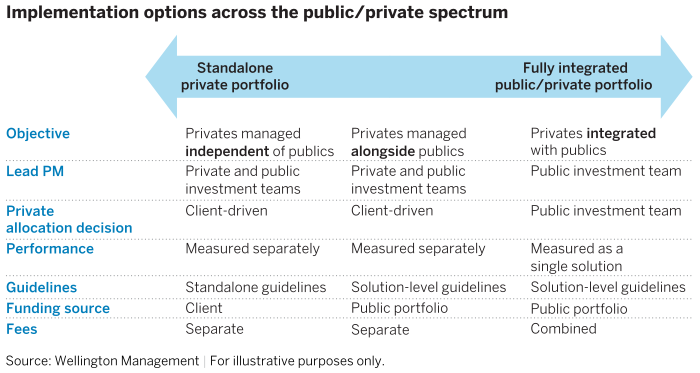
We think insurers making this decision should consider several factors, including:
Performance — From our perspective, one of the key arguments for pursuing some level of integration is that it can provide a clearer view of the relative value the private allocation is providing. Insurers may be better able to gauge whether the addition of private credit to the mix is offering the desired yield improvement and diversification.
Guidelines and funding sources — When adopting a more integrated approach, the adjustments to guidelines and policy statements necessary to account for the attributes of private credit may be fairly simple, such as minor changes in sector/issuer limits and quality exposures.
This realignment of guidelines can also address another potential benefit of integration: allowing for a more streamlined process of using the public allocation as the funding source for the private allocation. When a new investment opportunity arises on the private side, an integrated approach can avoid some of the burdensome operational steps that would otherwise be necessary to free up the required cash.
Accounting and regulatory issues — With insurers having been longtime investors in private credit, regulators and accounting agents are generally familiar with the asset class and typically have the appropriate infrastructure. Given the structural similarities in public and private credit, the same accounting practices and rules are generally used, including rules around impairment.
Custody services — Given certain operational complexities related to private credit, insurers may need to work through some initial setup issues with the custodian, including the ability to properly manage the physical settlement required with private credit deals.
Pricing and liquidity — Unlike public securities that price every day, privates are priced monthly. It’s important for stakeholders in the integration decision to be aware of this difference in timing.
Similarly, the less liquid nature of privates needs to be considered at the allocation level and the operational level. Again, we think the intention going into a private credit investment should be to hold it to maturity. It’s also important to recognize that the lack of liquidity means it can take time to build a diversified position in privates — potentially months or more.
Secondary market — While we see investment-grade private credit as a buy-and-hold asset class, the need for a secondary market does arise at times. That secondary market has grown to about $3 billion in trading annually, though given the strong demand for investment-grade private credit, it is supply-constrained (for context, deals in the original issue market on that syndicated side amount to about $100 billion a year). Given the downside protection features of investment-grade private credit, credit losses and impairments have not been common, but the secondary market can be available for transactions when needed.3
In summary, a thoughtful approach to the integration of investment-grade private credit into an insurer’s portfolio may enhance yield, diversification, and long-term outcomes. There are investment and operational factors to consider, such as liquidity, portfolio management responsibilities, and funding sources, but in our view, most of the decisions are relatively straightforward. We would welcome the opportunity to discuss them in greater detail and to share our experience.
1Wellington Management poll conducted at periodic webinar in November 2025, with 106 respondents. Participants consisted of insurers attending the event and may not be representative of the broader market. Responses reflect participant views at the time of the meeting and are subject to change. Results are based on self-reported data and are for illustrative purposes only. | 2Diversification does not ensure a profit or guarantee against a loss. | 3Downside protection does not ensure a profit or guarantee against a loss.
The views expressed are those of the authors at the time of writing. Other teams may hold different views and make different investment decisions. The value of your investment may become worth more or less than at the time of original investment. While any third-party data used is considered reliable, its accuracy is not guaranteed. For professional, institutional or accredited investors only.
Experts