menu
search
Skip to main content

Active management: Aligning portfolios with client goals

search

Top of Mind: Challenging false investment dichotomies

16 min read
2027-09-09
Archived info
Archived pieces remain available on the site. Please consider the publish date while reading these older pieces.
Top of Mind
Adam Berger, CFA, Multi-Asset Strategist
Top of Mind

Key points

Active vs passive

  • Both can play a role — the focus should be on how to allocate between them.
  • Let market efficiency guide allocations — but with about two-thirds of global market cap in US equities, don’t dismiss active management in the world’s largest market.
  • Portable alpha, extension (130/30), or “Core 2.0” strategies may help navigate concentrated markets.

US vs non-US

  • Diversification remains paramount — a global strategy offers a simple way to broaden equity exposure.1
  • Be deliberate and cautious about regional tilts, whether toward the US (given its weight in global benchmarks) or non-US markets (given the US market’s potential structural advantages).
  • Consider EM equities, which have some uniquely positive attributes today.

Public vs private

  • Size private allocations based on illiquidity capacity, excess-return needs, and access to good managers.
  • Use a role-based framework to allocate across private asset classes.
  • Consider “hybrid” strategies that dynamically allocate between public and private assets as opportunities shift.

This quarter, I discuss three familiar investment debates where rigid “either/or” thinking may lead investors to overlook the possibilities of “and”: active vs passive, US vs non-US, and public vs private. In a recent poll, we asked allocators which of these causes them the most stress: The top choices were active/passive (41%) and public/private (34%), followed by US/non-US (19%) and “other” (5%; e.g., growth/value).2

For each debate, I weigh the arguments on both sides before outlining investment ideas to help move beyond the “false dichotomy.”

Active versus passive

The case for passive rests on several evergreen points: It's simple, inexpensive to implement, and scalable (large asset owners can allocate significant capital to a passive strategy without meaningfully distorting the market). Recent market experience has added to the case, with passive strategies delivering strong results. In addition, technology has made information more widely available — potentially improving market efficiency and making it harder for active managers to gain an edge. At the same time, market returns in the last 3 – 5 years have become increasingly concentrated, with a relatively small number of stocks, especially in technology, driving index performance and creating a tougher backdrop for active managers.

The case for active is strong as well. At the top of my list: An index is not a fiduciary. A cap-weighted index of securities is designed to represent a market, not to reflect any individual investor’s goals, constraints, or risk sensitivities. In other words, low-cost, scalable exposure is not necessarily the same as an appropriate portfolio.

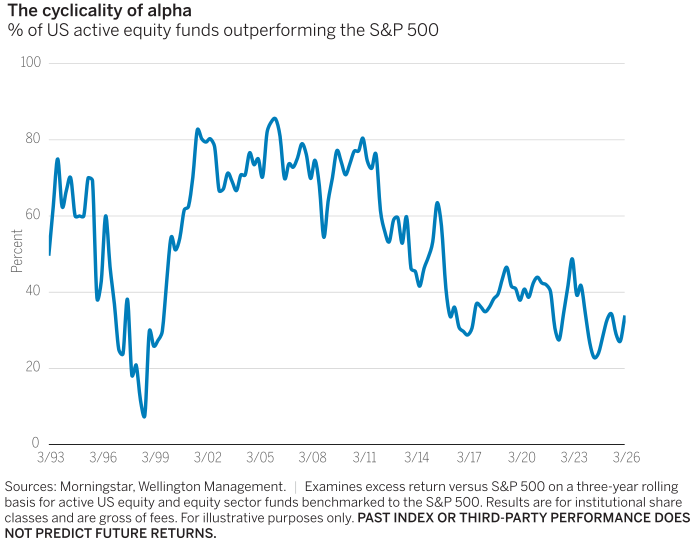
I also think there is a particular case for active management today. First, there's evidence that alpha is cyclical. Even in the large-cap US equity market — arguably one of the most efficient markets — there have been periods when a healthy share of active managers outperformed, followed by periods in which they struggled (Figure 1).

Figure 1

The cyclicality of alpha

Looking back over periods of active outperformance, our research shows that three key factors tend to drive the potential for alpha generation:

  • Market correlation is the tendency of most stocks in an index to move in the same direction day to day, measured by the average pairwise correlation of all stocks in an index to each other. When more stocks move in different directions (i.e., correlation is low), there is more opportunity for active managers to add value by picking between the winners and losers.
  • Market dispersion refers to the distribution of return outcomes across all stocks in an index. It is typically measured as the standard deviation of the returns of all index constituents over a given period. Higher dispersion translates to a richer hunting ground for active managers.
  • Market breadth can be defined in various ways, but for active management, think of the size of the opportunity set for active managers — the bigger the better. It can be measured by the percentage of stocks in an index that are ahead of the index over a given period.

From 2010 to 2020, all three of these factors were headwinds for active management. But in recent years, two of the three — correlation and dispersion — have turned in a more positive direction, driven by the move from a relatively stable economic environment to one marked by higher inflation, deglobalization, and growing policy variations across different regions.

Market breadth has remained a sticking point, with a relatively small number of stocks — especially mega-cap technology stocks — leading the market in recent years. However, we’ve begun to see signs of improvement in market breadth, including earnings growth across a wider range of companies and sectors.

It’s also worth noting that periods of narrow market leadership have often been followed by underperformance in the previously dominant areas — and a broader set of market winners. We saw this after the late-1990s technology boom, in financials before the global financial crisis, and in energy soon thereafter.

Beyond the false dichotomy: investment ideas

While some investors may still wrestle with the “active versus passive” debate, I think there’s a growing recognition that both may have a role to play. The question is how to allocate between them. As a starting point, I’ll offer this guidance: In deciding to go passive in a particular market, I think you need to believe that 1) a cap-weighted portfolio aligns with your objectives and can help you achieve your return target (without any incremental return above what passive provides) and 2) that the market is relatively efficient. To go active, I think you need only one of three beliefs: 1) a non-index portfolio better aligns with your objectives; 2) structural inefficiencies in the market create opportunities for managers; or 3) even in an efficient market, you can identify a manager capable of outperforming.

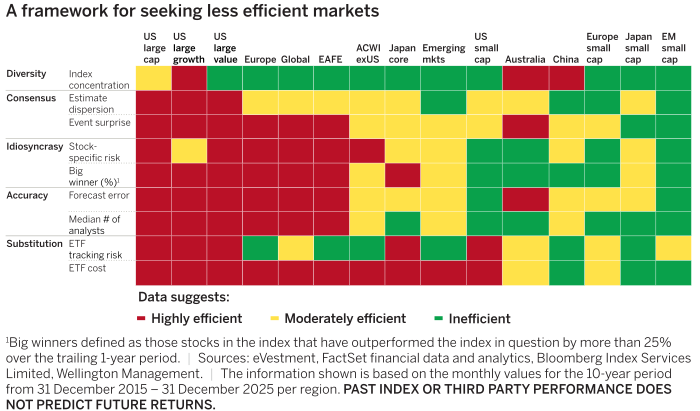
To help evaluate market efficiency, my colleagues in Wellington Solutions use the framework shown in Figure 2, which is based on their scoring (quantitative and qualitative) of various dimensions of efficiency. Markets to the right are less efficient, which may give active managers an edge.

Figure 2

A framework for seeking less efficient markets

But investors should not rule out active management in more efficient markets. Relying exclusively on passive strategies in large markets such as US large caps could leave potential alpha untapped, given these markets’ significant portfolio weight. Active management may also help address risks such as concentration. To that point, I think investors should consider several approaches to pursuing alpha and managing risk in more efficient markets:

  • Portable alpha combines a “pure” market-neutral alpha source from a performance-driven strategy (e.g., a hedge fund) with passive market exposure obtained through futures. This approach fell out of favor after the global financial crisis, when some strategies proved to contain unintended beta. But the industry has learned from that experience, contributing to improved outcomes and renewed interest.
  • Active extension (e.g., 130/30) strategies allow managers to express active views through both long and short positions. This flexibility lets them hold the largest benchmark names at market-cap weights when they lack a differentiated view, while taking more active positions elsewhere in the opportunity set.
  • Core 2.0 strategies may be even simpler and lower cost. They emphasize disciplined portfolio construction and efficient use of a more modest risk budget. While some of these strategies are strictly quantitative, investors can diversify with complementary fundamental strategies.

US versus non-US equities

The case for US equities remains compelling, even after years of “US exceptionalism” and despite some risks (e.g., high government debt). The country continues to benefit from a strong culture of innovation, shareholder-friendly management, solid economic growth, favorable demographics, and world-leading technology exposure. Strong earnings growth and market performance have reinforced investors’ confidence in these advantages.

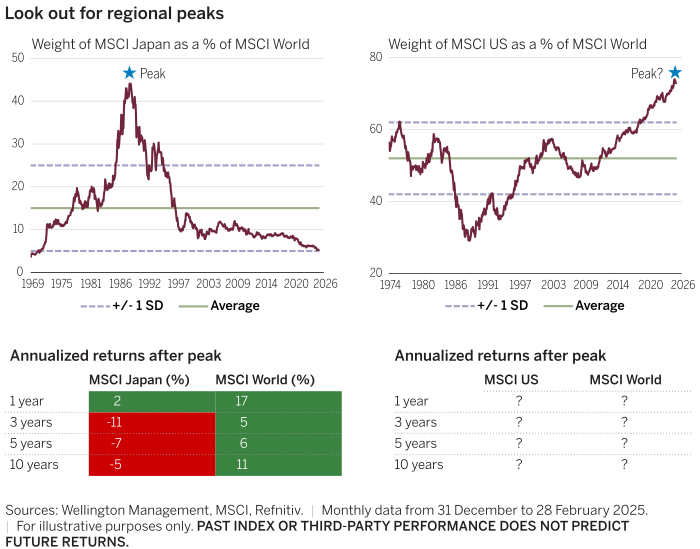
The case for non-US equities rests partly on valuations, which, based on long-term data, remain a bargain compared to the US. The growing concentration of US stocks in the global equity market also supports the case. For most of my investing career, the US accounted for 45% – 55% of global market capitalization; today, its share is approximately 65%. Combined with a history of shifting regional leadership and signs that some US exceptionalism may be moderating, this concentration strengthens the argument for broader global diversification.

Japan offers a useful case study. In the 1980s, its strength in technology and manufacturing helped lift its share of the global equity market from less than 10% to more than 40% (Figure 3). But its dominance eventually gave way to a prolonged decline. The US may not follow the same path, but Japan’s experience is a reminder that no period of market leadership lasts forever.

Figure 3

Look out for regional peaks

Beyond the false dichotomy: investment ideas

I’ll offer three ideas here:

1. Use a global equity strategy as your starting point

For many investors, a global equity strategy is a simple way to diversify beyond the US. Key benefits include:

  • Flexibility: Managers can invest in attractive companies and industries wherever they are located.
  • More ways to diversify: Returns can come from stock selection as well as differences among countries and regions.
  • Greater scope for active management: A global mandate may give skilled managers more opportunities to add value than a US-only portfolio.

A global equity approach also has potential drawbacks. Investors have less control over their US and non-US allocations. Some global managers may favor large-cap stocks, limiting exposure to smaller or more domestically focused companies, although regional specialists can help address this gap. Managers may also differ significantly from the benchmark, so investors should understand any resulting exposures, such as a structural underweight to the US.

2. Be deliberate but cautious about any tilts

A global portfolio can be a sound starting point, but I wouldn’t rule out the possibility of some thoughtful portfolio tilts as well. There may be arguments for growth- or value-based tilts — for example, strong US growth and technology leadership may support a US overweight, while lower valuations may favor non-US markets.

Any tilt should be deliberate and carefully sized, bearing in mind the risks of leaning too far in either direction. As noted, the US represents a large share of global markets, but its recent advantages could persist.

One balanced approach might be to add non-US exposure for diversification while complementing this with an overweight to US technology. This may reduce geographic concentration without giving up participation in a key source of market growth.

3. Consider emerging markets

Emerging markets may deserve a larger role in global portfolios. Broadly speaking, they are exhibiting some of the same advantages as the US, including strong technology exposure, shareholder-friendly management, and improving earnings growth.

In addition, emerging market valuations remain attractive relative to developed markets. If this long-standing discount narrows, it could provide an additional source of return. That discount has generally reflected concerns about political stability, inflation, and fiscal policy in emerging markets. But those gaps may be narrowing, as governance improves in some emerging markets and concerns grow in the developed world (e.g., questions about Federal Reserve independence in the US). Against this backdrop, our Wellington Solutions team has a positive tactical view on EM equities.

Public versus private

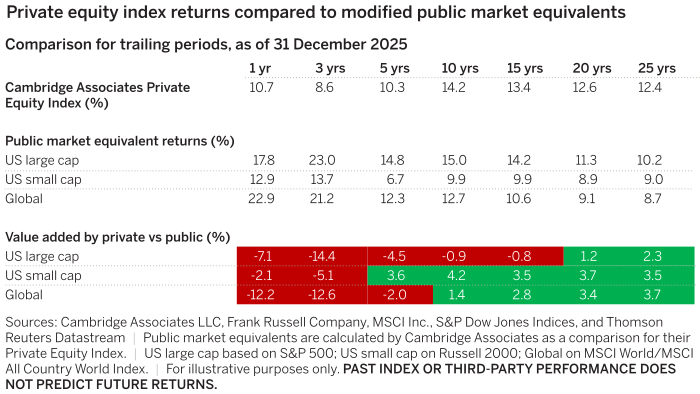
The case for private includes total return potential, a broad and differentiated opportunity set, and a perceived volatility advantage. (I say “perceived” because the true volatility of private equity is inherently difficult to estimate due to the intermittent and appraisal-based valuations of private equity holdings; read more about private-market volatility metrics.) Figure 4 highlights the potential return benefit. The Cambridge Associates Private Equity Index trailed public-market equivalents over shorter horizons but outperformed over longer ones. Note that the shorter periods coincided with exceptionally strong public-market gains and a more challenging backdrop for private equity.

Figure 4

Private equity index returns compared to modified

The case for public centers on lower costs, greater simplicity, and liquidity, which makes it easier to rebalance and maintain a portfolio's desired exposures and risk profile. Public investments also offer greater scalability, transparency, and benchmark-ability. And as Figure 4 shows, they can deliver very strong results.

Beyond the false dichotomy: investment ideas

Many investors I speak with see public and private markets as an increasingly integrated ecosystem and, therefore, a blend of public and private assets as the logical path forward. Pairing public and private equity in a portfolio is well established, and the approach is increasingly extending to other asset classes, including bonds, real estate, and infrastructure.

Investors also raise a variety of related implementation questions.

How should I size private allocations?

Several factors should be top of mind when setting strategic allocations to private assets, including:

  • The capacity to take on illiquidity and, to a lesser extent, complexity in a portfolio
  • The need for excess return beyond what public market investments can provide
  • The ability to consistently allocate to top-tier strategies, given the high degree of dispersion in the performance of private equity and private credit managers

How do I maximize my “liquidity budget”?

Investors with illiquidity constraints should consider prioritizing a) private-market assets offering exposures that are difficult to obtain via public markets, and b) private-market assets with the highest potential return premium to their public-market equivalents.

With respect to the latter, they should assess whether that premium will be sustainable over time and whether it’s possible to source managers who can deliver on it. On this basis, I am more skeptical about the potential premium in core real estate and infrastructure compared to other private assets. As a thought exercise, imagine there are two comparable Class A office buildings across the street from each other — one held privately (either directly or through a fund) and the other owned by a REIT. It is difficult to see why the privately held building should deliver a significant return premium. That differs from private equity or private credit, where private ownership may offer greater scope for generating excess returns.

There’s a lot happening in private markets today. Where should I focus?

I’ll share a few of my perspectives:

  • In private equity: Given elevated starting valuations in areas like US buyouts, consider niche opportunities and strategies diversified across sectors (including AI- and non-AI related sectors).
  • In private credit: With significant capital competing in middle-market direct lending, consider strategies that target less-crowded segments. For example, lingering post-COVID distress may create opportunities in transitional commercial real estate debt.
  • In private infrastructure: Recognize that AI-related investments may be more correlated with broad public equities — including mega-cap tech stocks — than traditional infrastructure assets such as toll roads and water utilities. Investors should ensure that allocations to IT-related infrastructure don’t carry the same downside as technology equities but with more limited upside.

Within private markets, how should I think about the role of different assets?

Because private-asset data is limited in history and frequency (and likely subject to more biases than public-market data), traditional allocation approaches based on mean-variance optimization may be less useful in determining where to go private. These approaches also tend to place public and private assets in separate buckets, even when they may serve similar portfolio purposes.

A better approach may be to evaluate each investment according to its intended role, regardless of whether it is publicly traded or privately held. For example, investors might assess public and private strategies using a consistent set of measures tied to roles such as diversification, income generation, and inflation resilience. Relevant measures could include correlation with other holdings, historical yield, and sensitivity to inflation surprises. A role-based framework does not eliminate the need for asset-class expertise or liquidity constraints, but it may help investors compare opportunities on more consistent terms and better assess the trade-offs.

What are some of the options for bringing public and private assets together?

In some cases, asset owners will take a more customized approach to public/private integration (as we see among insurance companies, for example). But I would also highlight several other approaches:

Hybrid strategies: Managers can shift between public and private exposures based on relative opportunities. In credit, for example, they might favor public markets when spreads are more attractive and private markets when compensation for credit risk is stronger.

Private-asset proxies: Liquid strategies across different asset classes (e.g., equities, credit, and infrastructure) can seek to replicate the return patterns of private assets. For investors who use traditional capital-call-based private asset exposures, these proxies may serve as a source of liquidity, a place to hold capital before it is called or after it is returned, or a temporary allocation for investors building private-market exposure.

Private late-stage growth strategies: With more companies staying private longer, investors may use late-stage growth strategies to capture pre-IPO growth and broaden small-cap exposure beyond a shrinking public-market universe. In a sense, this approach uses late-stage growth strategies as “completion portfolios” for a reduced public small-cap universe.

Final thoughts

Ultimately, these debates are less about choosing one side than about combining the strengths of each in ways that reflect an investor’s objectives, constraints, and opportunity set. By moving beyond rigid either/or thinking, I believe investors can build more diversified, flexible portfolios that are better equipped to navigate changing markets.

1Diversification does not ensure a profit or guarantee against a loss. | 2Wellington Management poll conducted at periodic webinar in July 2026. Responses reflect participant views at the time of the meeting, are subject to change, and are for illustrative purposes only.

The views expressed are those of the author at the time of writing. Other teams may hold different views and make different investment decisions. The value of your investment may become worth more or less than at the time of original investment. While any third-party data used is considered reliable, its accuracy is not guaranteed. For professional, institutional or accredited investors only.

Expert

Get our latest market insights straight to your inbox.

Read more from our experts