menu
search
Skip to main content

Active management: Aligning portfolios with client goals

search

Quarterly Asset Allocation Outlook

The rally: Refusing to yield?

•
10 min read
2027-10-31
Archived info
Archived pieces remain available on the site. Please consider the publish date while reading these older pieces.
maoartwork
Supriya Menon, Multi-Asset Portfolio Manager
maoartwork
Joshua Riefler, Product Reporting Lead
maoartwork

Key points

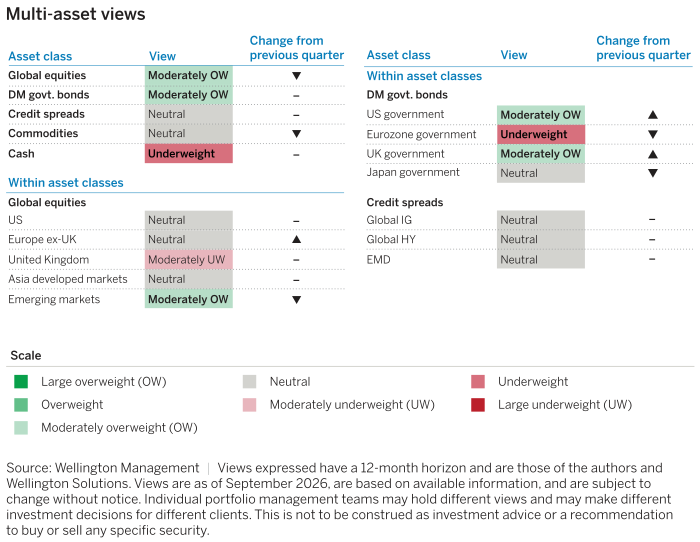
  • We have reduced our view on global equities from overweight to moderately overweight. Strong earnings, the resilience of the global economy, and continued AI-related investment support our constructive 12-month outlook. However, higher oil prices, rising bond yields, and a more hawkish policy backdrop have weakened the near-term risk/reward trade-off.
  • Among equity markets, we favor emerging markets over the UK, though we have significantly narrowed that preference. Over the longer term, attractive valuations and exposure to AI-related supply chains in East Asia continue to support emerging markets. Tactically, however, we have scaled back our view following strong relative performance and waning support from US-dollar weakness. We remain cautious on the UK, where earnings expectations appear overly optimistic given the growth backdrop.
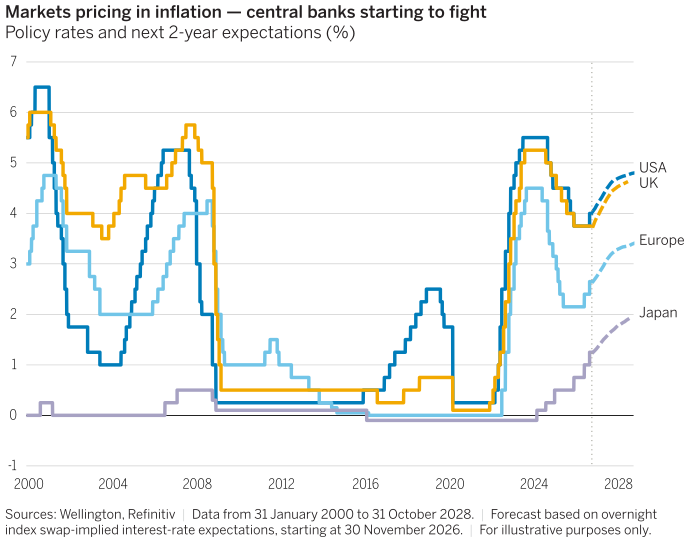
  • Markets have priced in tighter monetary policy globally, and central banks are beginning to follow through with rate hikes. Still, higher real yields have created a more attractive entry point for government bonds. We remain neutral on credit given significant tightening in spreads.
  • We are neutral on commodities. The Middle East conflict has spread to Saudi Arabia, driving energy prices higher and adding to uncertainty. On gold, the twin-engine demand story — powered by central bank purchases and ETF flows — is more mixed on the central bank side, while rate hikes pose an additional headwind. However, valuations have adjusted, supporting a neutral view.
  • Downside risks include equity market sensitivity to rapid rate increases, particularly if driven by inflation or a rising term premium; the market’s capacity to absorb credit issuance and blockbuster equity IPOs; a sharp reversal in AI capital-spending expectations; and prolonged disruption in oil and refined-product flows, which could raise stagflation risks. Upside risks include a resolution to the Middle East conflict that quickly restores oil supplies and eases inflationary pressure; continued equity market broadening beyond technology; and lower bond yields, provided they don’t reflect much weaker growth from tighter financial conditions.
Multi-asset views

Overview

The macro backdrop has become more demanding for investors. Bond yields have risen sharply as stubborn inflation, higher energy prices, and government debt concerns have driven hawkish monetary policy expectations.

At the same time, enthusiasm around AI has continued to support investment, anticipated productivity gains, and corporate earnings. Together, these forces have helped sustain the equity rally even in the face of higher rates.

Looking ahead over the next 12 months, we remain broadly constructive but less emphatically so. We think the balance of risks has weakened, prompting us to temper equity exposure while finding more value in government bonds. In this quarter’s outlook, we consider where the rally may still have room to run — and where rising yields, market concentration, and other forces may call for selectivity.

Equities

We have pared back our view on global equities from overweight to moderately overweight. Despite exceptional second-quarter earnings, continued support from AI infrastructure spending, and healthy earnings breadth, the near-term risk/reward trade-off has deteriorated. The bar for upside surprises in earnings is now much higher, and the speed and level of the rise in yields present some risks.

We remain largely positive on the AI capex cycle and its impact on earnings, with demand for compute still far outstripping supply. That said, we recognize that earnings have been running above trend and expect their exceptionally strong growth rates to decelerate.

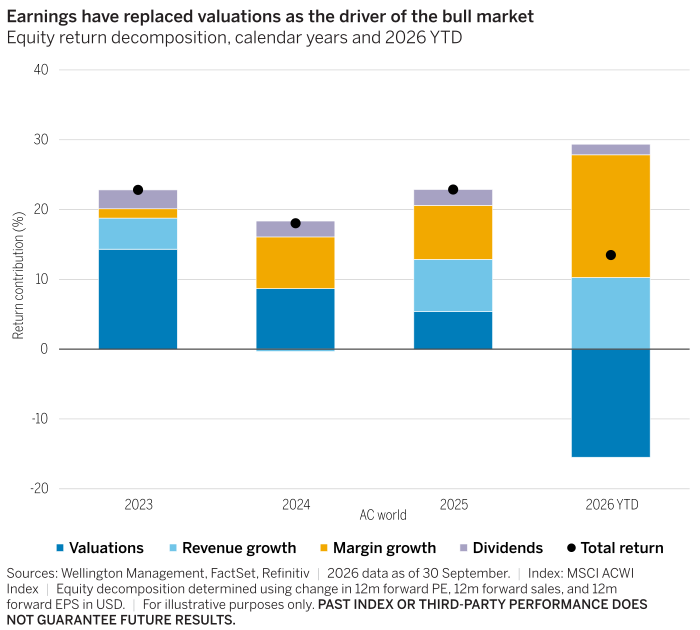
One concern is that while earning growth has broadened, market breadth has deteriorated. Market concentration in AI-related stocks, which are exposed to a potentially cyclical capital-spending boom, is driving a reluctance to assume current earnings expectations will be fully realized. Together with higher rates, these concerns have driven a contraction of approximately 15% in global equity valuation multiples this year (Figure 1).

Figure 1

Average returns after 20%+ oil shocks: Stagflation

It is also worth noting that higher yields are not inherently bearish for equities. Higher yields driven by stronger growth can generally be absorbed, while those driven by oil prices, inflation, or a higher term premium are more problematic, particularly if the increase is rapid. So far, the rate volatility has been reflected more in churn beneath the surface of the equity market than at the index level, with the global index largely flat for the quarter.

Over the next few weeks and months, we will be looking for some combination of strength in third-quarter earnings, stabilization in oil prices and long-term yields, easing in geopolitical risk, and limited risk of further monetary policy tightening. Alternatively, a meaningful equity correction without a deterioration in earnings could present a more attractive entry point.

Consistent with our broader equity stance, we have reduced our view on emerging market (EM) equities from overweight to moderately overweight, funded by a smaller underweight view on UK equities. Higher oil prices and US yields leave some EM equities with less scope for policy support, while earnings growth remains increasingly concentrated in Asian AI beneficiaries rather than reflecting a broad EM recovery. China and India have lagged the broader EM rally year to date, while Latin America has become more dependent on commodity prices and political outcomes in Brazil. On the other hand, the UK could benefit from more resilient energy-driven earnings and continued M&A activity supported by cheap valuations.

We are neutral on Japan. The market has seen broad-based earnings strength, reflected in upgrades across banks and industrials, as well as semiconductors and AI-linked segments. A stronger yen can create winners and losers within the market, rather than lead to broad weakness. However, significant macroeconomic and policy uncertainty is keeping us on the sidelines.

US equity valuations have contracted substantially, reflecting some skepticism about the strength of earnings, with the sharp rise in real rates providing an additional headwind. Continued earnings strength and a stabilization in bond yields could lead us to turn more bullish here.

Fixed income

Global yields have continued to grind higher, in certain instances revisiting multi-decade highs as markets contend with persistent inflation, a robust cycle, and growing fiscal concerns. The economy and labor market have been more resilient than expected, giving some central banks flexibility to address inflation via rate hikes without unduly weakening economic growth. While repricing of policy expectations has weighed on fixed income returns, markets may be pricing in more rate hikes than central banks will ultimately deliver (Figure 2). This could be particularly true if the Iran war is resolved and energy supplies are rapidly restored, bringing inflation down faster than anticipated. Still, upward pressure on rates has pushed nominal and real yields to increasingly attractive levels, improving the prospective return outlook for government bonds and supporting our constructive view on the asset class.

Figure 2

Stellar tech margins and return on invested capital

Entry yields are a key driver of long-term total returns, and we think today's elevated levels offer a more compelling starting point than investors have enjoyed for much of the past decade. They currently provide attractive carry and may create potential for capital appreciation in certain sectors if growth moderates or inflation eases more quickly than expected. Higher yields could also improve the ability of government bonds to serve as a portfolio diversifier, helping to offset equity market weakness in a slower-growth environment.

Globally, differences in the pricing of fiscal risks — and any missteps by central banks as they take action — could lead to relative value opportunities. We maintain our moderately overweight view on developed market government bonds overall but are becoming more selective across regions to capitalize on this dispersion potential.

We moved from neutral to a moderately overweight view on US and UK government bonds. Yield levels look attractive given the potential for economic growth to moderate, which could support longer-duration bonds. By contrast, we moved from neutral to an underweight view on Eurozone government bonds, where ongoing fiscal concerns and elevated issuance may continue to weigh on valuations. We have moved to neutral on Japanese government bonds (JGBs).

Within credit, we continue to have a neutral stance. While all-in yields are attractive and spreads have widened somewhat recently, they offer limited compensation for downside risks. AI-related capex needs are increasingly being financed through credit markets, with AI-related issuance accounting for a meaningful share of overall year-to-date fixed income issuance. We are monitoring the extent to which this creates technical headwinds, AI concentration risk, and greater dispersion across issuers over time. Overall, the risk/reward profile appears balanced, which we think warrants a neutral view.

Commodities

We have moved our view on oil from overweight to neutral. Oil markets face a near‑term deficit of about 5 million barrels per day, even as flows through the Strait of Hormuz have increased. Physical energy flows have been more resilient than expected, although diesel and refined-product supplies have been more disrupted. We also expect the market to shift to a surplus over the medium term, while many countries have already drawn down inventories substantially. With geopolitics rather than fundamentals driving the market, the binary nature of the risks limits our conviction. Rates of carry on offer due to a sharply downward-facing futures curve (i.e., the contract price for delivery of oil in the future is lower than the current spot price) are very attractive in our view, but we are reluctant to lean toward long positions at current oil prices.

We maintain our neutral view on gold. We think the precious metal can play an important role in long-term portfolio construction, particularly as a potential diversifier during periods of dollar debasement. Over the shorter term, however, high real rates and further central bank tightening present a less favorable backdrop. Turning to flows, ETF demand for gold has recovered from its lows, while central bank buying remains positive but uneven.

Investment implications

Look for diversification opportunities — As the effects of AI, higher oil prices, rising yields, and policy uncertainty create greater dispersion across regions, sectors, and individual securities, we think active positioning may add more value than broad market exposure.

Stay constructive on AI but expect more moderate equity market returns — AI investment and productivity gains continue to underpin our positive view on the economic and earnings cycles, although we believe the pace of earnings will decelerate following a period of exceptional growth. We see more moderate upside for global and EM equities, with earnings remaining the primary driver of returns.

Consider adding duration as real yields rise — Markets have shifted from pricing central bank easing to pricing broadly synchronized tightening, pushing real yields higher. We think this repricing is overdone and has left global government bonds at attractive valuations. Regional divergences in yields may also create opportunities for active positioning.

Remain selective in credit, where spreads appear too tight — Spreads have widened somewhat, but we find little value at current levels. We think European credit has better fundamentals than the US in terms of debt service and leverage, and it is more insulated from significant US issuance. In EM debt, opportunities appear more likely to come from country selection opportunities than broad market exposure.

The views expressed are those of the authors at the time of writing. Other teams may hold different views and make different investment decisions. The value of your investment may become worth more or less than at the time of original investment. While any third-party data used is considered reliable, its accuracy is not guaranteed. For professional, institutional or accredited investors only.

Experts

Get our latest market insights straight to your inbox.

Read more from our experts