




- Fixed Income Portfolio Manager
Explore our insights
Asset class
Formats
Education

Education
The views expressed are those of the authors at the time of writing. Other teams may hold different views and make different investment decisions. The value of your investment may become worth more or less than at the time of original investment. While any third-party data used is considered reliable, its accuracy is not guaranteed. For professional, institutional, or accredited investors only.
In our view, investors can have a tendency to be too short-term focused when it comes to investing in the high-yield bond market — approaching the asset class as a tactical trade rather than a longer-term, structural allocation. In contrast, we view high-yield investing as a marathon rather than a sprint — success isn’t about who records the best time for the next 10 km of the race but about who completes the course and crosses the finish line first.
For us, that translates into seeking solid income and total returns from high-yield credit by focusing on the high-quality companies likely to outperform over the long term, drawing on the experience gained across economic and market cycles and being wary of the hype surrounding potentially bubble-inducing developments like generative AI. Here, we set out what we believe are vital components of this long-term approach.
As high-yield investors, we think it’s vital to have a healthy scepticism when other investors become overly excited, due to the potential for the permanent loss of capital if a company defaults. So, we believe it’s important to seek to avoid industries undergoing a massive expansion of capacity, where economic profits are unlikely to live up to expectations and where this risk increases.
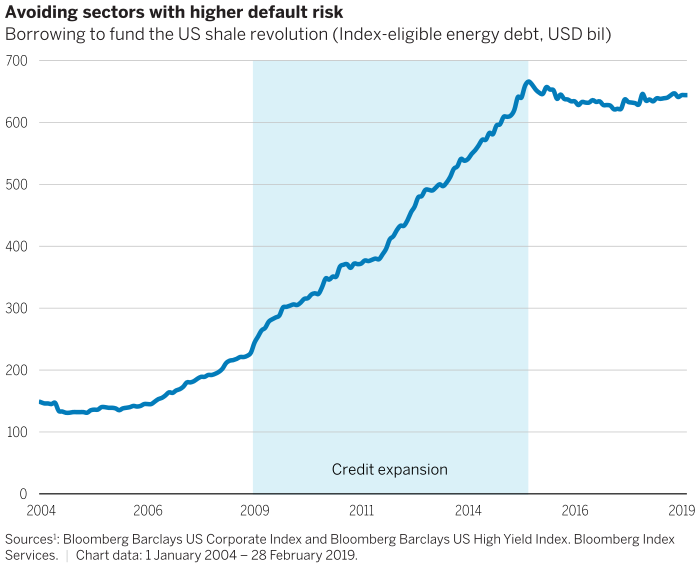
Given the difficulty of accurately forecasting demand — as trends can shift overnight under the influence of a wide variety of factors — we focus, instead, on looking at when supply is growing above trend. History has shown that during downturns, defaults tend to be concentrated in sectors undergoing increased capital supply and investment — the shale oil crisis in the 2010s is a prime case in point (Figure 1). In the run-up to this event, we saw that higher profits and prices in the sector led to increased capital investment and competition, which was ultimately exposed when demand slowed. This example highlights that market enthusiasm can often come with unintended risk.
Figure 1
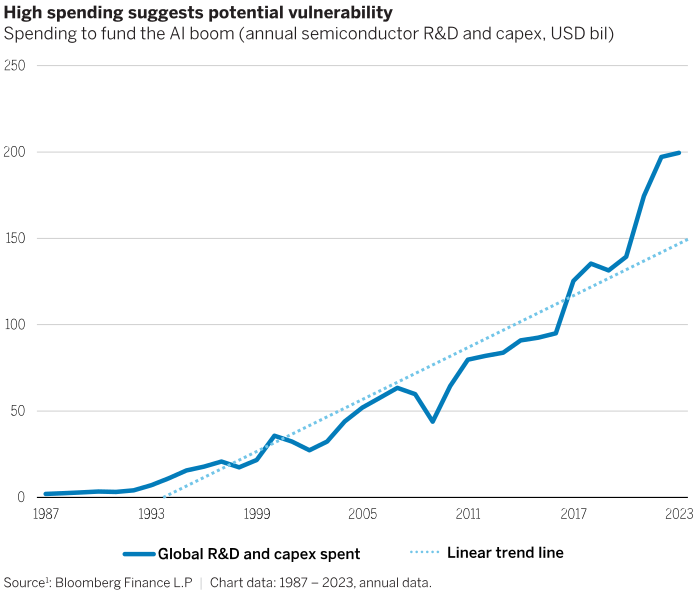
The older investors among us will remember the dotcom bubble of the late 1990s, and we believe that the advent of AI could be another case in point. AI is, of course, enabling an exciting new phase in the ongoing technological revolution with potentially promising new applications across society. But predicting who will be the winners and losers of the AI boom is far from straightforward and there will inevitably be instances of misdirected capital. We’re wary about the significant levels of above-trend investment and capex and the resulting potential for another bubble to form given the enormous level of borrowing seen in the industry (Figure 2). As such, we’re doubtful about the prospects for companies with high exposure to the AI theme, for example, in technology hardware.
Figure 2
Core to our investment philosophy is the belief that the high-yield market is highly inefficient at pricing default risk.
Taking advantage of that potential for market mispricing and minimising default risk requires significant fundamental, bottom-up credit research to uncover the highest-quality companies in terms of their underlying economic fundamentals. Equally, as we highlighted above, it means avoiding those companies with a risk of permanent destruction of capital, as well as the sectors and regions where we believe defaults are likely to be concentrated in a recession scenario in the event that we don’t achieve a soft economic landing.
Our approach to uncovering high-quality issuers prioritises seeking out companies with proven competitive advantages or moats. For example, while we’re cautious on companies that have high levels of exposure to the AI theme within the technology sector, we see a number of opportunities in payment providers and software services providers with strong competitive moats like the high expense of changing providers. In the automotive sector, we are more cautious on auto manufacturers where we have seen a large expansion in competition and new entrants to the market, but we are selectively optimistic about the potential performance of auto suppliers, which often have high barriers to entry. Many of these companies have deeply integrated relationships with OEMs (original equipment manufacturers) and there are financial, technical and regulatory hurdles associated with switching suppliers, particularly in the middle of an auto production cycle, which can last upwards of 10 years.
For all issuers, we seek to take a longer-term mindset, with an average holding period of around three years. Importantly, holding high-conviction issuers for the long term also avoids diluting investors’ potential returns with high levels of transaction costs.
We’re currently navigating a fast-evolving market backdrop. Provided we continue to avoid a default cycle — which is our base case — we believe high yield has significant appeal for long-term investors who use their scale and expertise to undertake the necessary bottom-up fundamental research and who have the experience to implement a disciplined sector and country framework that avoids those issuers and sectors with a higher risk of default.
1The examples shown are presented for illustrative purposes only and are not to be viewed as representative of actual holdings. Holdings vary and it should not be assumed any portfolio has invested, or would invest, in this (or a similar) example, nor should it be assumed that an investment in the example has been or will be profitable. BLOOMBERG® and the Bloomberg indices listed herein (the “Indices”) are service marks of Bloomberg Finance L.P. and its affiliates, including Bloomberg Index Services Limited (“BISL”), the administrator of the Indices (collectively, “Bloomberg”) and have been licensed for use for certain purposes by the distributor hereof (the “Licensee”). Bloomberg is not affiliated with Licensee, and Bloomberg does not approve, endorse, review, or recommend the financial products named herein (the “Products”). Bloomberg does not guarantee the timeliness, accuracy, or completeness of any data or information relating to the Products.