


- Equity Portfolio Manager
Explore our insights
Asset class
Formats
Education

Education
The views expressed are those of the authors at the time of writing. Other teams may hold different views and make different investment decisions. The value of your investment may become worth more or less than at the time of original investment. While any third-party data used is considered reliable, its accuracy is not guaranteed. For professional, institutional, or accredited investors only.
Although markets can be volatile and unpredictable, we think investors in growth equities can benefit from exposure to some of the most impactful, profitable, and innovative companies in the world. We believe that determining what to own and when to own it requires a clearly defined, proven, and repeatable investment philosophy and process. Here, we offer our view on the current economic environment, our guide to what we believe are key components of an effective approach to navigating growth equity investing, and our insights on where we see opportunities now.
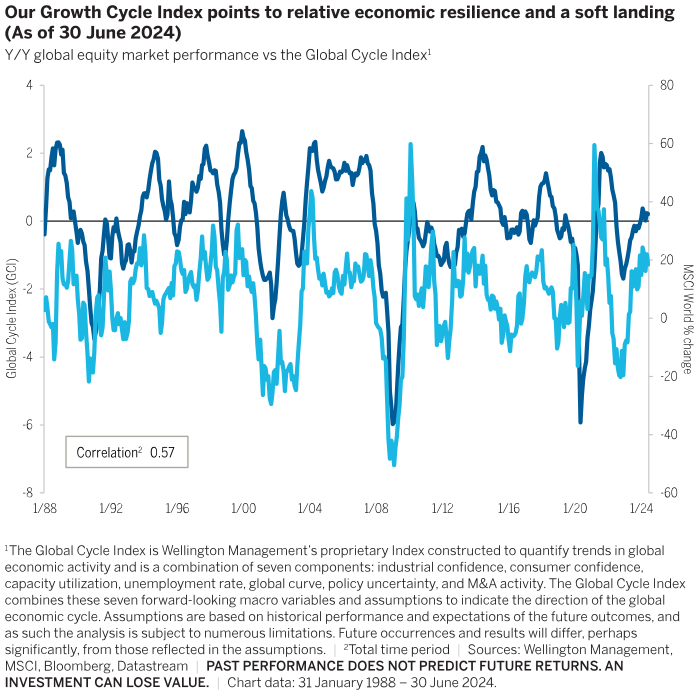
As we look ahead to the final quarter of 2024, the equity market is digesting disparate macro signals, geopolitical volatility, and monetary and fiscal policy uncertainty in the lead up to closely contested elections in the US and aftermath of elections in Europe where far-right factions created tension. Our proprietary Global Cycle Index (Figure 1), a composite of seven independent macroeconomic variables, tracks when global economic activity is getting better or worse. Currently, the index points to growth remaining stable and in line with long-term averages, suggesting relative resilience and potential for a soft landing. Inflation has declined considerably over the past year such that the US Federal Reserve seems to be considering a cut in US rates to support acceptable employment levels in line with its dual mandate. Elsewhere several major central banks (e.g., ECB and BoE) already have cut rates. Lower interest rates are typically positive for growth companies.
Figure 1
Investing in equities involves a degree of risk tolerance because equity prices inevitably go up and down. We believe that an active investment process supported by data can contribute to a better risk/reward experience for investors interested in the growth equity space. Based on our research, a bottom-up approach that integrates discipline, dynamic positioning, and downside mitigation is an effective means of building exposure to high-quality growth stocks.
In our view, one of the most effective ways to identify opportunities and mitigate risks in the quality growth space is to focus on quantitative back tests that highlight key stock characteristics that have performed well over time. Our research points to four key characteristics:
We believe discipline enables efficient and transparent decision making across market environments. In our view, a disciplined, active approach to the growth equity market requires deep fundamental research to forecast the four factors as accurately as possible and a measured, repeatable means of ranking these companies to construct a resilient portfolio of the highest-ranking stocks. We also consider the macro picture and salient market themes.
We believe that dynamic positioning informed by data supports an active investor’s ability to protect capital when the global economic cycle decelerates and to keep up when the global economic cycle accelerates. Tools – like our Global Cycle Index (Figure 1) – can help active investors tilt their exposures based on where we are in the economic cycle.
In our experience, downside risk mitigation supports the potential for higher cumulative alpha over time. Here’s why: underperforming by 25% in down markets requires outperforming by 33% in up markets just to get back to neutral. Therefore, we believe that an effective active approach to managing an equity portfolio should be designed to limit downside when equity markets decline.
We think this can be accomplished in growth equity space in several ways: focusing on high-quality companies, maintaining a valuation discipline, avoiding companies with the most negative earnings estimate revisions, and constructing a portfolio that seeks to manage active exposures to stocks, sectors, and factors. We also maintain flexibility to position for downturns in the economic cycle.
While data show that economic activity is stable and we are encouraged by the prospects of rate cuts, there could be bouts of volatility created by the US election cycle as well as continued geopolitical instability. Therefore, we believe it is prudent to balance risk/reward considerations in building a quality growth exposure. Based on our research and ranking of the four characteristics outlined above, here are areas where we currently see some of the most compelling opportunities:
As highlighted by this list of investable ideas, navigating an active exposure to growth equities using a data-based, disciplined, dynamic, and risk-aware approach could help investors benefit from exposure to companies that are leaders in some of today’s most vibrant investment themes.