



- Equity Portfolio Manager
Explore our insights
Asset class
Formats
Education

Education
The views expressed are those of the authors at the time of writing. Other teams may hold different views and make different investment decisions. The value of your investment may become worth more or less than at the time of original investment. While any third-party data used is considered reliable, its accuracy is not guaranteed. For professional, institutional, or accredited investors only.
It’s been a volatile year thus far. Markets have swung up and down, US President Donald Trump has set the most protectionist tariff goals in a century, Germany introduced an enormous fiscal package, and European equity markets have at times outperformed the US and global peers for the first time in several years. However, we see this volatility as a potential tailwind for long/short European equities.
Since the COVID pandemic, as discussed in our recent WellSaid podcast, Europe has transitioned into a new economic regime, characterized by higher inflation, more frequent and volatile economic cycles, and greater regional divergence.
Higher inflation: Higher inflation is likely here to stay for three reasons. First, we’ve entered an era of deglobalization. The COVID crisis laid bare the vulnerabilities of global supply chains and sparked a pivot toward onshoring and “friendshoring” in the name of supply security. This cemented an already underway trend away from globalization (which supports low inflation) toward deglobalization (which supports high inflation). Second, since the pandemic, there has been very little consolidation of public finances, and fiscal policy is structurally becoming more supportive of higher inflation. Finally, central banks are quietly deemphasizing their inflation targets, focusing instead on lower unemployment.
Figure 1
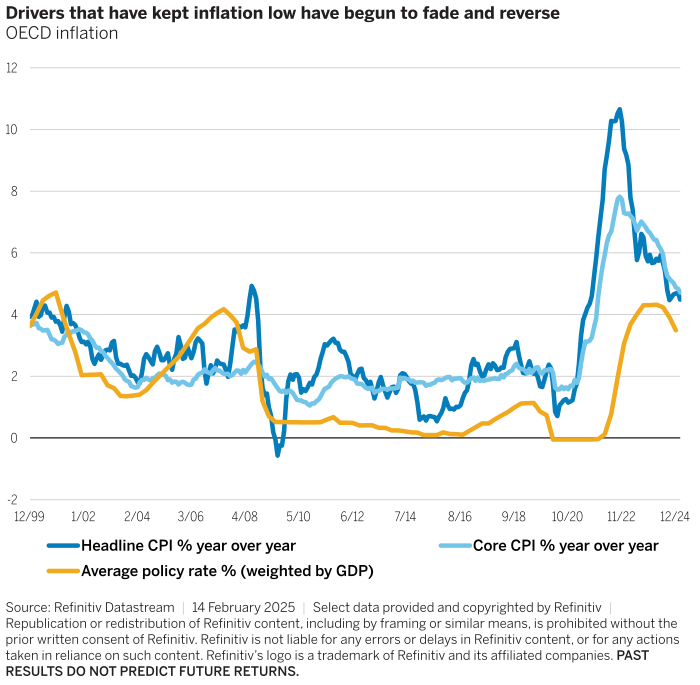
More frequent and volatile economic cycles: When we face the next market shock — from tariffs or something else — central banks are unlikely to have the same freedom to cut interest rates as they used to. In the past, central banks could slash interest rates during downturns and printed money to buy bonds. Now, with stickier inflation, they won’t be able to loosen policy so quickly.
Regional divergence: Globalization and fiscal austerity helped harmonize economic cycles and suppress inflation across the world. Now these factors have begun to fade. Cycles are likely to become more disjointed, and countries will react differently to market events, with varying fiscal and monetary responses.
The Trump administration potentially adds fuel to these three fires. The tariffs Trump has proposed inherently accelerate deglobalization trends by making international trade more difficult and expensive. Changes to trade will prompt diverse policy responses from one place to the next.
Beyond this, no matter what shape Trump’s tariffs ultimately take, they fracture the relationship between Europe and its largest trading partner. To call this a big deal is an understatement. The US represents as much as 3% of GDP for Europe. Plus, the US has been a growing market for European exports, which have risen by 40% since 2019 (by contrast, exports to China have remained flat).
What’s more, Trump has diluted if not withdrawn US security guarantees, which puts pressure on Europe to do two things: integrate more and ramp up defense and infrastructure investment. A major step forward on these fronts is the recently announced German fiscal package, which, at US$1.3 trillion, is the largest we’ve seen since German reunification.
Especially in Europe, the first 10 – 15 years following the global financial crisis (GFC) saw a significant shift away from value-oriented toward growth-oriented investing. This shift coincided with the rise of technology stocks, as well as a few consumer and health care names. Many achieved high-single-digit or even double-digit growth in earnings per share, and in the early days of this period, these stocks’ price-to-earnings multiples were low. In the decade since, multiples have expanded massively. Today, these companies trade at elevated multiples, but in some cases, they now face a significant risk of potential earnings disappointments.
Now, for market leadership to shift within equity cohorts, there need to be new sources of structural growth among companies that can also deliver strong performance. For a long time, this was hard to find, but we think this has changed since COVID. In our view, a “new core” of European enterprises demonstrating high-single- to double-digit growth at much lower multiples than the post-GFC-period “old core” is emerging.
Examples include banks, with interest rates no longer near zero and settling at different levels. We also see this playing out among some defense stocks, where growth rates are as high as 20% – 30% in some cases, and certain cyclicals, such as cement companies, where strong pricing discipline is driving growth.
Now, to layer in the long/short perspective. Heightened market volatility and performance dispersion among regions and companies make for fertile ground for long/short investors capable of covering a diverse mix of European stocks, across sectors and countries. We’re keeping a close eye on company responses to tariffs. No matter how the tariff policies shake out, they’ve created uncertainty for businesses and investors making large capital expenditures (capex). As a result, many companies, no matter where in the world their production base is, may wait until there’s a clearer trade picture to make any significant spending decisions. This will have downstream effects on companies that use capex to fund their products.
We’re also mindful of stocks with peak revenues, margins, and valuations — for example, some data-center-related companies. While many of these are quality companies that could grow nicely, with revenues, margins, and valuations at peak levels, they’re not pricing in the possibility of a global slowdown, which could very well come to pass if broad uncertainty persists or worsens. We’re cautious in this space, but this is also where we search for short opportunities.
With more and more single-stock news (both good and bad) coming through, we expect there to be significant dispersion among stock reactions to tariffs. But volatility can create opportunities, and right now, we believe they may be blooming among European equities. Actively managed strategies with long/short capabilities may benefit from this type of environment, which likely requires flexibility, agility, and vigilance to capture alpha, both long and short.





















Quarterly Market Review — 3Q26
Continue readingBy